


Many people are being put off the idea of heaving children due to concerns about climate change, a review has found.
Worries over uncertainty about the future, being able to provide, as well as concerns that having children would contribute to overpopulation and overconsumption were given as reasons for not starting a family.
Research published in the journal Plos Climate involving nearly 11,000 people found political sentiment – such as refusal to have children until systemic change was enacted – was also a motivating factor.
“Recent media attention has been paid to a growing number of individuals factoring their concerns about climate change into their childbearing plans," said lead author Hope Dillarstone, a former student at the UCL Institute for Global Health.
“However, we were concerned that public discourse may have oversimplified this relationship.
“Our first-of-its-kind study shows that there is a complex and intricate relationship between climate change and reproductive choices, with differences noted both within and between countries across the world.
“Our analysis shows that not only are many people concerned about their child’s welfare growing up in a world of uncertainty, but they are also considering the impact of having children on the environment, their family’s ability to subsist and their politics.”
Ten pictures that tell the story of the climate crisis
-
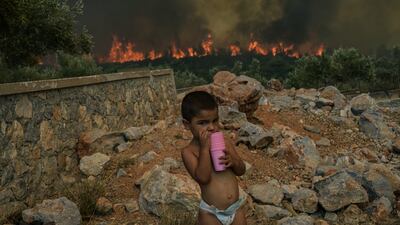
A child stands in his family's yard as a wildfire burns nearby, in the village of Agios Charalampos near Athens, in July 2023. Europe saw record temperatures amid a relentless heatwave and wildfires that scorched vast regions of the Northern Hemisphere, forcing the evacuation of 1,200 children close to a Greek seaside resort. Health authorities sounded alarms from North America to Europe and Asia, urging people to stay hydrated and shelter from the burning sun, in a stark reminder of the effects of global warming. AFP -
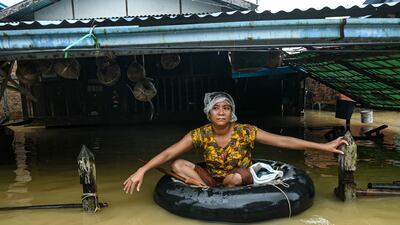
A resident uses a buoy to move through a flooded house after heavy rains in Bago township, in Myanmar's Bago region, in October. Floods sparked by record rain hit parts of southern Myanmar, inundating roads and fields and sending residents fleeing for higher ground. AFP -

Ali Hakim, an Iraqi Marsh Arab man, Iooks at the remains of a buffalo that died due to drought and the salinity of the water at the Basra marshes, Iraq. Reuters -
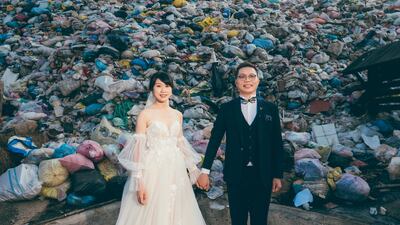
Iris Hsueh, left, and her fiance Ian Ciou pose for a pre-wedding photo in front of a rubbish heap in Puli Township, Taiwan. The couple chose the site for their photoshoot because the environment-conscious bride said she wanted to discourage guests and the public from generating waste. AFP -
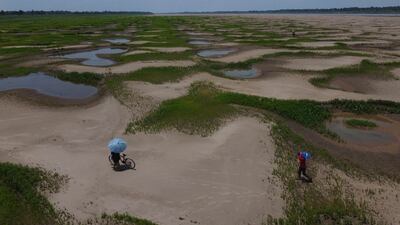
Residents of a riverside community in Amazonas state, Brazil, carry food and containers of drinking water distributed by the state's humanitarian aid action, amid a continuing drought and high temperatures that affect the region of the Solimoes River. AP -
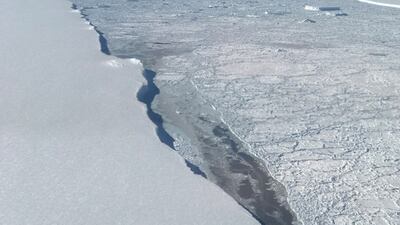
The edge of Larsen C Ice Shelf, left, and the western edge of iceberg A68 in the distance over the Antarctic in November 2017. The iceberg detached from the ice shelf in July 2017, becoming one of the largest in recorded history to split off from Antarctica. AFP -

A man walks past construction vehicles submerged in debris caused by flash floods after a lake burst in Rangpo, India, in October. Reuters -
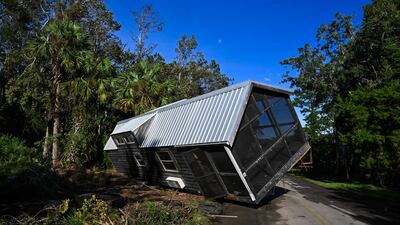
A mobile home swept by floodwaters in Steinhatchee, Florida, in August 2023, after Hurricane Idalia made landfall. Idalia slammed into north-west Florida as an 'extremely dangerous' Category 3 storm, buffeting coastal communities as officials warned of 'catastrophic' flooding in parts of the southern US state. AFP -
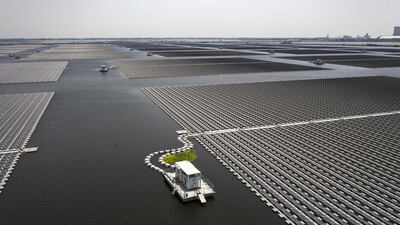
A floating solar farm, built on the site of a former coal mine since filled with water, in Huainan, China. The installation by Sungrow Power Supply Co covers the size of more than 400 football pitches and generates power for more than 100,000 homes. Getty Images -

A handprint of glue left behind by an activist from the group Last Generation (Letzte Generation), after they were removed by police, is visible on the asphalt following a blockade at an intersection in Berlin, Germany, in September. Last Generation is continuing its disruptive protests in an effort to put pressure on politicians to stop the burning of fossil fuels. Getty Images


In a first systematic review exploring the effects of climate change-related concerns on the decision to have children, the researchers looked at 13 studies involving 10,788 people from countries such as the US, Canada, New Zealand and various European nations including the UK.
They found the concerns were associated with a desire or intent for fewer or no children.
Conversely, in countries such as Zambia, people reported being in favour of having more children because they were concerned about their ability to support their family without the household labour provided by additional offspring.
Ms Dillarstone added: “Understanding why some people choose to adjust their reproductive decisions as a result of climate change may prove instrumental for shaping public policy, showing a need for collaboration among policymakers to incorporate local-level environmental concerns within national and international climate change, mental health and sexual and reproductive health policies."

