


Earth’s vital signs have reached unprecedented levels of degradation, posing a considerable risk to future life on the planet, a climate report has revealed.
Published in Bioscience, the report indicates that 20 of the 35 monitored planetary vital signs, used as climate-change indicators, have reached historically adverse extremes.
The research presents a collection of record-breaking climate-related occurrences in 2023, notably in areas such as ocean temperatures, sea ice, and wildfires, underscoring the urgency of addressing escalating climate adversities.
Led by a group of international climate scientists including Prof William Ripple from the Oregon State University College of Forestry and former OSU researcher Christopher Wolf, it is a stark warning about the unsustainable strain humanity is placing on the Earth’s natural resources.
Speaking to The National, Prof Ripple outlined actions his team believe are necessary: “To address climate change, rapid reductions in fossil fuel emissions must be a top priority.
“World leaders should phase out fossil fuel subsidies. We need to eliminate the use of coal and we should enact a fossil fuel non-proliferation treaty.
"Massive suffering due to climate change is already here, imperilling stability and life-support systems. This was demonstrated by the intense Mediterranean storm Daniel, which caused flooding that killed more than 11,000 people in Libya," Prof Ripple said.
The report highlights the doubling of fossil fuel subsidies from $531 billion in 2021 to more than $1 trillion in 2022.
Additionally, 2023 was a year enormous greenhouse gas emissions from Canadian wildfires, releasing more than one gigaton of carbon dioxide, which eclipses Canada’s total emissions in the previous year.
In a revealing assessment of the multifaceted nature of the climate crisis, the report also considers human and livestock population numbers as crucial indicators. This approach underscores the complex web of factors contributing to the escalating environmental imbalance we are witnessing today.
Prof Tim Lenton, chair in climate change and earth system science at the University of Exeter, told The National: "The rise in sea surface temperatures, decline of Antarctic sea ice, and increase in the area of Canada burnt by forest fires are all unprecedented and surprising. The sharp increase in fossil fuel subsidies is also striking."

A significant observation in the study was the occurrence of 38 days in 2023 where global temperatures soared 1.5ºC above pre-industrial levels, a scenario rarely witnessed in past records.
The record-breaking surface temperature in July, suspected to be the highest in the past 100,000 years, was also noted.
Highlighting the disparity in global emission contributions, the report unveils a staggering statistic: the top 10 per cent of emitters were culpable for nearly half of the total global emissions in 2019.
This finding illuminates the profound inequality that pervades the global emission landscape, revealing that a disproportionate burden of responsibility lies with a minute segment of the global population.
Mr Wolf emphasised the report’s crucial message: “Without actions that address the root problem of humanity taking more from the Earth than it can safely give, we’re on our way to the potential collapse of natural and socioeconomic systems and a world with unbearable heat and shortages of food and fresh water.”
The authors advocate for strategic redirection towards policies addressing the core issue of "ecological overshoot"’.
They urge the cultivation of policies focused on transitioning the global economy to prioritise human well-being, reduce rampant overconsumption, and curtail excessive emissions, predominantly from affluent sectors.
-

Firefighters try to extinguish a blaze in Ourem, Portugal. EPA -

Trees burn in a forest fire as pictured from the A1 highway in the locality of Cardosos. EPA -

People watch as a wildfire rages in Aljezur. Reuters -
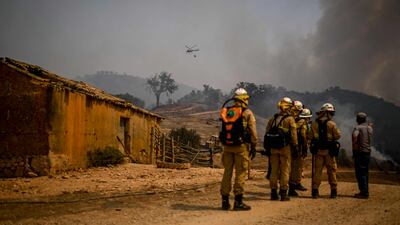
Firefighters arrive to battle a blaze in Reguengo, Portugal. AFP -
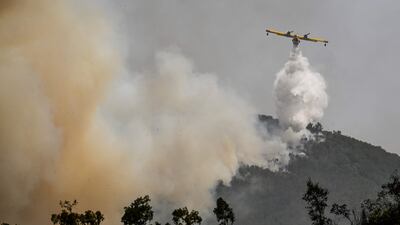
An amphibious aircraft drops water over the fire in Reguengo. AFP -

Firefighters attempt to put out the flames in Carrascal, Portugal. AFP -

The fire in Aljezur has forced the evacuation of about 1,400 people. Reuters -
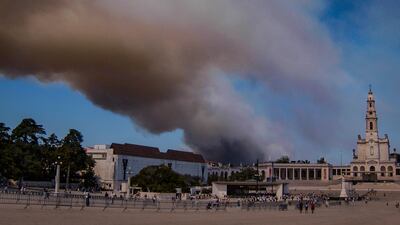
Smoke billows above the Sanctuary of Our Lady of Fatima, after a fire broke out in Fatima, Portugal. AFP -

Firefighters watch the progression of a wildfire near Odeceixe village, Portugal. AFP


The recommended strategies are multifaceted, including the phasing out of fossil fuel subsidies, encouraging the adoption of plant-based diets, enhancing forest conservation efforts, and fostering the initiation of international treaties advocating the abolition of coal and prohibiting fossil fuel proliferation.
"[Increased fossil fuel subsidies] will increase future climate damage by delaying the transformation to renewable energy that is already under way. They will also cost us all more in the long run because renewable energy is now the cheapest form of power in most of the world," Prof Lenton told The National.
An emphasised necessity in these strategies is the incorporation of equity and social justice, recognising the disproportionate impact of climate adversities on the less affluent populations who have contributed the least to the prevailing climate crisis.
Painting a grim portrait of the future, the report forewarns that by the year 2100, our planet could witness a scenario where between three billion and six billion people find themselves inhabiting regions outside the realms of ecological liveability. These individuals would be besieged by an onslaught of climatic hostilities, including excruciating heatwaves, severe food scarcity, and alarmingly high mortality rates, underscoring the urgent need for transformative climate action.
“We need policies to protect and restore forests, which sequester carbon. To achieve these and other effective climate mitigation measures, humanity must shift away from an economic paradigm based on excessive consumption by the wealthy towards a more sustainable path focused on equality and ensuring the well-being of all people,” Prof Ripple told The National.

