


Live updates: Follow the latest news on Cop28
As Cop28 negotiations continue, it looks like key areas of discussion could be difficult to resolve.
And, if previous Cop summits are anything to go by, there could be an extension on Tuesday's scheduled deadline.
The global stocktake will take centre stage, which assesses where the world is on climate change and what needs to happen now.
The crunch point is what the text will – or won’t – say about dealing with fossil fuels.
A draft text published on Friday indicated that five options were being considered, including phasing out of all fossil fuels in line with scientific recommendations.
Intermediate options include a complete phasing out of fossil fuels, which would allow their continued burning, as long as emissions were captured.
The EU has previously announced its desire for there to be a commitment to "phase out" fossil fuels, as has the Alliance of Small Island States (AOSIS), which represents some of the countries most vulnerable to climate change.
And Bob Ward, from the Grantham Research Institute on Climate Change and the Environment in the UK, said Cop28 President Dr Sultan Al Jaber was keen for progress to be made on the subject.
"I think the Presidency of Dr Sultan Al Jaber has been very active in laying out an ambitious agenda, has been trying to drive for an ambitious outcome," Mr Ward told The National.
"The Cop Presidency, it’s a difficult job. You’re trying to co-ordinate 197 countries. It often means long, hard days, lack of sleep, a lot of pressure."

Mr Ward said that the UAE itself wanted to deal with climate change because it was as much affected by it "as any other country".
"They can see the impact in this region," he added. "Dr Sultan Al Jaber has credibility on this issue. I think he is seriously committed."
Mr Ward added that adaptability is now key, as negotiators enter the latter stages of the conference.
"Nothing is agreed until everything is agreed," he said.
"There’s unofficial linkages. Some countries are obstructive in some areas in order to leverage influence in other areas.
-
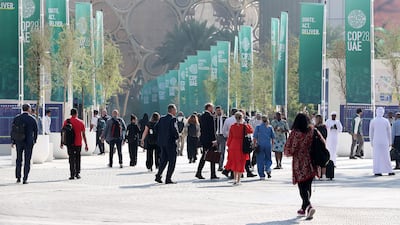
Delegates on the 11th day of the Cop28 summit at Expo City Dubai. Pawan Singh / The National -
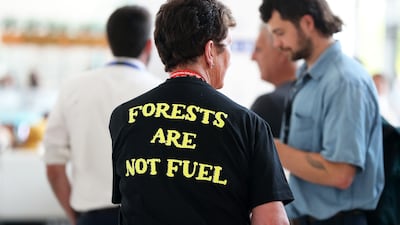
Cop28 is scheduled to conclude at 11am on Tuesday. Pawan Singh / The National -

Mariam Almheiri, UAE Minister of Climate Change and Environment, addresses a press conference on agriculture on the 11th day of Cop28 in Dubai. Pawan Singh / The National -
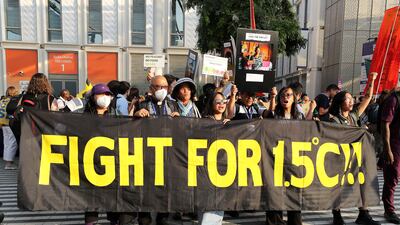
Activists called for a ceasefire in Gaza and measures to protect the climate on the 10th day of the summit. Pawan Singh / The National -
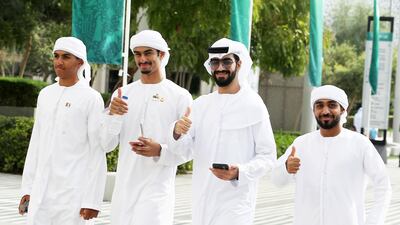
Visitors walk in the Green Zone, in Expo City Dubai’s Sustainability District. Pawan Singh / The National -

Models take part in the Sustainable Fashion Show held on the seventh day of the summit at Al Wasl Plaza. Pawan Singh / The National -

The summit heard from indigenous peoples, many of whom inhabit island nations and contribute the least to greenhouse emissions. Chris Whiteoak / The National -

UN climate change executive secretary Simon Stiell speaks to the media on the 12th day of Cop28. Chris Whiteoak / The National -

About 70,000 participants are attending the two-week event. Chris Whiteoak / The National -

The last two scheduled days of the summit have been left clear for final negotiations. Chris Whiteoak / The National -

The Wake Up experience with Sadhguru, on the sixth day of Cop28. Chris Whiteoak / The National -

Activists from youth organisation Engajamundo stage a protest about smog caused by deforestation in the Amazon. Chris Whiteoak / The National -

Lights shine from Al Wasl Dome at Expo City Dubai. AP -
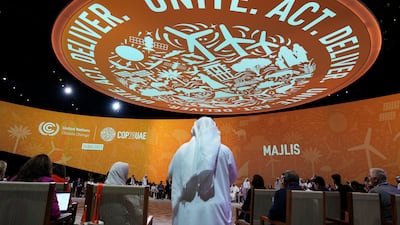
Delegates arrive for a meeting at the Cop28 summit. AP -
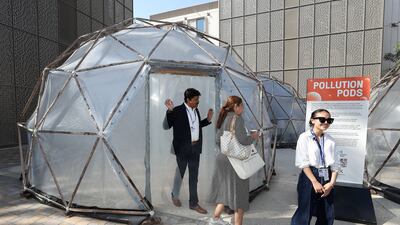
Cop28 attendees visit British artist Michael Pinsky's Pollution Pods, which replicate the air quality in Beijing, London and New Delhi, at Expo City in Dubai. Pawan Singh / The National -
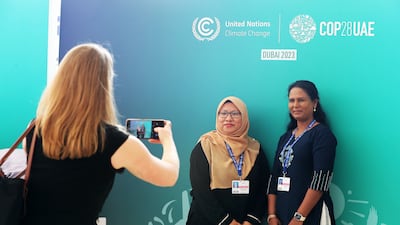
Delegates on the 10th day of the Cop28 UAE at the Expo City in Dubai. Pawan Singh / The National -
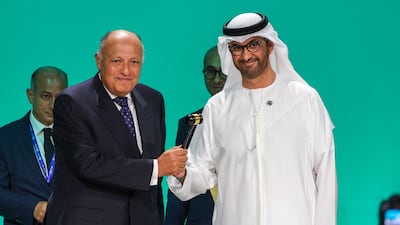
Cop27 President Sameh Shoukry, left, hands over the gavel to Cop28 President Dr Sultan Al Jaber at the UN climate conference's opening ceremony. AFP -
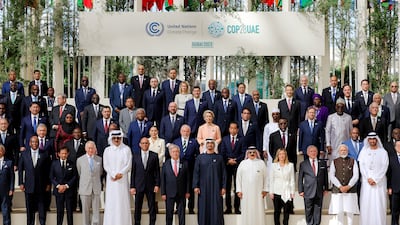
World leaders on day two of Cop28 in Dubai. Reuters -
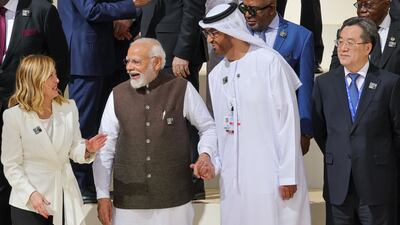
From left, Italy's Prime Minister Giorgia Meloni, Prime Minister Narendra Modi of India, Cop28 President Dr Sultan Al Jaber and Japan's Prime Minister Fumio Kishida arrive for a group photo. AFP -
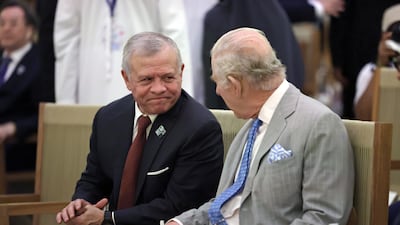
King Charles III with King Abdullah II of Jordan during the opening ceremony of the World Climate Action Summit at Cop28. PA -
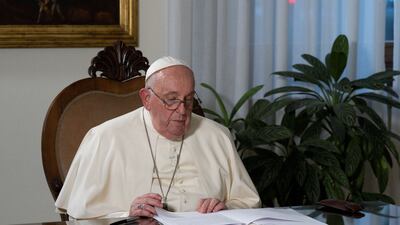
Pope Francis records a video message to be broadcast during the inauguration of the Faith Pavilion, at Casa Santa Marta, in the Vatican. Reuters -
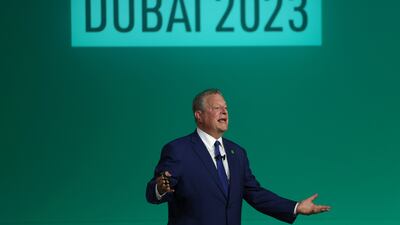
Al Gore, environmentalist and former US vice president, presents the Climate Trace global greenhouse gases emissions database on day four of Cop28. Getty Images -
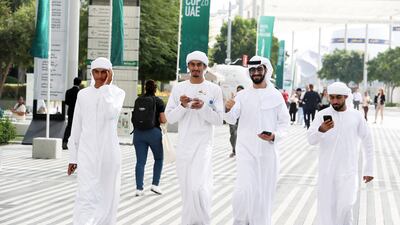
Visitors in the Green Zone at Expo City Dubai. Pawan Singh / The National -

Sheikh Abdullah bin Zayed, Minister of Foreign Affairs, Microsoft co-founder Bill Gates, Tanzanian President Samia Hassan and Reem Al Hashimy, Minister of State for International Co-operation, attend the Reaching the Last Mile Forum held alongside Cop28. Reuters -
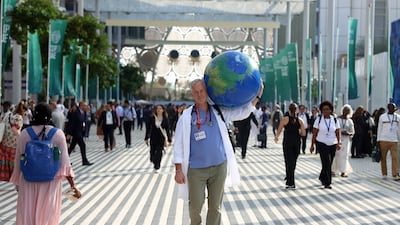
Joseph Vipond from the Canadian Association of Physicians for the Environment crosses the Blue Zone. Getty Images -
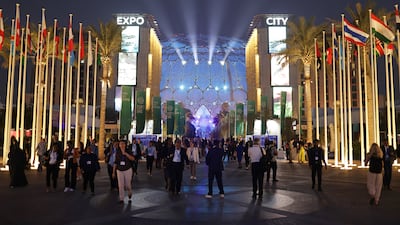
Participants walk among flagpoles on day four of the Cop28 summit in Dubai. Getty Images -
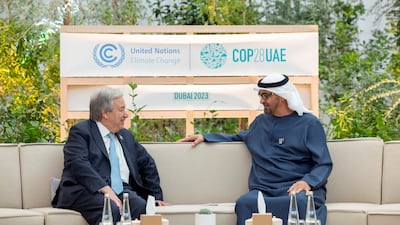
President Sheikh Mohamed and UN Secretary General Antonio Guterres hold a meeting at the Cop28 summit in Dubai. Photo: UAE Presidential Court


"Adaptation is a key issue, particularly for the most vulnerable countries. They’re dealing with it right now."
Mr Ward said finding agreement on adaptation was "even more critical" than the setting up of the fund for the loss and damage caused by climate change.
This fund, initiated at Cop27 in Egypt last year but with its first funding announcements made at Cop28, has been seen as a key early success of this year’s gathering in Dubai.
While nations with major fossil fuel interests are thought likely to push back against tougher language on fossil fuels in the final text, it is understood that negotiations are continuing in a constructive manner.
One possible area of agreement between major emitters, such as the US and China, may involve commitments to expanding renewables being tied to the phasing down of fossil fuels.
The idea of common but differentiated responsibilities (CBDR) underpins many discussions on climate change, reflecting the reality that not all countries are equally responsible for causing climate change, nor have equal means to deal with it or to transition their economies to greener technology.
While acknowledging that different countries will have to move at different speeds when it comes to limiting emissions, some developed countries are nonetheless reluctant for a binary division between the nearly 200 nations involved in the process to emerge.

