


Planting certain kinds of trees can make cities hotter at night, not cooler, according to a new study. Trees can significantly reduce the temperature of cities during the day by providing shade, changing the airflow and through the evaporation of water from microscopic pores in their leaves.
But a new study has found that tree canopies can trap heat, closing those pores in response to heat and drought stress, leading to higher temperatures at night. The research, published on Tuesday in peer review journal Communications Earth & Environment, found that urban trees can bring surface temperatures down by as much as 12°C. But that cooling ability is heavily dependent on the species, urban layout and climate.
In heavily built-up and dry cities like Dubai, trees cool the air more, Dr Ronita Bardhan, associate professor of Sustainable Built Environment at the University of Cambridge, told The National. They take the water in the air into their leaves through their pores, using it to perform photosynthesis, where they convert light into chemical energy.
"If you’re sweating and standing under a tree, the sweat is taken up by the air into the leaves and the leaves then use that to perform their photosynthesis function. That’s why you feel cooler," said Dr Bardhan. But at night, the microscopic pores in trees' leaves close. "Where it closes down, the heat below it is trapped. It is no longer able to escape."
In arid climates, air has less water, so trees take up less water. Whereas in a very humid area, even after the trees had taken a lot of humidity to do their evapotranspiration process, there is still water remaining, said Dr Bardhan. The study "busts the myth that trees are the ultimate panacea for overheating cities across the globe”, she added.

“Trees have a crucial role to play in cooling cities down but we need to plant them much more strategically to maximise the benefits which they can provide.”
In tropical wet and dry climates, trees cool cities in countries such as Nigeria by as much as 12°C during the day, but heat the area around them at night by up to 0.8°C. In arid climates, including the UAE, trees cooled cities by around 9°C in daytime, warming them at night by 0.4°C.
Ghaf trees – in pictures
-
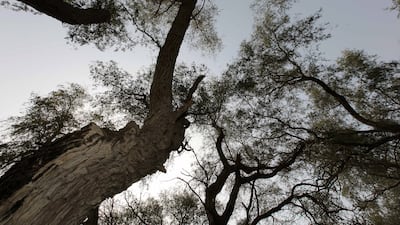
The Ghaf tree, native to the Emirates, is a potential source of biochar, which helps in soil rejuvenation and carbon capture. Pawan Singh / The National -
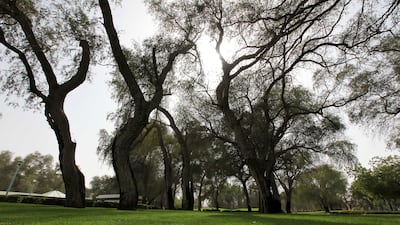
Famed for its ability to live in harsh conditions, the Ghaf tree is found in the deserts of Arabia and in the Indian subcontinent. Photo: Pawan Singh / The National -
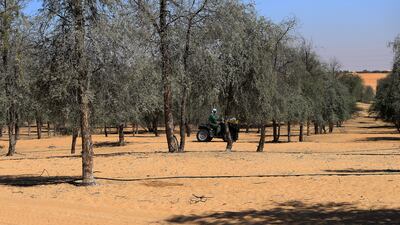
Ghaf trees in Khab Al Dahs forest, near Madinat Zayed, in Al Dhafra. Photo: Ravindranath K / The National -
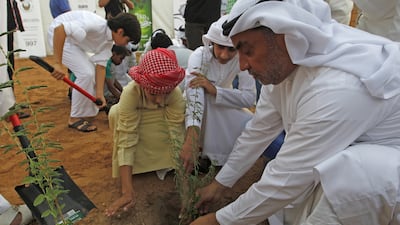
Orphans plant saplings of Ghaf trees at the heritage village in Al Shindagha to commemorate Zayed Humanitarian Day. Jeffrey E Biteng / The National -
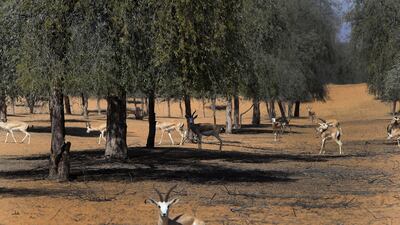
Researchers have found that some Ghaf tree biochar is better at absorbing carbon dioxide than other types of biochar derived from sources such as rice husks, coconut shells, carrot peel or wheat flour. Ravindranath K / The National


In tropical, humid climates, the daytime cooling effect dropped to 2°C, with 0.8°C warming at night. In temperate climates, trees can cool cities by up to 6°C and warm them by 1.5°C. Urban environments are more likely to feature a variety of evergreen and deciduous trees of different sizes – a mix that tends to result in greater cooling in temperate, continental and tropical climates, according to the study.
Using a variety of trees in these climates generally results in 0.5°C more cooling than in cities which only have deciduous or evergreen trees. Researchers said this is because mixed trees can balance seasonal shading and sunlight, providing three-dimensional cooling at various heights.
However, in arid climates, evergreen species dominate and cool more effectively in cities like Cairo and Dubai. Popular evergreen species in the UAE include the national tree – the ghaf – scientific name prosopis cineraria – which typically lives for 120 years. It was traditionally used to feed livestock and was revered for its purported medicinal properties.
In open urban layouts, cooling can be improved by about 0.4°C because their larger green spaces allow for more and larger tree canopies and a greater mix of tree species, the study said.
“Our study provides context-specific greening guidelines for urban planners to more effectively harness tree cooling in the face of global warming,” Dr Ronita Bardhan said.
“Our results emphasise that urban planners not only need to give cities more green spaces, they need to plant the right mix of trees in optimal positions to maximise cooling benefits. Urban planners should plan for future warmer climates by choosing resilient species which will continue to thrive and maintain cooling benefits,” she added.

