


A fleet of “dark vessels” linked to clandestine oil trading from Iran and Russia is producing a small country’s worth of previously uncounted carbon emissions, the Cop29 climate summit has heard.
Ships spotted in satellite images after failing to “ping” their location gave out 375 million tonnes of CO2 last year, according to new estimates. Vessels in the “shadow fleet” are believed to sail in poor condition and run the risk of oil spills by transferring fuel at sea.
Insurers say dark vessels have flourished since Russian oil sales were restricted over the war in Ukraine, and have also been used by Iran and Venezuela to circumvent sanctions. They operate outside international rules at a time when the maritime industry is under pressure to marshal global efforts to clean up.
Ships must be subject to “concrete, binding regulations” to achieve a goal of carbon-neutral shipping by 2050, Camille Bourgeon, a technical officer at the International Maritime Organisation, told delegates at the Cop29 talks on Wednesday. The emissions figures from Climate Trace, a tracker co-founded by Al Gore, are thought to be the first estimate of the dark fleet’s CO2 footprint.
“We are seeing a rise in ships that are deliberately turning off their safety equipment, called dark vessels, in order to avoid embargoes; or illegal fishers will often do this,” said Gavin McCormick, a fellow co-founder of Climate Trace. “About 7 per cent of shipping emissions, or something as large as the emissions of the nation of Ireland, are now from dark vessels.”
Cop29 summit – in pictures
-

Participants at the Cop29 venue in Baku, Azerbaijan. Reuters -
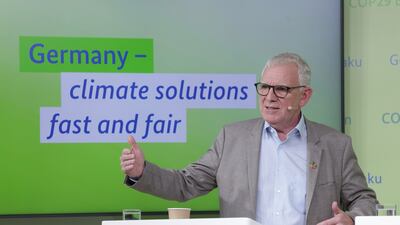
Jochen Flasbarth, State Secretary in the German Ministry for Economic Co-operation and Development, speaks in the Germany pavilion. Getty Images -
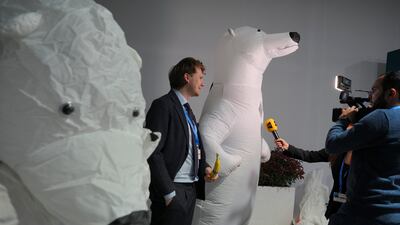
Nuclear power activists demonstrate. AP -
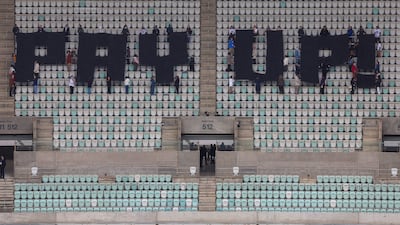
Activists hold a protest calling on developed nations to provide financing. Reuters -
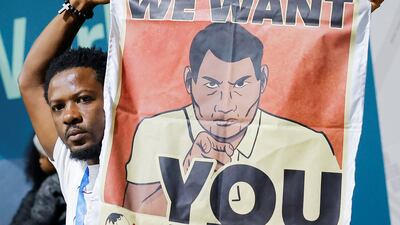
An activist holds up a sign. Reuters -
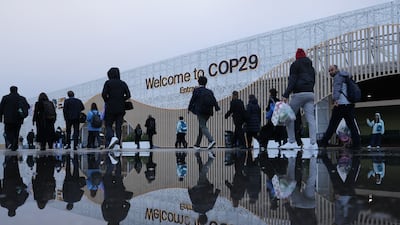
Conference participants arrive on day four. Getty Images -
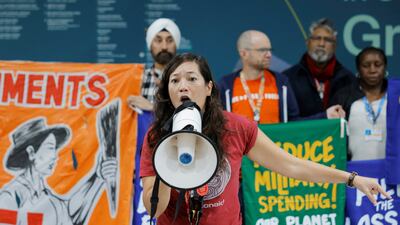
Another protest. Reuters -
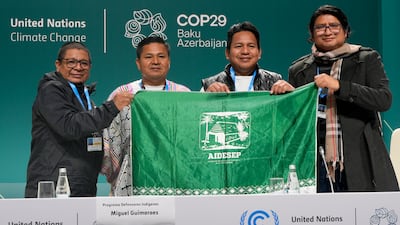
From left, Jorge Perez, Rolando Escobar, Miguel Vasquez and Esteban Cama at a session on Indigenous communities in the Peruvian Amazon. AP -
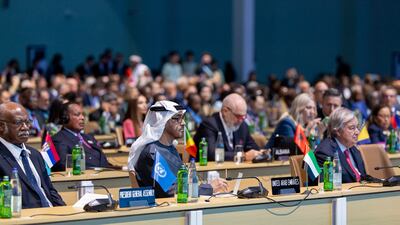
President Sheikh Mohamed attends the World Leaders Climate Action Summit at Cop29, in Azerbaijan's capital Baku. UAE Presidential Court -
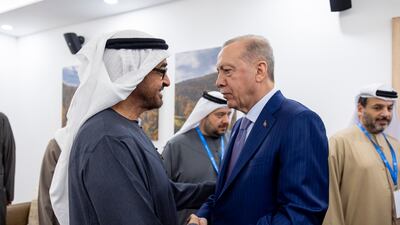
Sheikh Mohamed greets Recep Tayyip Erdogan, President of Turkey. WAM -
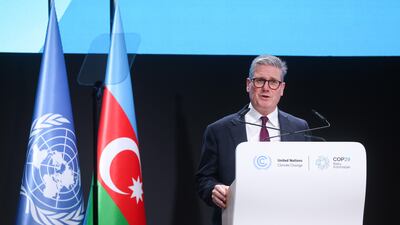
British Prime Minister Keir Starmer at Cop29. Bloomberg -

Ding Xuexiang, China's first Vice Premier, at Cop29. Bloomberg -
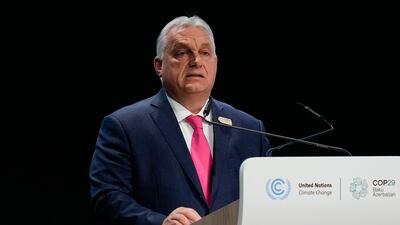
Hungary's Prime Minister Viktor Orban at a plenary session at Cop29. AP -
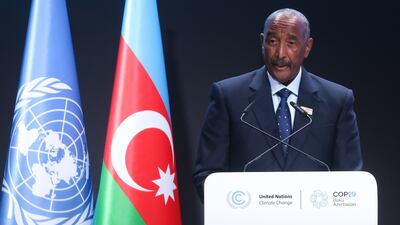
Sudan's military leader Abdel Fattah Al Burhan, at Cop29. Bloomberg -
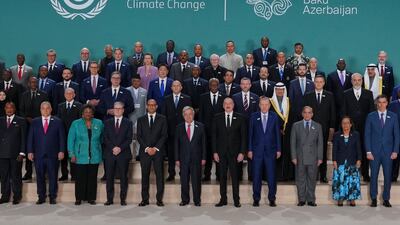
World leaders pose for a group photo at the Cop29 United Nations Climate Change Conference, in Baku, Azerbaijan. AP -
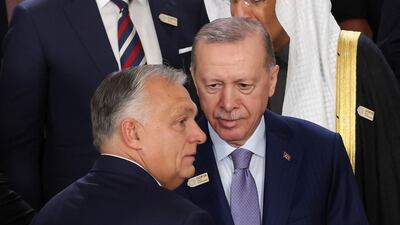
Hungarian Prime Minister Viktor Orban, left, stands next to Turkish President Recep Tayyip Erdogan. Reuters -
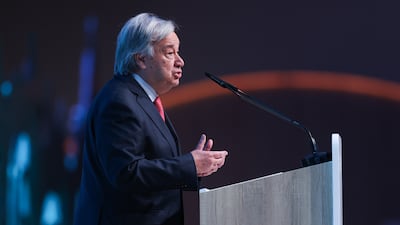
Antonio Guterres, UN secretary-general, addresses Cop29. Bloomberg -
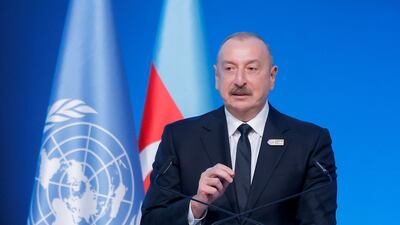
Azerbaijan's President Ilham Aliyev speaks during the Cop29 opening ceremony. Reuters -
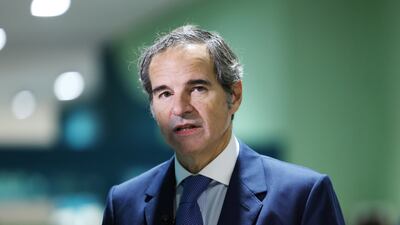
Rafael Grossi, director general of International Atomic Energy Agency (IAEA), at Cop29. Bloomberg -

Activists demonstrate for climate justice and a ceasefire in the Israel-Hamas war in Gaza, on day one of Cop29. AP -
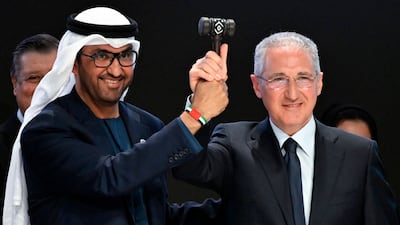
Cop28 President Dr Sultan Al Jaber and Cop29 President Mukhtar Babayev at the official handover. AFP -
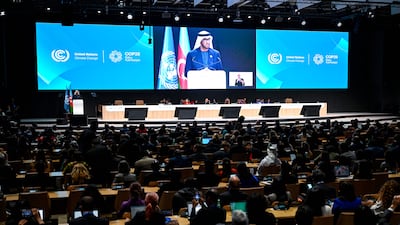
Dr Al Jaber, Minister of Industry and Advanced Technology, delivers a speech during the opening of Cop29 in Baku. AFP -
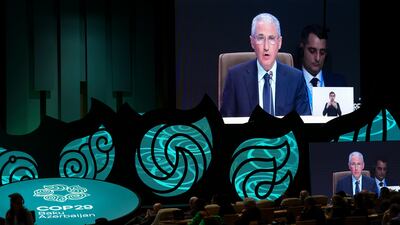
Mr Babayev speaks during the opening plenary session. AP -
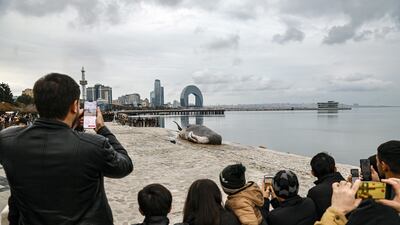
An installation depicting a beached whale by the Belgian art collective Captain Boomer on an embankment in Baku. EPA -

The Turkey Solidarity Centre pavilion. Bloomberg -
Simon Stiell, executive secretary of the UN Framework Convention on Climate Change, speaks during the opening ceremony. EPA -
People begin arriving for the start of Cop29 in Baku. Bloomberg -
Dr Al Jaber at Cop29 with Moroccan climate researcher Cherif El Khalil. AP -

A mosaic adorns a wall at the Cop29 venue, Baku Stadium, in the capital of Azerbaijan. Bloomberg -

A woman tries out a VR headset at the tourism booth as the Cop29 UN climate summit gets under way in Baku, Azerbaijan. AP


Large cargo ships normally carry transponders that ping their location to base stations on the mainland, in what is known as an Automatic Identification System (AIS) that prevents them colliding at sea. Scientists can work out a vessel's CO2 footprint from the path it takes and the specifications of its engine, which show how much power it must have used.
Where no pings were received, analysts at Climate Trace and Global Fishing Watch drew on images from the European radar satellite Sentinel-1 to spot ocean-faring vessels, work out their length and how many did not match with AIS tracking, and use that data to estimate the carbon footprint of the missing "dark" ones. The spacecraft takes an image of Earth's entire surface every 12 days.
Hundreds of ships making up as many as one in five of the world’s oil tankers are part of the “dark fleet”, according to the insurer Allianz, which said in a May briefing that Russia's shadow tankers had emerged in response to Western sanctions over Ukraine. Data can sometimes be lacking because of a lack of AIS coverage rather than because of any clandestine activity, and turning off transponders can be a legitimate anti-piracy tactic when passing through dangerous waters.
However, the US Treasury Department wrote in a memo to fuel carriers in September that vessels carrying petroleum to Syria "have been known to intentionally manipulate their AIS transponders to mask their movement". Last month it ordered sanctions on six vessels believed to be part of a "shadow fleet" exporting oil despite international sanctions on Tehran.
The European Parliament last week accused Russia of trading oil on “unsafe and uninsured vessels” with “no regard for international safety or the potential for irreversible environmental damage” from an oil spill. It said the "scale and sophistication" of Russia's operations "set it apart" from similar tactics used by Iran, Venezuela and North Korea.

Countries exposed to environmental disasters, such as Fiji and Barbados, are using Cop29 to lobby for a CO2 levy on shipping to raise funds for the climate fight. “International shipping is committed to do more on climate action,” Arsenio Dominguez, secretary general of the International Maritime Organisation, told an event in Baku on Wednesday.
In the switch to clean fuel for ships “we need standards, we need them to be consistent across jurisdictions”, said Lais de Souza Garcia, the head of a renewable energy division in Brazil’s Ministry of Foreign Affairs. “If we have fragmented rules, it’s going to be impossible to tell a business they are going to be able to scale production.”
Maritime unions are meanwhile using Cop29 to lobby for proper training on green vessels. Singapore plans to train 10,000 personnel in the coming years in operating refitted ships. Concerns have been raised about a shortage of seafarers and the safety of handling alternative fuels such as methanol.
"There’s a huge trade coming in and out of South Africa, but there are very few jobs," said Zazi Nsibanyoni-Mugambi of the National Union of Metalworkers. "African workers in the shipping industry need to capture a meaningful stake in this transition."

