


The melting of Antarctica's vast Thwaites Glacier will increase “inexorably” this century, potentially destabilising the entire West Antarctic Ice Sheet, leading to its eventual collapse, scientists have warned.
Thwaites, which is roughly the size of Britain and more than 2km thick in places, is nicknamed the Doomsday Glacier because it represents more than half a metre of global sea level rise potential and could destabilise neighbouring glaciers that have the potential to cause a further three-metre rise.
The world’s widest glacier is currently losing about 50 billion more tonnes of ice than it receives in snowfall, in an accelerating process first observed in the 1970s.
Researchers at the International Thwaites Glacier Collaboration, a project that includes researchers from the British Antarctic Survey, the US National Science Foundation and the UK’s Natural Environment Research Council, wanted to know how rapid that melt has become.
Using a small torpedo-shaped robot, researchers studied the underside of Thwaites, discovering a thin layer of cold water insulating the glacier. But in areas where the parts lift off the seabed and the ice begins to float, tidal action is pumping warmer seawater, at high pressure, as far as 10km under the ice. The process is disrupting that insulating layer and is likely to significantly speed up how fast the grounding zone – the area where the glacier sits on the seabed – retreats. A similar process has been observed on glaciers in Greenland.
Some computer models suggest that reductions in greenhouse emissions under the 2015 Paris Agreement may still slow the pace of runaway loss, extending its collapse well past the end of this century. But the outlook remains “grim”, according to an International Thwaites Glacier Collaboration report released on Friday.
Thwaites has been retreating for more than 80 years but that process has accelerated in the past 30, said Rob Larter, a marine geophysicist who contributed to the research. “Our findings indicate it is set to retreat further and faster.” Other dynamics that are not currently incorporated into large-scale models could speed up its demise, the new research shows.
Antarctica sea ice study – in pictures
-

Researchers from NYUAD's Centre for Global Sea Level Change return from deploying a wave buoy to study ice in Antarctic in 2017. -

Clare Eayrs and Daiane Faller from NYUAD get ready to deploy onto the sea ice on a chilly spring morning in 2019. -
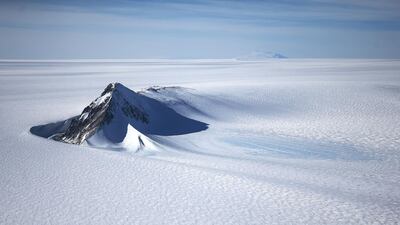
The vastness of the Antarctic viewed from a window of a Nasa plane. -
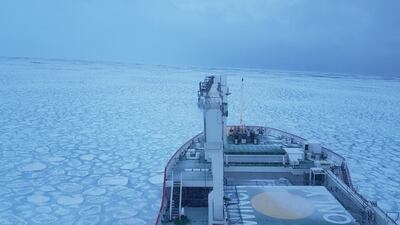
Travelling through sea ice in the Atlantic southern ocean aboard the 'S.A. Agulhas II', a South African ice-breaking polar supply and research ship, in the winter of 2017. -
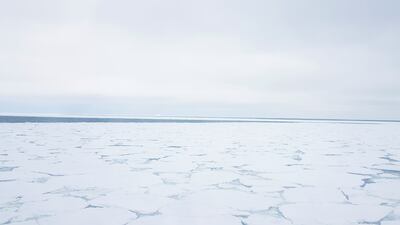
Ice in the Lazarev Sea, Antarctica, during spring 2019. A distant iceberg can be seen on the horizon. -
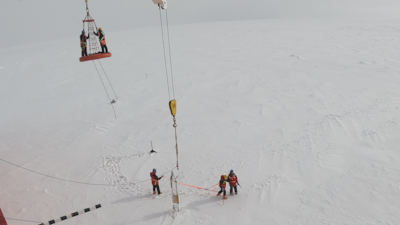
Researchers from NYUAD's Centre for Global Sea Level Change on their way to retrieve a mast installed on sea ice in the Southern Ocean in 2019. -
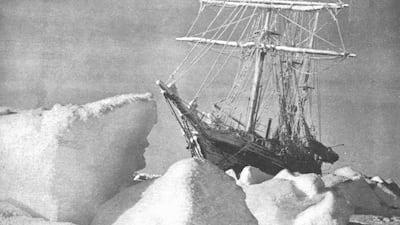
Antarctica has fascinated explorers for centuries. Explorer Ernest Shackleton's ship 'Endurance' was trapped and slowly crushed by ice in the Weddell Sea during his second expedition to the Antarctic in 1915. -
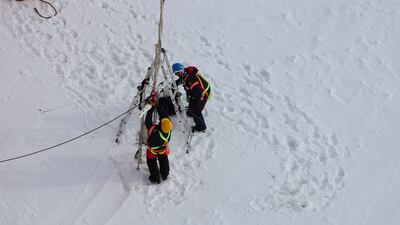
Clare Eayrs and Daiane Faller install a mast on sea ice in the Southern Ocean in 2019. The mast supports instruments to measure turbulent and radiative fluxes. -
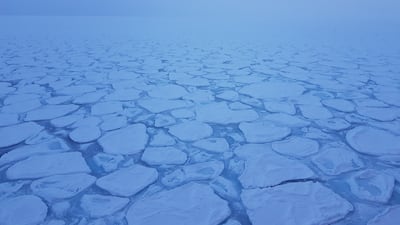
Sea ice in 2017 forming through the 'pancake cycle'. The characteristic raised rims are caused when the pancakes crash into each other through wind and wave action.


In a worst-case scenario, which would see the formation of 100-metre-or-higher ice cliffs at the front of Thwaites that then rapidly calve off as icebergs, sea levels could rise by tens of centimetres this century. However, the researchers said it is too early to know if such scenarios are likely.
The researchers found the glacier has retreated much faster in the past than what is seen today. Ridges show where it retreated more than 2km a year several centuries ago – twice as fast as the current rate. But climate change could make its recovery more unlikely this time.
Heavy snowfalls regularly occur in the Antarctic and help replenish ice loss. “The problem though is that we have this imbalance: there is more ice loss occurring than snowfall can compensate for,” said Michelle Maclennan, a climate scientist with the University of Colorado Boulder.
Increased moisture in the planet’s atmosphere, caused by global warming evaporating ocean waters, could result in more Antarctic snow – at least for a while. At a certain point, though, that is expected to switch over to rain and surface melting on the ice, creating a situation where the glacier is melting from above and below. How fast that happens depends in part on nations’ progress to slow climate change, say scientists.
Earlier this year, scientists discovered Thwaites' retreat began in the 1940s, after an extreme El Nino weather event. The US study found the significant rate of melting began then, about the same time the retreat of the nearby Pine Island Glacier started, probably due to an extreme El Nino that warmed the western Antarctic.

