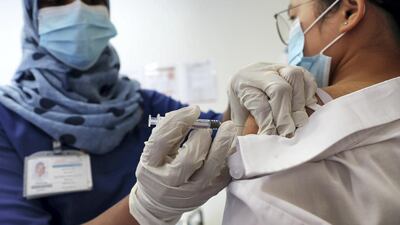
A nurse gives a patient a vaccine shot in Dubai. The UAE had administered 51.11 vaccine doses for every 100 people as of Sunday, second only to Israel Pawan Singh / The National

Will the UAE’s accelerated vaccine campaign help fuel economic growth?


  • English
  • Arabic

Countries around the world, including in the Gulf region, have registered a sharp increase in Covid-19 cases amid a rise in new virus strains.

As the number cases grows, the UAE has reintroduced more stringent restrictions and penalties for non-compliance to ensure the safety of residents and stem the pandemic’s spread.

In tandem with safety measures, the country has also hastened its vaccination drive since December and is currently a global leader, having administered 51.11 vaccine doses for every 100 people as of Sunday, making it second only to Israel.

With four vaccines being expended currently – Sinopharm, Pfizer-BioNTech, AstraZeneca and Sputnik V – the government is on track to vaccinate more than half the population by the end of the first quarter of this year.

Is this sufficient to support economic recovery?

Given the paucity of monthly indicators or data from official sources, we use purchasing managers’ index numbers released by IHS Markit to gauge the level of business activity in the UAE and Dubai.

Both PMIs have stayed quite close to the neutral 50-mark from December to January after having spent two consecutive months in contractionary territory. Job prospects seem to be improving in Dubai and across the country.

However, Dubai’s tourism sector, which recorded a sharp increase in activity in December, returned to sub-50 levels as tourists returned after the New Year holidays and travel restrictions were tightened.

With the vaccination drive, it is evident that as the nation inches closer to achieving herd immunity, domestic activity and business and consumer levels will gradually build up to pre-pandemic levels.

Investor and business-friendly reforms to convince skilled professionals to take up residence in the country will help spur economic activity. While the success of these structural reforms will not be immediate, their steady and effective application is expected to support economic growth in the medium and long term.

How can the UAE step up its recovery?

It is in the best interests of the UAE and Dubai, which is hosting the Expo later this year, for the wider region and the rest of the world to achieve high vaccination levels.

The longer countries remain unvaccinated, the greater the risk of newer strains emerging that could potentially result in another cycle of infections and subsequent movement restrictions.

There are two potential ways to support this.

First, it is crucial to increase the production of vaccines. A recent paper by the University of Chicago said "increasing the total supply of vaccine capacity available in January 2021 from two to three billion courses per year generated $1.75 trillion in social value, while additional firm revenue was closer to $30bn", far outweighing the investment required to do so.

Vaccination is a public social good that has several private benefits while the coronavirus remains a global threat. So, the UAE’s plans to manufacture the Sinopharm Covid-19 vaccine later this year would be a win-win situation that would cater to both domestic and global demand – especially if the vaccine is to be administered on an annual basis – and boost growth.

Secondly, the manufactured vaccines need to be distributed faster to reach those in need. To this end, the UAE is well-positioned as a global logistics and transport hub – both for delivering vaccines to smaller nations in the region and using its vast cargo network to transport Covid-19 shots around the world.

Abu Dhabi’s Hope Consortium was set up for vaccine storage and distribution while Dubai’s Vaccine Logistics Alliance will support the World Health Organisation’s effort to deliver two billion doses of vaccines this year.

This could be supported by vaccine aid – either in its contribution to global alliances such as Covax, which plans to deliver 2.3 billion doses this year, or through the free delivery of vaccines to smaller and poor nations, for example, India’s campaign to distribute free vaccines in Nepal, Bhutan and Bangladesh.

A global recovery is essential to the UAE’s overall growth prospects. As a country that relies on trade and tourism, which accounted for about 15 per cent of national gross domestic product and about 30 per cent of Dubai’s GDP in 2019, the impact of Covid-19 has been significant.

Despite Opec+ production cuts and a subdued demand for crude, signs of a recovery in oil demand (declining oil inventories in China and India) and higher oil prices (about $60 now) will be beneficial to trade and growth.

The UAE’s oil and related product exports are about 40 per cent of total exports and the main export destinations include India, China and Japan, which together account for more than 25 per cent of overall exports and are recovering faster than European markets and the US – to the UAE’s benefit.

Lastly, no outlook is complete without risks. Long-term diversification away from oil is an overarching imperative, as is decarbonisation and debt sustainability, especially in the context of another potential taper tantrum or a faster-than-expected increase in interest rates that leads to tighter financing conditions.

The UAE should continue to press forward with its clean energy initiatives and energy efficiency policies. As the success of the Mars Hope probe has demonstrated, the country has the will, leadership and access to technology and resources to turn the challenge posed by the pandemic into a lever that can help its economy and activities become green, clean, innovative and resilient to climate change.

Nasser Saidi is founder and president of Nasser Saidi & Associates and Aathira Prasad is a director of macroeconomics


Key facilities
  • Olympic-size swimming pool with a split bulkhead for multi-use configurations, including water polo and 50m/25m training lanes
  • Premier League-standard football pitch
  • 400m Olympic running track
  • NBA-spec basketball court with auditorium
  • 600-seat auditorium
  • Spaces for historical and cultural exploration
  • An elevated football field that doubles as a helipad
  • Specialist robotics and science laboratories
  • AR and VR-enabled learning centres
  • Disruption Lab and Research Centre for developing entrepreneurial skills
What is the definition of an SME?

SMEs in the UAE are defined by the number of employees, annual turnover and sector. For example, a “small company” in the services industry has six to 50 employees with a turnover of more than Dh2 million up to Dh20m, while in the manufacturing industry the requirements are 10 to 100 employees with a turnover of more than Dh3m up to Dh50m, according to Dubai SME, an agency of the Department of Economic Development.

A “medium-sized company” can either have staff of 51 to 200 employees or 101 to 250 employees, and a turnover less than or equal to Dh200m or Dh250m, again depending on whether the business is in the trading, manufacturing or services sectors. 

Venom

Director: Ruben Fleischer

Cast: Tom Hardy, Michelle Williams, Riz Ahmed

Rating: 1.5/5

Evacuations to France hit by controversy
  • Over 500 Gazans have been evacuated to France since November 2023
  • Evacuations were paused after a student already in France posted anti-Semitic content and was subsequently expelled to Qatar
  • The Foreign Ministry launched a review to determine how authorities failed to detect the posts before her entry
  • Artists and researchers fall under a programme called Pause that began in 2017
  • It has benefited more than 700 people from 44 countries, including Syria, Turkey, Iran, and Sudan
  • Since the start of the Gaza war, it has also included 45 Gazan beneficiaries
  • Unlike students, they are allowed to bring their families to France
ALRAWABI%20SCHOOL%20FOR%20GIRLS
%3Cp%3ECreator%3A%20Tima%20Shomali%3C%2Fp%3E%0A%3Cp%3EStarring%3A%C2%A0Tara%20Abboud%2C%C2%A0Kira%20Yaghnam%2C%20Tara%20Atalla%3C%2Fp%3E%0A%3Cp%3ERating%3A%204%2F5%3C%2Fp%3E%0A
Ten tax points to be aware of in 2026

1. Domestic VAT refund amendments: request your refund within five years

If a business does not apply for the refund on time, they lose their credit.

2. E-invoicing in the UAE

Businesses should continue preparing for the implementation of e-invoicing in the UAE, with 2026 a preparation and transition period ahead of phased mandatory adoption. 

3. More tax audits

Tax authorities are increasingly using data already available across multiple filings to identify audit risks. 

4. More beneficial VAT and excise tax penalty regime

Tax disputes are expected to become more frequent and more structured, with clearer administrative objection and appeal processes. The UAE has adopted a new penalty regime for VAT and excise disputes, which now mirrors the penalty regime for corporate tax.

5. Greater emphasis on statutory audit

There is a greater need for the accuracy of financial statements. The International Financial Reporting Standards standards need to be strictly adhered to and, as a result, the quality of the audits will need to increase.

6. Further transfer pricing enforcement

Transfer pricing enforcement, which refers to the practice of establishing prices for internal transactions between related entities, is expected to broaden in scope. The UAE will shortly open the possibility to negotiate advance pricing agreements, or essentially rulings for transfer pricing purposes. 

7. Limited time periods for audits

Recent amendments also introduce a default five-year limitation period for tax audits and assessments, subject to specific statutory exceptions. While the standard audit and assessment period is five years, this may be extended to up to 15 years in cases involving fraud or tax evasion. 

8. Pillar 2 implementation 

Many multinational groups will begin to feel the practical effect of the Domestic Minimum Top-Up Tax (DMTT), the UAE's implementation of the OECD’s global minimum tax under Pillar 2. While the rules apply for financial years starting on or after January 1, 2025, it is 2026 that marks the transition to an operational phase.

9. Reduced compliance obligations for imported goods and services

Businesses that apply the reverse-charge mechanism for VAT purposes in the UAE may benefit from reduced compliance obligations. 

10. Substance and CbC reporting focus

Tax authorities are expected to continue strengthening the enforcement of economic substance and Country-by-Country (CbC) reporting frameworks. In the UAE, these regimes are increasingly being used as risk-assessment tools, providing tax authorities with a comprehensive view of multinational groups’ global footprints and enabling them to assess whether profits are aligned with real economic activity. 

Contributed by Thomas Vanhee and Hend Rashwan, Aurifer

Dr Afridi's warning signs of digital addiction

Spending an excessive amount of time on the phone.

Neglecting personal, social, or academic responsibilities.

Losing interest in other activities or hobbies that were once enjoyed.

Having withdrawal symptoms like feeling anxious, restless, or upset when the technology is not available.

Experiencing sleep disturbances or changes in sleep patterns.

What are the guidelines?

Under 18 months: Avoid screen time altogether, except for video chatting with family.

Aged 18-24 months: If screens are introduced, it should be high-quality content watched with a caregiver to help the child understand what they are seeing.

Aged 2-5 years: Limit to one-hour per day of high-quality programming, with co-viewing whenever possible.

Aged 6-12 years: Set consistent limits on screen time to ensure it does not interfere with sleep, physical activity, or social interactions.

Teenagers: Encourage a balanced approach – screens should not replace sleep, exercise, or face-to-face socialisation.

Source: American Paediatric Association