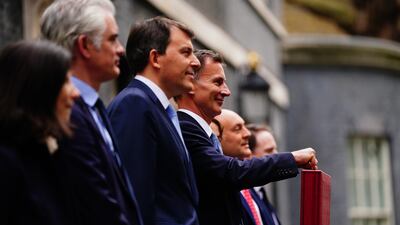
With an election approaching, Conservative MPs hope UK Chancellor Jeremy Hunt will offer something to impress voters. PA

UK budget: Doom for non-dom tax status?


Matthew Davies
  • English
  • Arabic

Big tax giveaways are reserved for chancellors presiding over booming and growing economies.

Unfortunately for Jeremy Hunt, the UK economy is currently in rather a sorry state, stalked by stagnation, recession and a lack of growth.

He will deliver what may be his last budget on Wednesday, should his Conservative Party lose the next election, which is widely expected to take place in the autumn.

Pundits are predicting a highly politicised budget, one which the Conservatives hope will impress voters with headline-grabbing tax cuts.

While chancellors of the Exchequer always like to pull a rabbit out of the hat when they take to the dispatch box in Parliament, distraction techniques may be more the name of the game for Mr Hunt.

“We have a Chancellor, and a government, that is fighting for life, so we are likely to get a piece of political theatre designed to generate headlines and try to win votes,” Russ Mould, investment director at AJ Bell, told The National.

On that score, it seems non-doms are toast.

Non-doms in focus?

Mr Hunt can only work with what he has got and the number-crunching by the Office for Budgetary Responsibility (OBR) shows he has about £13 billion ($16.5 billion) of so-called headroom to juggle with within the fiscal rules.

It is currently being speculated that one of the big targets of Mr Hunt's Budget will be those who are not domiciled in the UK and, as such, do not pay tax on their overseas earnings – the so-called non-doms.

Economists at the London School of Economics and the University of Warwick calculated that removing the non-dom tax status would bring in as much as £3.2 billion in tax revenue, about half the cost of taking 1p off income tax.

The same research also found that more than one in five senior bankers in the City of London financial district have claimed non-dom tax status at one time or another.

Experts say any move to dismantle the UK's non-dom tax status will affect recruitment in the City of London. Reuters

If the status was removed in the UK, it would affect about 70,000 people who currently do not pay income tax or capital gains tax on their overseas earnings.

The issue of the non-dom tax status was thrust into the spotlight two years ago, after it emerged that it was enjoyed by Prime Minister Rishi Sunak’s wife, Akshata Murty. She has since agreed to pay UK tax on her overseas earnings.

The number of people claiming non-dom status in the UK has been falling for some time, following a change in the rules to stop it being permanent. At the moment, there are 68,800 non-doms in the UK, who contributed £8.5 billion to the Exchequer in the 2021/2022 tax year.

The UK's non-doms often own properties and business that not only create jobs, but also generate earnings and capital gains that are subject to UK tax.

Mr Hunt remarked in 2022 that scrapping the status would simply serve to drive non-doms, many of whom are wealthy job-creating entrepreneurs, away from the UK. They would not have to go far. Ireland also operates a non-dom system.

It could be argued that Ireland's tax system is more attractive anyway. In the UK, there are time limits for the status and a £60,000 annual charge for the very wealthy – restrictions Ireland does not have. It has been suggested Mr Hunt might ramp that figure up to £150,000.

As such, some tax watchers argue that targeting the non-dom tax status could actually be one of those measures that grabs a headline on budget day, but backfires in terms of money flowing in the Exchequer's coffers in the long-term.

Removing the non-dom tax status would also be a tricky political move for Mr Hunt and represent somewhat of an about-turn to his position two years ago when he told the BBC that non-doms were “foreigners who could live easily in Ireland, France, Portugal, Spain”.

“They all have these schemes. All things being equal, I would rather they stayed here and spent their money here,” he said.

Non-dom status is also seen as an attractive perk for high-earners in London. A recruiter for hedge funds recently told Bloomberg the removal of the status would seriously damage London’s appeal.

“Clients say, ‘I love living in London,’ but there is a cost of doing so at which you say this is unacceptable,” said Mark Davies, a tax adviser for the super-wealthy. “There is a sense that cost is going over a tipping point.”

The opposition Labour party has indicated it would scrap the non-dom tax status should it come to power, but would allow for a four-year grace period.

Nonetheless, some experts say that the overall value of the non-doms to the economy as a whole, outweighs the short-term benefits of removing the status, if they relocated their tax affairs to places such as Ireland, Malta and Singapore.

“There has also been speculation that a Labour government might seek to dismantle the current non-dom status regime, but personally I think that is unlikely as the presence and buying power of the non-doms is important to all the political parties,” Peter Wetherell, executive chairman of the prime residential Mayfair estate agents Wetherell, told The National.

For Anthony Whatling, managing director at Alvarez & Marsal Tax, Mr Hunt will have to weigh up the pros and cons of scrapping the non-dom tax status.

“As always, the balance will be between the short-term lift from collecting taxes from non-doms who are a current captive audience and the longer-term risk that non-doms vote with their feet and leave for more attractive shores,” he said.

Air passenger duty

There is some speculation that the chancellor will increase air passenger duty in order to raise tax revenue.

A quick glimpse at the cost breakdown of a flight ticket departing the UK shows that the much of the total is made up of fuel surcharges, airport levies, environmental charges and an air passenger duty (APD).

The APD has been in place since 1993, when the then Conservative chancellor Kenneth Clarke introduced as an alternative to a fuel tax, which was banned in the EU.

Initially, the APD was set at £5 for European flights and £10 for long haul flights. Today, it can constitute about £175 of the cost of a ticket.

The amount of APD that is attached to the cost of an air fare for a flight leaving the UK now depends on how the flight is going and which class the passenger is seated in.

An Emirates Airbus A380 plane taking off from London's Heathrow airport. Airlines departing the UK have to pay air passenger duty (APD), the cost of which is passed on to customers. Chancellor Hunt could increase the APD in the budget on Wednesday. PA Wire

The distance from London to the destination cities is divided into three bands: A, B and C. Essentially, band A covers European flights, band B is for cities that lie between 2,001 and 5,500 miles (3,218km and 8,851km) from London, which includes Abu Dhabi and Dubai, and band C is for long haul flights of more than 5,500 miles from London.

There is also a domestic band that covers flights taking off and landing within the UK.

Plane operators also have to calculate the number of passengers in each class (economy, business and first) and pay the APD accordingly, while passing the cost on to the passengers.

For business and private jets, the APD system is even more complicated and depends on which way the seats face and the amount the seats can recline.

For example, under charging plans, which are due to come in next month, the APD per passenger on a jet carrying fewer than 19 passengers would be £581 a passenger.

An economy seat on a flight from London to Dubai will incur an APD of £88 from April 1, while the duty on a business class seat will be £194.

But there is speculation that Mr Hunt could change some of these charges in his budget on Wednesday, especially the business class APD.

The OBR has calculated that the APD will raise £3.8 billion in the 2023/24 tax year, so the temptation for Mr Hunt will be to increase the duty on some, if not all, classes of travel.

In September last year, British Prime Minister Rishi Sunak pledged that there would be no new taxes to flights that would “to discourage flying or going on holiday”.

While it could also be argued that APD is not a new tax, an airline industry source told The Telegraph newspaper that an increase in APD would be “against the spirit of the promise”.

The UK's APD is the only tax of it's kind in the world, and the airlines have long opposed it. Last month, budget airline Ryanair said UK airports are at an “enormous disadvantage” because of the APD.

“London will be always fine but where UK APD is doing untold damage is to the regional UK airports,” said Ryanair's chief commercial officer Jason McGuinness.

“I think that's going to get worse over the next number of years, predominantly because European airports are becoming significantly more competitive.”

Tax-free shopping

In his autumn statement last year, Mr Hunt indicated that he might consider reintroducing tax-free shopping for international travellers, something which Rishi Sunak removed when he was chancellor three years ago.

Mr Hunt announced that the OBR would revisit its calculations on tax-free shopping and present its findings alongside the Budget.

Retailers, particularly high-end shops in London's West End, claim the loss of the ability of international tourists to claim back 20 per cent VAT on their purchases has cost the economy dearly, as potential UK visitors opt to do their shopping in other European cities, especially Paris and Milan.

Hoteliers, restaurateurs and others involved in the UK's hospitality sector say the loss of tax-free shopping has had a knock-on effect on tourist numbers and spending.

A Gucci store on London's Bond Street. The luxury brand is among retailers calling for the reinstatement of tax-free shopping. Getty Images

The British Chambers of Commerce, several chief executives of leading hotel and retail groups, as well as the boss of London's Heathrow Airport, have all called for the reinstatement of tax-free shopping for international visitors. The UK is the only country in Europe that does not have it.

The lobbying efforts seemed to be going well until a few weeks ago, when a government minister appeared to pour cold water on the idea.

Nigel Huddleston, the minister responsible for the tax system, said in a letter seen by the by The Times that it was “not possible to introduce the same system as before, given that it would now need to be open to visitors from the EU, as well as the rest of the world”.

Mr Huddleston argued that because of Brexit, tourists from the EU are now essentially international visitors to the UK. This means that the VAT relief would have to be extended to those from the union.

According to data from Statista, while the biggest group of overseas visitors to the UK comes from the US, the next seven largest groups are all from European countries – France, Ireland, Germany, the Netherlands, Spain, Poland and Italy.

Aside from this, the reintroduction of tax-free shopping would have little impact either way on UK households, so for that reason alone experts feel its reinstatement is far down Mr Hunt's list of priorities for his Budget.

“I think the problem with the tax-free shopping issue is that it is something that was abolished by Rishi Sunak when he was chancellor, when he claimed it cost the country billions in lost VAT revenue and removing it would therefore be an overall benefit,” Stuart Cole, chief macro economist at Equiti Capital told The National.

“If Hunt brings it back so soon after it was abolished, then he is effectively saying Sunak was wrong to get rid of it. I think the body of evidence does, indeed, suggest that its removal has been a mistake. But is Hunt willing to potentially embarrass his boss? I doubt it.”

Limited scope for tax cuts

In highly politicised budgets, finance ministers look to please crowds with tax cuts and raise revenue from sources that have little or no immediate effect on voter households.

As such, taxing foreigners is much easier than taxing voters. For example, last year Singapore raised the stamp duty on property transactions made by foreign buyers by 60 per cent. The UK's Labour party is considering making changes to stamp duty on property purchases by overseas buyers, should it get into government.

But the effectiveness of aiming tax measures at overseas property buyers, non-dom residents and international visitors is limited, and any tinkering is unlikely to make much of a difference to the prospects for the UK economy.

A cut to income tax or national insurance may look like a crowd-pleasing move, but it will be tempered by the fact that millions of people are paying more tax now than a few years ago simply because tax thresholds have been frozen – what is called fiscal drag.

Craig Rickman from Interactive Investor told The National that because the freezes are set to remain until 2028, “the tax bills of both workers and retirees will continue to rise over the coming years”.

Earlier this week, the Institute of Fiscal Studies said that the “the economic case for tax cuts is weak” and that the public finances remained in a “poor position”.

The IFS added that revenue from taxation is forecast to climb to as much as 37.7 per cent of national income by the 2028/29 tax year – which would be the highest level since the Second World War.

Analysts say the burden-weary British taxpayer ought to be unimpressed with any short-term headline giveaways or yet more tweaking at the edges of the tax system.

“I don’t think the Chancellor has much ability in next week’s budget to make meaningful changes to spending and taxation that, in themselves, will boost growth,” Mr Cole told The National.

“The public has already expressed its distaste for ‘austerity’, and without any meaningful spending cuts the room for tax cuts is extremely limited.”

The Budget through the years - in pictures

  • Chancellor Jeremy Hunt holds his ministerial red box outside 11 Downing Street before delivering his 2023 Budget. All photos: Getty Images
    Chancellor Jeremy Hunt holds his ministerial red box outside 11 Downing Street before delivering his 2023 Budget. All photos: Getty Images
  • Rishi Sunak departs Downing Street to deliver the Budget in 2020 with the first UK lockdown less than two weeks away
    Rishi Sunak departs Downing Street to deliver the Budget in 2020 with the first UK lockdown less than two weeks away
  • Philip Hammond holds the red case as he departs 11 Downing Street in 2017
    Philip Hammond holds the red case as he departs 11 Downing Street in 2017
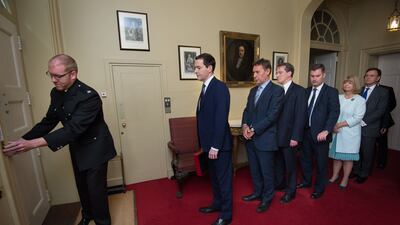
  • George Osborne leads his Treasury team out of 11 Downing Street to deliver the first Budget of the new Conservative government in 2015
    George Osborne leads his Treasury team out of 11 Downing Street to deliver the first Budget of the new Conservative government in 2015
  • Alistair Darling stands with his wife Margaret as he prepares to deliver his final Budget before the 2010 general election
    Alistair Darling stands with his wife Margaret as he prepares to deliver his final Budget before the 2010 general election
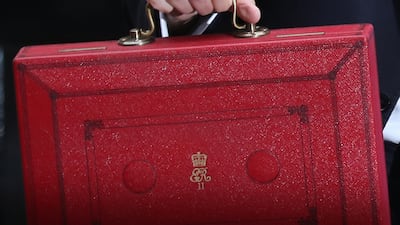
  • The Budget box – or "Gladstone box" – sits in Alistair Darling's study before the 2008 Budget
    The Budget box – or "Gladstone box" – sits in Alistair Darling's study before the 2008 Budget
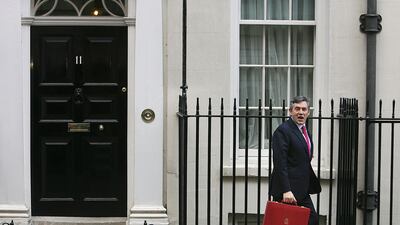
  • Gordon Brown leaves for Parliament to present his 11th Budget statement in 2007, his last before becoming prime minister
    Gordon Brown leaves for Parliament to present his 11th Budget statement in 2007, his last before becoming prime minister
  • Nigel Lawson and his wife Therese leaving 11 Downing Street prior to the 1988 Budget statement
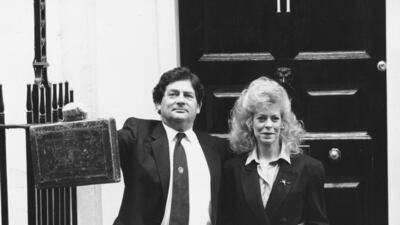
    Nigel Lawson and his wife Therese leaving 11 Downing Street prior to the 1988 Budget statement
  • Labour chancellor Denis Healey leaves Downing Street for the House of Commons with his budget box in 1974
    Labour chancellor Denis Healey leaves Downing Street for the House of Commons with his budget box in 1974
  • Conservative chancellor Anthony Barber prepares for the 1971 Budget in his office at the Treasury
    Conservative chancellor Anthony Barber prepares for the 1971 Budget in his office at the Treasury
  • Equal Pay for Women activists demonstrate as chancellor Rab Butler leaves Conservative Party headquarters to present his Budget in 1954
    Equal Pay for Women activists demonstrate as chancellor Rab Butler leaves Conservative Party headquarters to present his Budget in 1954
  • Rab Butler faces the cameras at the Treasury before his presentation of the Budget in 1953
    Rab Butler faces the cameras at the Treasury before his presentation of the Budget in 1953
  • John Simon leaves the Treasury to present his first war Budget in 1939
    John Simon leaves the Treasury to present his first war Budget in 1939
  • Neville Chamberlain prepares his Budget in 1937
    Neville Chamberlain prepares his Budget in 1937
  • Winston Churchill makes his way to the House of Commons to present his Budget in 1929, accompanied by his daughter, Diana
    Winston Churchill makes his way to the House of Commons to present his Budget in 1929, accompanied by his daughter, Diana

Richard Jewell

Director: Clint Eastwood

Stars: Paul Walter Hauser, Sam Rockwell, Brandon Stanley

Two-and-a-half out of five stars 

Champions League Last 16

Red Bull Salzburg (AUT) v Bayern Munich (GER) 

Sporting Lisbon (POR) v Manchester City (ENG) 

Benfica (POR) v Ajax (NED) 

Chelsea (ENG) v Lille (FRA) 

Atletico Madrid (ESP) v Manchester United (ENG) 

Villarreal (ESP) v Juventus (ITA) 

Inter Milan (ITA) v Liverpool (ENG) 

Paris Saint-Germain v Real Madrid (ESP)  

About Seez

Company name/date started: Seez, set up in September 2015 and the app was released in August 2017  

Founder/CEO name(s): Tarek Kabrit, co-founder and chief executive, and Andrew Kabrit, co-founder and chief operating officer

Based in: Dubai, with operations also in Kuwait, Saudi Arabia and Lebanon 

Sector:  Search engine for car buying, selling and leasing

Size: (employees/revenue): 11; undisclosed

Stage of funding: $1.8 million in seed funding; followed by another $1.5m bridge round - in the process of closing Series A 

Investors: Wamda Capital, B&Y and Phoenician Funds 

Zimbabwe v UAE, ODI series

All matches at the Harare Sports Club

  • 1st ODI, Wednesday, April 10
  • 2nd ODI, Friday, April 12
  • 3rd ODI, Sunday, April 14
  • 4th ODI, Sunday, April 16

Squads:

  • UAE: Mohammed Naveed (captain), Rohan Mustafa, Ashfaq Ahmed, Shaiman Anwar, Mohammed Usman, CP Rizwan, Chirag Suri, Mohammed Boota, Ghulam Shabber, Sultan Ahmed, Imran Haider, Amir Hayat, Zahoor Khan, Qadeer Ahmed
  • Zimbabwe: Peter Moor (captain), Solomon Mire, Brian Chari, Regis Chakabva, Sean Williams, Timycen Maruma, Sikandar Raza, Donald Tiripano, Kyle Jarvis, Tendai Chatara, Chris Mpofu, Craig Ervine, Brandon Mavuta, Ainsley Ndlovu, Tony Munyonga, Elton Chigumbura
How to avoid crypto fraud
  • Use unique usernames and passwords while enabling multi-factor authentication.
  • Use an offline private key, a physical device that requires manual activation, whenever you access your wallet.
  • Avoid suspicious social media ads promoting fraudulent schemes.
  • Only invest in crypto projects that you fully understand.
  • Critically assess whether a project’s promises or returns seem too good to be true.
  • Only use reputable platforms that have a track record of strong regulatory compliance.
  • Store funds in hardware wallets as opposed to online exchanges.
Ruwais timeline

1971 Abu Dhabi National Oil Company established

1980 Ruwais Housing Complex built, located 10 kilometres away from industrial plants

1982 120,000 bpd capacity Ruwais refinery complex officially inaugurated by the founder of the UAE Sheikh Zayed

1984 Second phase of Ruwais Housing Complex built. Today the 7,000-unit complex houses some 24,000 people.  

1985 The refinery is expanded with the commissioning of a 27,000 b/d hydro cracker complex

2009 Plans announced to build $1.2 billion fertilizer plant in Ruwais, producing urea

2010 Adnoc awards $10bn contracts for expansion of Ruwais refinery, to double capacity from 415,000 bpd

2014 Ruwais 261-outlet shopping mall opens

2014 Production starts at newly expanded Ruwais refinery, providing jet fuel and diesel and allowing the UAE to be self-sufficient for petrol supplies

2014 Etihad Rail begins transportation of sulphur from Shah and Habshan to Ruwais for export

2017 Aldar Academies to operate Adnoc’s schools including in Ruwais from September. Eight schools operate in total within the housing complex.

2018 Adnoc announces plans to invest $3.1 billion on upgrading its Ruwais refinery 

2018 NMC Healthcare selected to manage operations of Ruwais Hospital

2018 Adnoc announces new downstream strategy at event in Abu Dhabi on May 13

Source: The National

ETFs explained

Exhchange traded funds are bought and sold like shares, but operate as index-tracking funds, passively following their chosen indices, such as the S&P 500, FTSE 100 and the FTSE All World, plus a vast range of smaller exchanges and commodities, such as gold, silver, copper sugar, coffee and oil.

ETFs have zero upfront fees and annual charges as low as 0.07 per cent a year, which means you get to keep more of your returns, as actively managed funds can charge as much as 1.5 per cent a year.

There are thousands to choose from, with the five biggest providers BlackRock’s iShares range, Vanguard, State Street Global Advisors SPDR ETFs, Deutsche Bank AWM X-trackers and Invesco PowerShares.

The specs: 2017 Dodge Viper SRT

Price, base / as tested Dh460,000

Engine 8.4L V10

Transmission Six-speed manual

Power 645hp @ 6,200rpm

Torque 813Nm @ 5,000rpm

Fuel economy, combined 16.8L / 100km

Genesis G80 2020 5.0-litre Royal Specs

Engine: 5-litre V8

Gearbox: eight-speed automatic

Power: 420hp

Torque: 505Nm

Fuel economy, combined: 12.4L/100km

Price: Dh260,500

UAE currency: the story behind the money in your pockets
RESULT

West Brom 2 Liverpool 2
West Brom: Livermore (79'), Rondón (88' ) 
Liverpool: Ings (4'), Salah (72') 

GIANT REVIEW

Starring: Amir El-Masry, Pierce Brosnan

Director: Athale

Rating: 4/5

Tightening the screw on rogue recruiters

The UAE overhauled the procedure to recruit housemaids and domestic workers with a law in 2017 to protect low-income labour from being exploited.

 Only recruitment companies authorised by the government are permitted as part of Tadbeer, a network of labour ministry-regulated centres.

A contract must be drawn up for domestic workers, the wages and job offer clearly stating the nature of work.

The contract stating the wages, work entailed and accommodation must be sent to the employee in their home country before they depart for the UAE.

The contract will be signed by the employer and employee when the domestic worker arrives in the UAE.

Only recruitment agencies registered with the ministry can undertake recruitment and employment applications for domestic workers.

Penalties for illegal recruitment in the UAE include fines of up to Dh100,000 and imprisonment

But agents not authorised by the government sidestep the law by illegally getting women into the country on visit visas.

Pearls on a Branch: Oral Tales
​​​​​​​Najlaa Khoury, Archipelago Books

HOSTS

T20 WORLD CUP 

2024: US and West Indies; 2026: India and Sri Lanka; 2028: Australia and New Zealand; 2030: England, Ireland and Scotland 

ODI WORLD CUP 

2027: South Africa, Zimbabwe and Namibia; 2031: India and
Bangladesh 

CHAMPIONS TROPHY 

2025: Pakistan; 2029: India  

Where to buy

Limited-edition art prints of The Sofa Series: Sultani can be acquired from Reem El Mutwalli at www.reemelmutwalli.com

The%20stats%20and%20facts
%3Cp%3E1.9%20million%20women%20are%20at%20risk%20of%20developing%20cervical%20cancer%20in%20the%20UAE%3C%2Fp%3E%0A%3Cp%3E80%25%20of%20people%2C%20females%20and%20males%2C%20will%20get%20human%20papillomavirus%20(HPV)%20once%20in%20their%20lifetime%3C%2Fp%3E%0A%3Cp%3EOut%20of%20more%20than%20100%20types%20of%20HPV%2C%2014%20strains%20are%20cancer-causing%3C%2Fp%3E%0A%3Cp%3E99.9%25%20of%20cervical%20cancers%20are%20caused%20by%20the%20virus%3C%2Fp%3E%0A%3Cp%3EA%20five-year%20survival%20rate%20of%20close%20to%2096%25%20can%20be%20achieved%20with%20regular%20screenings%20for%20cervical%20cancer%20detection%3C%2Fp%3E%0A%3Cp%3EWomen%20aged%2025%20to%2029%20should%20get%20a%20Pap%20smear%20every%20three%20years%3C%2Fp%3E%0A%3Cp%3EWomen%20aged%2030%20to%2065%20should%20do%20a%20Pap%20smear%20and%20HPV%20test%20every%20five%20years%3C%2Fp%3E%0A%3Cp%3EChildren%20aged%2013%20and%20above%20should%20get%20the%20HPV%20vaccine%3C%2Fp%3E%0A
The 12 Syrian entities delisted by UK 

Ministry of Interior
Ministry of Defence
General Intelligence Directorate
Air Force Intelligence Agency
Political Security Directorate
Syrian National Security Bureau
Military Intelligence Directorate
Army Supply Bureau
General Organisation of Radio and TV
Al Watan newspaper
Cham Press TV
Sama TV

Ten tax points to be aware of in 2026

1. Domestic VAT refund amendments: request your refund within five years

If a business does not apply for the refund on time, they lose their credit.

2. E-invoicing in the UAE

Businesses should continue preparing for the implementation of e-invoicing in the UAE, with 2026 a preparation and transition period ahead of phased mandatory adoption. 

3. More tax audits

Tax authorities are increasingly using data already available across multiple filings to identify audit risks. 

4. More beneficial VAT and excise tax penalty regime

Tax disputes are expected to become more frequent and more structured, with clearer administrative objection and appeal processes. The UAE has adopted a new penalty regime for VAT and excise disputes, which now mirrors the penalty regime for corporate tax.

5. Greater emphasis on statutory audit

There is a greater need for the accuracy of financial statements. The International Financial Reporting Standards standards need to be strictly adhered to and, as a result, the quality of the audits will need to increase.

6. Further transfer pricing enforcement

Transfer pricing enforcement, which refers to the practice of establishing prices for internal transactions between related entities, is expected to broaden in scope. The UAE will shortly open the possibility to negotiate advance pricing agreements, or essentially rulings for transfer pricing purposes. 

7. Limited time periods for audits

Recent amendments also introduce a default five-year limitation period for tax audits and assessments, subject to specific statutory exceptions. While the standard audit and assessment period is five years, this may be extended to up to 15 years in cases involving fraud or tax evasion. 

8. Pillar 2 implementation 

Many multinational groups will begin to feel the practical effect of the Domestic Minimum Top-Up Tax (DMTT), the UAE's implementation of the OECD’s global minimum tax under Pillar 2. While the rules apply for financial years starting on or after January 1, 2025, it is 2026 that marks the transition to an operational phase.

9. Reduced compliance obligations for imported goods and services

Businesses that apply the reverse-charge mechanism for VAT purposes in the UAE may benefit from reduced compliance obligations. 

10. Substance and CbC reporting focus

Tax authorities are expected to continue strengthening the enforcement of economic substance and Country-by-Country (CbC) reporting frameworks. In the UAE, these regimes are increasingly being used as risk-assessment tools, providing tax authorities with a comprehensive view of multinational groups’ global footprints and enabling them to assess whether profits are aligned with real economic activity. 

Contributed by Thomas Vanhee and Hend Rashwan, Aurifer

Electric scooters: some rules to remember
  • Riders must be 14-years-old or over
  • Wear a protective helmet
  • Park the electric scooter in designated parking lots (if any)
  • Do not leave electric scooter in locations that obstruct traffic or pedestrians
  • Solo riders only, no passengers allowed
  • Do not drive outside designated lanes
The specs

Engine: four-litre V6 and 3.5-litre V6 twin-turbo

Transmission: six-speed and 10-speed

Power: 271 and 409 horsepower

Torque: 385 and 650Nm

Price: from Dh229,900 to Dh355,000

Nepotism is the name of the game

Salman Khan’s father, Salim Khan, is one of Bollywood’s most legendary screenwriters. Through his partnership with co-writer Javed Akhtar, Salim is credited with having paved the path for the Indian film industry’s blockbuster format in the 1970s. Something his son now rules the roost of. More importantly, the Salim-Javed duo also created the persona of the “angry young man” for Bollywood megastar Amitabh Bachchan in the 1970s, reflecting the angst of the average Indian. In choosing to be the ordinary man’s “hero” as opposed to a thespian in new Bollywood, Salman Khan remains tightly linked to his father’s oeuvre. Thanks dad. 

Top investing tips for UAE residents in 2021

Build an emergency fund: Make sure you have enough cash to cover six months of expenses as a buffer against unexpected problems before you begin investing, advises Steve Cronin, the founder of DeadSimpleSaving.com.

Think long-term: When you invest, you need to have a long-term mindset, so don’t worry about momentary ups and downs in the stock market.

Invest worldwide: Diversify your investments globally, ideally by way of a global stock index fund.

Is your money tied up: Avoid anything where you cannot get your money back in full within a month at any time without any penalty.

Skip past the promises: “If an investment product is offering more than 10 per cent return per year, it is either extremely risky or a scam,” Mr Cronin says.

Choose plans with low fees: Make sure that any funds you buy do not charge more than 1 per cent in fees, Mr Cronin says. “If you invest by yourself, you can easily stay below this figure.” Managed funds and commissionable investments often come with higher fees.

Be sceptical about recommendations: If someone suggests an investment to you, ask if they stand to gain, advises Mr Cronin. “If they are receiving commission, they are unlikely to recommend an investment that’s best for you.”

Get financially independent: Mr Cronin advises UAE residents to pursue financial independence. Start with a Google search and improve your knowledge via expat investing websites or Facebook groups such as SimplyFI. 

Updated: March 04, 2024, 2:37 PM