


Although decades of sanctions mean hotels and infrastructure are not five star, a tentative political thaw with the West is drawing visitors to Iranian attractions steeped in myth and rumour.
-
-
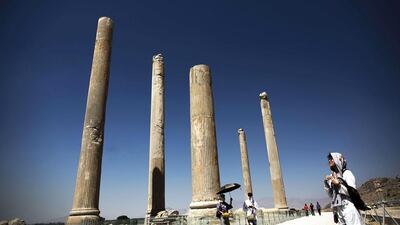
A Chinese tourist from Hong Kong looks at the coloumns of the ancient Persian city of Persepolis near Shiraz in southern Iran. Persepolis, a jewel of the first Persian empire whose palace and terraces took more than 100 years to build, starting under Darius the Great in 518 BC, is one of the country's highlights. Behrouz Mehri/ AFP -
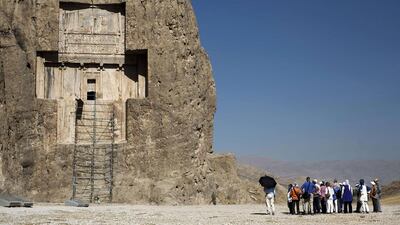
A group of German tourists visit the tomb of Achaemenid emperor Darius I the Great at Naqsh-e Rostam necropolis, located about 12km northwest of Persepolis, near Shiraz in southern Iran. Behrouz Mehri / AFP -
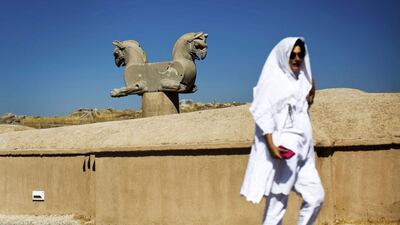
A Spanish tourist walks past an Achaemenid griffin at the ancient Persian city of Persepolis near Shiraz in southern Iran. The election of president Hassan Rouhani last year, and his decision to resume negotiations with the United States and other leading nations about Iran’s nuclear programme, has been a catalyst for Iranian tourism. Behrouz Mehri / AFP -
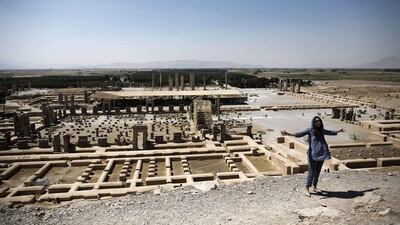
A European woman gestures over the ruins of Persepolis. Pilgrims from Iraq, Kuwait, Lebanon and Pakistan currently make up 60 per cent of Iran’s visitors. But the government’s main push is to recapture the spending power of Europe, Asia and America. Behrouz Mehri / AFP -
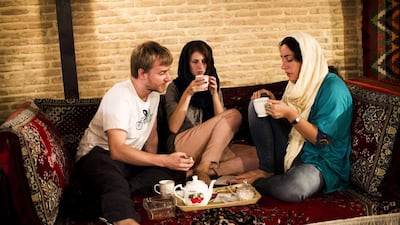
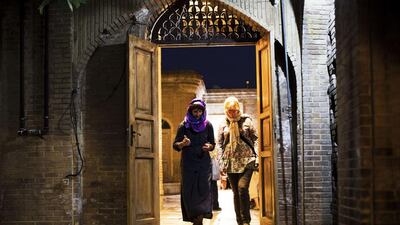
European tourists drink tea in a tea house in the city of Shiraz, 990km south of Tehran. Behrouz Mehri / AFP -
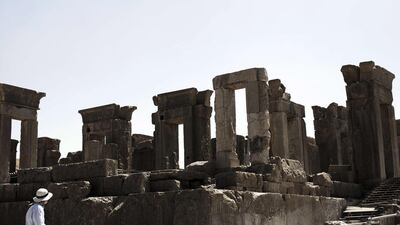
A tourist visits the Tachara Palace also known as the palace of King Darius of Achaemenid (522-486 BC) at the ancient city of Persepolis. For Iran – whose currency, the rial, has been depressed by rampant inflation – tourism offers a foreign exchange windfall. Behrouz Mehri / AFP -
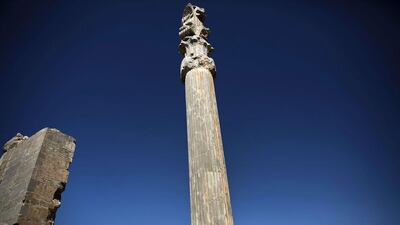
A Chinese tourist from Hong Kong poses for a picture at the "Gate of All Nations" at the ancient city of Persepolis. The cities of Isfahan, Shiraz and Yazd, all steeped in culture, are considered Iran’s top attractions. Behrouz Mehri / AFP -
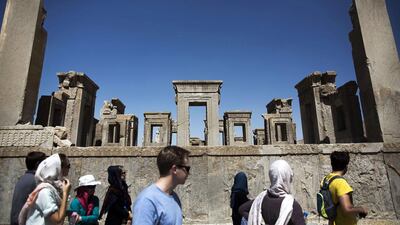
European and Iranian tourists visit the Tachara Palace. Official figures show that at the end of March, tourist numbers were up 35 per cent year-on-year to 4.5 million, bringing in $6 billion. Iran, with 17 Unesco-listed World Heritage sites, wants 20m visitors within a decade. Behrouz Mehri / AFP -
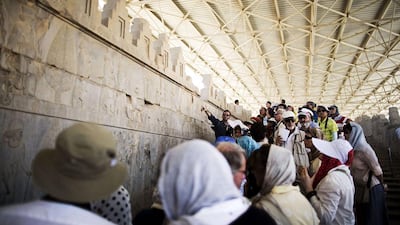
An Iranian tour guide shows the European tourists the figures carved on the wall of the eastern stairway of the Apadana palace at the ruins of Persepolis. A nuclear deal remains a hope and tour operators know optimism can vanish quickly. For the moment, local guides are filling their pockets. Behrouz Mehri / AFP -
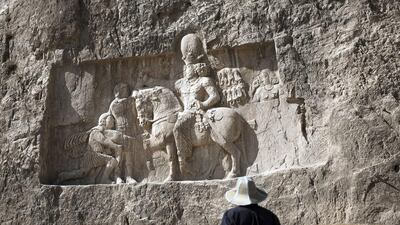
A European tourist looks at the over-lifesized rock relief triumph of Sassanid emperor Shapur I over the Roman Emperor Valerian, and Philip the Arab at Naqsh-e Rostam necropolis, located about 12km northwest of Persepolis, near Shiraz. Although many hotels have been built in the sprawling conurbations of Mashhad, Esfahan and Shiraz, the closest city to Persepolis, they are primarily for the domestic market. In the tourism sector there is a specific need for customer-focused training and more development. Behrouz Mehri / AFP
Iran seeks rebirth of tourism industry - in pictures
Most popular today

