

This month, the chief executive of Ola – a ride-hailing app that competes with Uber in India – unveiled a new artificial intelligence (AI) company focused on building a complete Indian AI system from scratch.
It is something that is a relatively new territory for the country, as it strives to make AI India-centric.
Many of the existing AI models that are being used globally are largely based on the English language and rooted in Western culture, founder Bhavish Aggarwal, who is also the chief executive and co-founder of Ola, said during a live-stream of the launch of the new AI company, called Krutrim.
It has been fully developed for India specifically and can understand India’s 22 official languages and generate content in 10 of them.
Mr Aggarwal demonstrated some of the technology's capabilities by asking Krutrim, which means “artificial” in Sanskrit, to write a poem in Bengali about the monsoon rains.
Billions of pieces of data that are unique to India have been used to create Krutrim, which will be fully open for use next month, the company says.
“AI will define the future paradigms of economy and culture,” says Mr Aggarwal. “And to become a true leader of the world, India needs to become a global leader in AI.”
Krutrim has been designed to have uses ranging from education to business communications, it says.
The company's launch comes amid AI’s wide use globally and developments which have prompted growing calls and concerns around the regulation of AI.
This year, there have been breakthroughs globally – as well as controversies – with the rise of generative AI, which is capable of creating new content including text, videos, images and audio.
ChatGPT is the best known example of this. Developed by AI research company OpenAI, ChatGPT is a chatbot that engages in conversational dialogue and can generate text to meet users' specific requirements.
Such strides in technology present an opportunity to create efficiencies and boost economies, analysts say.
If India fully capitalises on generative AI technology, the country has the potential to add $359 billion to $438 billion in the financial year between April 2029 and March 2030, which would be a 5.9 per cent to 7.2 per cent increase on its baseline gross domestic product, a report by EY said.
It says that most of this impact will come from AI's use in sectors including IT, financial services and retail.
The Indian government has highlighted AI as a significant enabler of the country's digital economy.
Investment is flowing into the sector. The total investment into AI start-ups in India reached $3.24 billion last year, the fifth highest globally, Stanford University's AI Index Report said.

“AI is pervasive across Indian organisations, influencing both business functions and industry sectors, as they increasingly embrace the transformative power of AI to drive innovation and enhance overall operational efficiency,” says Sameer Dhanrajani, chief executive at AI consulting and advisory firm AIQRATE and at 3AI, a platform for AI and analytics leaders and professionals.
However, besides using AI, India, which has a thriving IT sector, also has an opportunity to be a part of its development and create systems that are designed for the country of more than 1.4 billion people, with unique and diverse cultural aspects and languages. While OpenAI and Google do have Indian language databases, they largely rely on English data.
That is where companies like Krutrim step in.
India has been embracing AI, and a wide range of start-ups in the country have emerged offering AI solutions as they try to tap into the trend.
Companies including Krutrim are hoping to take this a step further by developing their own foundational model, known as a large language model (LLM).
“A lot of companies – both start-up and large companies – are racing to do that,” says Jaspreet Bindra, founder of consultancy The Tech Whisperer.
Other companies in India that are engaged in the task of creating LLMs include Tech Mahindra, one of the world’s largest IT services companies.
Called Project Indus, Tech Mahindra's aim is for its model to understand 40 different Indian languages. Beyond India's 22 official languages, there are dozens of other major languages.
Start-up CoRover.ai this month announced the launch of its Indian generative AI platform, BharatGPT, for which it has tied up with Google Cloud as a technology partner.
Another start-up, Sarvam AI, based in Bengaluru is also building LLMs.
“There has been a lot of discussion around India-centric models,” says Mr Bindra. “The inspiration from that comes from countries that have already created their own models – China has over 100 such models.
“The UAE pleasantly surprised the world by creating Falcon and then Jais, which are world-class open-source AI and LLMs. Therefore, the question in India is that why can’t India – with all its IT prowess, with all the human resources that it has – create its own LLMs?”
-
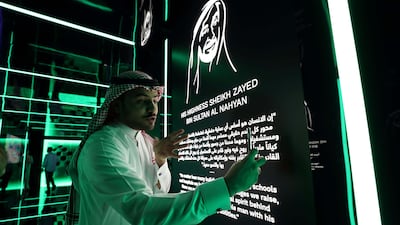
An official at the launch of Mohamed bin Zayed University of Artificial intelligence in Masdar City, Abu Dhabi. AI is central to the UAE's economic growth agenda. Chris Whiteoak / The National -
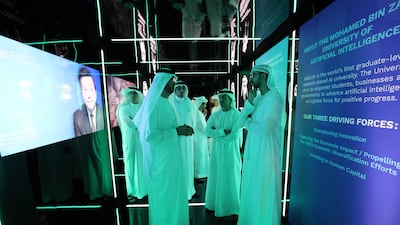
From left, Dr Sultan Al Jaber, Dr Ahmad Al Falasi and Omar Al Olama at the launch of the university. Chris Whiteoak / The National -

The university has teamed up with IBM to open a research centre at its Masdar City campus. Chris Whiteoak / The National -
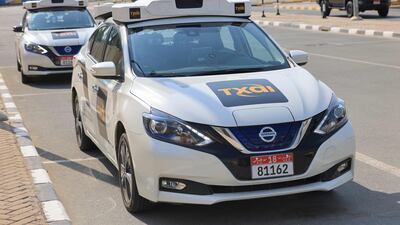
Self-driving taxis in Abu Dhabi. The UAE intends to become one of the leading AI nations by 2031. AFP -

MBZUAI has developed a curriculum and programmes that support academic research to contribute to tackling real-world challenges. AFP -

A robot outside the Dutch pavilion at the Expo 2020 Dubai. New districts are being built in the UAE, with artificial intelligence at their core. AFP -

Ajman's first self-driving bus goes on its first official drive with Sheikh Rashid bin Humaid, director of the Ajman Municipality and Planning Department, and Mr Al Olama onboard. -

MBZUAI is the only graduate-level university in the world singularly focused on developing AI tools. Photo: MBZUAI -

Through the IBM Skills Academy programme, MBZUAI will have access to lectures, labs, industry use cases and design-thinking sessions. Photo: MBZUAI -
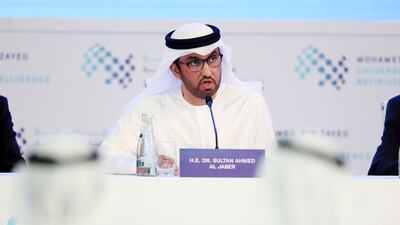
Dr Al Jaber, Minister of Industry and Advanced Technology and chairman of the MBZUAI board of trustees, has in the past emphasised the UAE's plans to use AI as a transformative tool to support its development. Chris Whiteoak / The National -

MBZUAI offers an executive programme to equip UAE government and business leaders with practical skills to tap into the benefits of cutting-edge technology. AFP


However, it is “not very easy to create an LLM of the scale, size and performance of a ChatGPT”, Mr Bindra says.
For one, it can require billions of dollars to create a ground-up, full stack LLM, he explains.
Other hurdles include sourcing the talent to develop the technology.
Krutrim, for example, was developed by computer scientists based in Bengaluru and San Francisco.
But one of the most difficult parts of the process, Mr Bindra says, is gathering the huge amounts of data required for developing such models.
“More important than language is context,” he says. “We need models with Indian context – Indian healthcare information, Indian data from radio and TV channels, Indian land records data, legal, education. All of these are going to be important to create the right kind of models for India,” he says.
Ultimately, if India can develop models that are accessible to the mass population, it will give a massive boost to the economy, he adds.
“India-centric AI models are crucial due to the country's diverse linguistic, cultural and socio-economic landscape,” says Deepika Loganathan, co-founder and chief executive at HaiVE. Tech, an AI provider.
“Tailoring AI models to India's unique context ensures they are more effective and inclusive.”
However, India's work in this area is still at a relatively nascent stage, she adds.
“While some strides have been made in this area, notably in language processing and localised applications, there's a need for more extensive work,” says Ms Loganathan.
This includes “developing data sets that reflect India’s diversity and addressing local challenges through AI”.
The main challenges include shortage of skilled AI professionals, infrastructural constraints and data privacy concerns, she says.
“Additionally, there's a need for more comprehensive regulatory frameworks to govern AI use.”
The rapid acceleration and growing capabilities of AI means that India, along with other countries, faces the conundrum of how to regulate the technology amid worries about ethical implications, concerns about security and the potential impact on jobs.
Addressing these challenges requires “a multifaceted approach”, Ms Loganathan says. This would involve enhancing AI education and training, investing in infrastructure, formulating clear AI policies and developing public-private partnerships.
Industry experts, meanwhile, remain optimistic about the progress that AI could experience in India in 2024.
“With increasing investment in AI research and development, growing government support, and the rising adoption of AI across industries, we are likely to see significant advancements,” says Ms Loganathan.
“I anticipate more collaboration between academia, industry and government to drive AI innovation, addressing both domestic and global challenges.”

