

Two Abu Dhabi companies have decided to merge in a deal that will create one of the world's most valuable listed space companies.
Bayanat, a geospatial data products and services provider, and Al Yah Satellite Communications, better known as Yahsat, will have a market capitalisation of Dh15 billion ($4.08 billion), based on the closing share prices of the two businesses as of December 18.
“This merger will unite two leading home-grown companies to create the Mena region’s first AI-powered space technology company," Bayanat chairman Tareq Al Hosani said on Tuesday.
"Together, we will leverage our key synergies to reinforce our position as a key engine of growth and strategic solutions provider to the UAE government and its agencies, while expanding our reach to global customers.”
The new entity will be called Space42 once the deal is concluded.
The proposed transaction will be executed through a share swap, with Bayanat remaining as the legal entity, the companies said.
The shareholders of Bayanat and Yahsat will own 54 per cent and 46 per cent, respectively, of the merged business.
Bayanat, which is majority owned by AI and cloud group G42, was created after the commercialisation of the UAE's Military Survey Department, a sector of the Armed Forces.
It provides national-level mapping and geospatial products and services for the public and private sectors in the Emirates.
Yahsat, meanwhile, a subsidiary of Abu Dhabi’s sovereign investment arm Mubadala Investment Company, offers satellite services in more than 150 countries across Europe, the Middle East, Africa, South America, Asia and the Australasia region.
The merger, which is expected to take place in the second half of 2024, is subject to several conditions, including regulatory approvals from government authorities such as the Securities and Commodities Authority and the Abu Dhabi Global Market Registration Authority.
Bayanat and Yahsat will continue to operate independently until the merger is effective.
-

Sheikh Mohammed bin Rashid, Vice President and Ruler of Dubai, met senior officials and decision-makers from leading global agencies shaping climate policies and space programmes on December 5. All photos: Dubai Media Office -

He did so on the sidelines of the Space Agencies Leaders’ Summit at Expo City Dubai -

Sheikh Mohammed highlighted the UAE's clean energy and space projects and noted how they promote the country's dedication to innovation -

Those present discussed ways of enhancing data-sharing between established and emerging space nations, as well as strengthening climate research by allocating resources and funding -

International space agencies agreed to improve how much scientific data is shared among nations or groups involved -

The UAE Space Agency has played a key role at Cop28, with the Space Pavilion established under the slogan ‘Space for Sustainability’ -

The Space Agencies Leaders’ Summit concluded with a pledge to enhance space-based climate initiatives by financing programmes and strengthening research in line with the commitments made under the 2015 Paris Agreement


Competition in the space sector is heating up with more private players entering the industry.
The space economy grew by 8 per cent to $546 billion in 2022 and is projected to expand by another 41 per cent over the next five years, according to the Space Foundation.
The UAE, the Arab world's second-largest economy, has the largest space sector in the region in terms of investment size and diversity.
Last year, the Emirates launched a Dh3 billion ($820 million) fund to support its space programme and a new initiative to develop radar satellites.
"The merger is a compelling opportunity to amplify value creation for shareholders, utilising synergies and strategic consolidation to create a technologically advanced champion," said Yahsat chairman Musabbeh Al Kaabi.
"The enlarged entity will benefit from accelerated growth potential as a player of scale with enhanced competitive advantage."
Mansoor Al Mansoori, the group chief operating officer of G42, will be the chairman of the new company, while Bakheet Al Katheeri, the chief executive of Mubadala’s UAE Investments platform, will take the role of vice chairman.
Karim Sabbagh will join as managing director of Space42.
Mr Sabbagh previously held the same role at satellite constellation company E-Space’s Europe and Middle East operations.
Yahsat swung into profit in the third quarter as revenue received a boost from the strong performance of its mobility solutions business and higher finance income.
Net profit attributable to shareholders of the company for the three months to the end of September were $26.4 million, compared with a loss of $10.2 million during the same period last year.
The company's revenue for the period grew by 8 per cent annually to $117.4 million, which was the second highest on record.
-

-
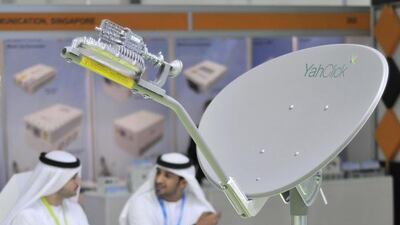
A YahLive satellite for home use is displayed on the Yahsat exhibition stand at the CABSAT 2013 exhibition at the Dubai World Trade Centre in March 2013. Charles Crowell for The National -
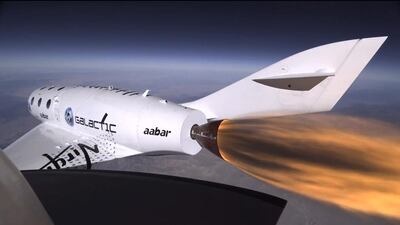
Virgin Galactic, the world’s first commercial spaceline owned by Sir Richard Branson’s Virgin Group and Abu Dhabi’s Aabar Investments, successfully completed the second rocket-powered, supersonic flight of its passenger carrying reusable space vehicle, SpaceShipTwo (SS2). In addition to achieving the highest altitude and greatest speed to date, the test flight demonstrated the vehicle’s full technical mission profile in a single flight for the first time, including a high altitude deployment of the unique wing “feathering” re-entry mechanism. All of the test objectives were successfully completed. -
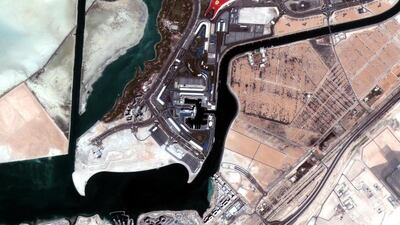
Image from DubaiSat-1 which was launched in July of 2009 of Yas Island from space. Courtesy EIAST -

The DubaiSat-1 which was launched in July of 2009. It was the first satellite to be owned by an Emirati entity. Courtesy EIAST -

The Arianespace launch site in Kourou, French Guiana shows the launch of an Ariane 5 rocket. It successfully placed two satellites in orbit, after twice delaying the launch for technical reasons. Riyadh-based communications operator Arabsat's 4.9-tonne satellite, made by Astrium and Thales Alenia Space, separated 26 minutes and 39 seconds after the launch while the South Korean satellite separated 32 minutes later. P Baudon / AFP -
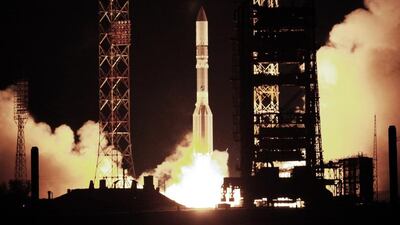
Yahsat launched its second satellite, Y1B in Kazakhstan. Satellite coverage now reaches more than 80 countries. Courtesy Mubadala -
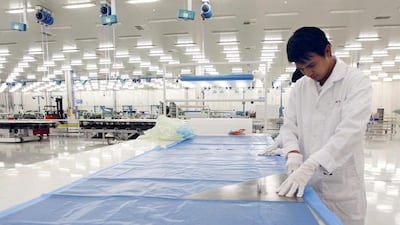
A clean-room operator cuts through a sheet of carbon fiber at STRATA, a composite aerostructures manufacturing plant in Al Ain. Flanked by dunes on an ancient Frankincense route from Yemen to Mesopotamia, the factory is designed to help make lightweight carbon jets that will open up the trade lanes of the future. Jumana El Heloueh / Reuters -
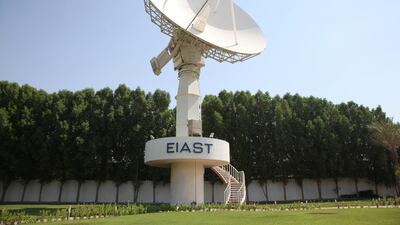
A EIAST Antenna. Courtesy EIAST -
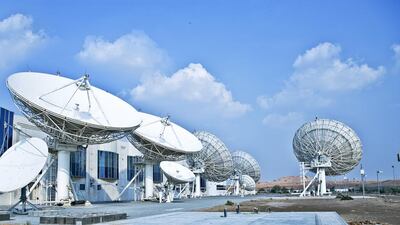
Thuraya, the satellite phone subsidiary of Etisalat. Courtesy Thuraya -

An image from DubaiSat-1 of the World Islands and the Dubai coastline. Courtesy EIAST -
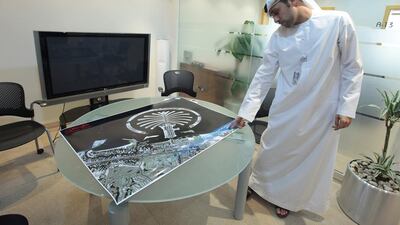
Salem Humaid Al Marri, the assistant director general for scientific and technical affairs, Emirates Institution for Advance Science and Technology, with the new imagery completed by Dubai Sat 2. Jeffrey Biteng / The National



