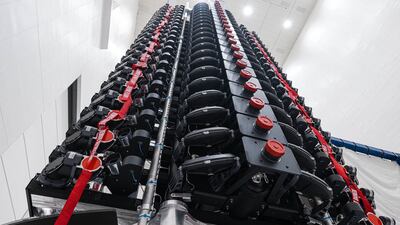
Amazon has launched its first pair of satellites for its global orbital internet service, in a direct challenge to Elon Musk's Starlink.
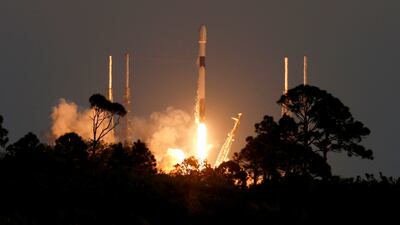
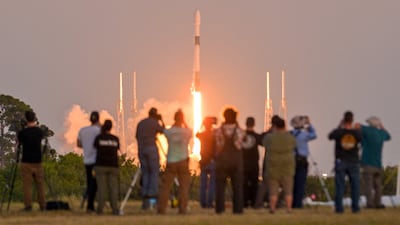
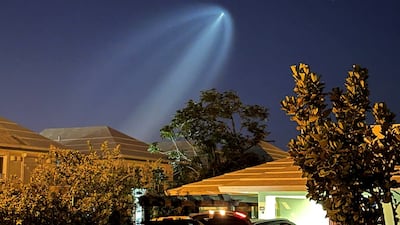
The two satellites for the company's Project Kuiper were carried by an Atlas V rocket, operated by Boeing and Lockheed Martin joint venture United Launch Alliance, from Cape Canaveral in Florida on Friday.
Amazon made its first contact with the satellites about an hour later, the Seattle-based company said.
“We’ve done extensive testing here in our lab and have a high degree of confidence in our satellite design, but there’s no substitute for on-orbit testing,” Rajeev Badyal, Project Kuiper’s vice president of technology, said on Amazon's website.
Amazon said its first production satellites are on track for launch in the first half of 2024, with beta testing with early commercial customers expected by the end of next year, the company said.
“This is Amazon’s first time putting satellites into space, and we’re going to learn an incredible amount regardless of how the mission unfolds.”
Project Kuiper is an initiative to increase global broadband access through a constellation of 3,236 satellites in low-Earth orbit (LEO), with a mission is to bring “fast, affordable broadband to unserved and underserved communities around the world”, according to Amazon.
That is compared to Starlink's 5,222 deployed satellites, of which 4,265 are operational, according to latest data from astronomer Jonathan McDowell, who tracks the Starlink constellation on his website.
These include Starshield satellites, a derivative of Starlink designed for military or government purposes.
LEOs orbit at heights of between 200km and 2,000km. For perspective, the International Space Station is at 408km, while the Hubble Space Telescope is at 547km.
Amazon's plan is to deploy Project Kuiper to “many countries” around the world, which would serve “billions of people … [who] don’t have reliable access to broadband”.
“Poor connectivity means limited access to modern communications, education, health services and other important resources, which can create an economic disadvantage for unserved and underserved communities,” Amazon said on its website.
The project is targeting a wide base of users, including schools, hospitals, businesses, government agencies and others operating “in places without reliable connectivity”, it said.
Amazon will be offering three tiers of speeds to customers – an ultra-compact model with speeds of up to 100Mbps, a standard option with up to 400 Mbps and the largest model, intended for enterprise, government and telecoms applications, with up to 1Gbps.
“We’re designing the system to balance performance and affordability, and we plan to provide choice and flexibility by offering a range of options for customers,” Amazon said.
Starlink, meanwhile, has four plans on offer, and says users can expect to experience download speeds of up to 220Mbps, according to its website. The company, which is a unit of SpaceX, intends to reach speeds of up to 1Gbps.
Starlink began launching satellites in 2019. Earlier that year, Project Kuiper was announced, with Amazon founder Jeff Bezos saying the company plans to spend billions on it.
Satellites can also provide internet access even in the most remote areas, compared to using a 5G or broadband connection, which requires a user to be within range of a cell tower.
Amazon and Starlink are part of the growing satellite internet sector: China is planning to launch 13,000 satellites as part of its GuoWang constellation, while Canada's Telesat and German start-up Rivada are planning to add 300 and 600, respectively.
These are in addition to the 300 to 500 satellites eyed by the US military's Space Development Agency and the 170 from the EU's Iris initiative.
Amazon said it will be testing Project Kuiper's networking hardware and software “to refine how they support the flow of data through the Kuiper System and Amazon Web Services”.
“Gateway antennae positioned around the world will track and communicate with the satellites and also connect the Kuiper System to the internet,” it said.
“As the mission progresses, we will test the network from end to end, sending data back and forth between the internet, our ground gateways, the satellites and our customer terminals.”

More coverage from the Future Forum
Avatar: Fire and Ash
Director: James Cameron
Starring: Sam Worthington, Sigourney Weaver, Zoe Saldana
Rating: 4.5/5
The Dark Blue Winter Overcoat & Other Stories From the North
Edited and Introduced by Sjón and Ted Hodgkinson
Pushkin Press
UAE SQUAD FOR ASIAN JIU-JITSU CHAMPIONSHIP
Men’s squad: Faisal Al Ketbi, Omar Al Fadhli, Zayed Al Kathiri, Thiab Al Nuaimi, Khaled Al Shehhi, Mohamed Ali Al Suwaidi, Farraj Khaled Al Awlaqi, Muhammad Al Ameri, Mahdi Al Awlaqi, Saeed Al Qubaisi, Abdullah Al Qubaisi and Hazaa Farhan
Women's squad: Hamda Al Shekheili, Shouq Al Dhanhani, Balqis Abdullah, Sharifa Al Namani, Asma Al Hosani, Maitha Sultan, Bashayer Al Matrooshi, Maha Al Hanaei, Shamma Al Kalbani, Haya Al Jahuri, Mahra Mahfouz, Marwa Al Hosani, Tasneem Al Jahoori and Maryam Al Amri
How to wear a kandura
Dos
- Wear the right fabric for the right season and occasion
- Always ask for the dress code if you don’t know
- Wear a white kandura, white ghutra / shemagh (headwear) and black shoes for work
- Wear 100 per cent cotton under the kandura as most fabrics are polyester
Don’ts
- Wear hamdania for work, always wear a ghutra and agal
- Buy a kandura only based on how it feels; ask questions about the fabric and understand what you are buying
Wicked
Director: Jon M Chu
Stars: Cynthia Erivo, Ariana Grande, Jonathan Bailey
Allardyce's management career
Clubs (10) - Limerick (1991-1992), Perston North End (1992), Blackpool (1994-1996), Notts County (1997-1999), Bolton Wanderers (1999-2007), Newcastle United (2007-2008), Blackburn Rovers (2008-2010), West Ham United (2011-2015), Sunderland (2016), Crystal Palace (2016-2017)
Countries (1) - England (2016)
About Okadoc
Date started: Okadoc, 2018
Founder/CEO: Fodhil Benturquia
Based: Dubai, UAE
Sector: Healthcare
Size: (employees/revenue) 40 staff; undisclosed revenues recording “double-digit” monthly growth
Funding stage: Series B fundraising round to conclude in February
Investors: Undisclosed
Key facilities
- Olympic-size swimming pool with a split bulkhead for multi-use configurations, including water polo and 50m/25m training lanes
- Premier League-standard football pitch
- 400m Olympic running track
- NBA-spec basketball court with auditorium
- 600-seat auditorium
- Spaces for historical and cultural exploration
- An elevated football field that doubles as a helipad
- Specialist robotics and science laboratories
- AR and VR-enabled learning centres
- Disruption Lab and Research Centre for developing entrepreneurial skills
The specs
Engine: 4.0-litre V8 twin-turbocharged and three electric motors
Power: Combined output 920hp
Torque: 730Nm at 4,000-7,000rpm
Transmission: 8-speed dual-clutch automatic
Fuel consumption: 11.2L/100km
On sale: Now, deliveries expected later in 2025
Price: expected to start at Dh1,432,000
Mercer, the investment consulting arm of US services company Marsh & McLennan, expects its wealth division to at least double its assets under management (AUM) in the Middle East as wealth in the region continues to grow despite economic headwinds, a company official said.
Mercer Wealth, which globally has $160 billion in AUM, plans to boost its AUM in the region to $2-$3bn in the next 2-3 years from the present $1bn, said Yasir AbuShaban, a Dubai-based principal with Mercer Wealth.
“Within the next two to three years, we are looking at reaching $2 to $3 billion as a conservative estimate and we do see an opportunity to do so,” said Mr AbuShaban.
Mercer does not directly make investments, but allocates clients’ money they have discretion to, to professional asset managers. They also provide advice to clients.
“We have buying power. We can negotiate on their (client’s) behalf with asset managers to provide them lower fees than they otherwise would have to get on their own,” he added.
Mercer Wealth’s clients include sovereign wealth funds, family offices, and insurance companies among others.
From its office in Dubai, Mercer also looks after Africa, India and Turkey, where they also see opportunity for growth.
Wealth creation in Middle East and Africa (MEA) grew 8.5 per cent to $8.1 trillion last year from $7.5tn in 2015, higher than last year’s global average of 6 per cent and the second-highest growth in a region after Asia-Pacific which grew 9.9 per cent, according to consultancy Boston Consulting Group (BCG). In the region, where wealth grew just 1.9 per cent in 2015 compared with 2014, a pickup in oil prices has helped in wealth generation.
BCG is forecasting MEA wealth will rise to $12tn by 2021, growing at an annual average of 8 per cent.
Drivers of wealth generation in the region will be split evenly between new wealth creation and growth of performance of existing assets, according to BCG.
Another general trend in the region is clients’ looking for a comprehensive approach to investing, according to Mr AbuShaban.
“Institutional investors or some of the families are seeing a slowdown in the available capital they have to invest and in that sense they are looking at optimizing the way they manage their portfolios and making sure they are not investing haphazardly and different parts of their investment are working together,” said Mr AbuShaban.
Some clients also have a higher appetite for risk, given the low interest-rate environment that does not provide enough yield for some institutional investors. These clients are keen to invest in illiquid assets, such as private equity and infrastructure.
“What we have seen is a desire for higher returns in what has been a low-return environment specifically in various fixed income or bonds,” he said.
“In this environment, we have seen a de facto increase in the risk that clients are taking in things like illiquid investments, private equity investments, infrastructure and private debt, those kind of investments were higher illiquidity results in incrementally higher returns.”
The Abu Dhabi Investment Authority, one of the largest sovereign wealth funds, said in its 2016 report that has gradually increased its exposure in direct private equity and private credit transactions, mainly in Asian markets and especially in China and India. The authority’s private equity department focused on structured equities owing to “their defensive characteristics.”