

China’s WeRide, which is trialling autonomous cars in the UAE, aims to rapidly expand its presence in the country with plans to have hundreds of vehicles on the roads by 2025, as the Emirates drives forward with its future mobility strategy.
The company this month received the UAE’s first preliminary licence to operate self-driving cars. The licence will allow WeRide to trial all its vehicles – including robotaxis, robobuses, robovans and robosweepers – in the country.
WeRide currently has 10 vehicles, including eight robotaxis and two robobuses operating in the UAE and is planning to increase that number next year, said the company's vice president Jennifer Li.
“2025 is going to be a big year and we hope by then there will be more autonomous cars on the street, here in the UAE … so we're hopeful to get to [hundreds of vehicles here],” she said.
The company has been testing its fully electric robotaxis in Yas Island and Saadiyat Island in collaboration with Bayanat, the UAE-based artificial intelligence geospatial solutions provider that is part of technology company G42.
In the past 18 months, more than 10,000 passengers have already tried the robotaxis in Abu Dhabi, which are operating under the authority of the government’s Integrated Transport Centre.
Based on the positive feedback, the company, which has driverless test permits in China and the US, began talks with the UAE government for a licence.
“We started the communication with the local government on the licence from last year,” said Tony Han, chief executive of WeRide. "During this process, we provided materials including [information about the] company, products and operations … we finally received the licence after an official presentation."
The company officially established its presence in Abu Dhabi in March and now has a local team of 10 as it seeks to “further accelerate the commercialisation of autonomous driving technology in the UAE”, Mr Han said.
The UAE is pushing forward with efforts to bring future modes of mobility into the mainstream transport market.
-
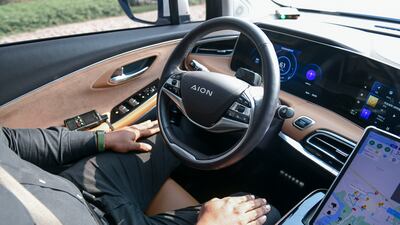
WeRide's self-driving service has been operating at Yas Island for a year and a half. Khushnum Bhandari / The National -

A safety driver is required in the car as part of the government's regulations. Khushnum Bhandari / The National -
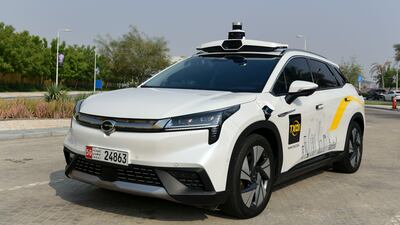
So far, more than 10,000 passengers have already tried the service known as 'Txai'. Khushnum Bhandari / The National -
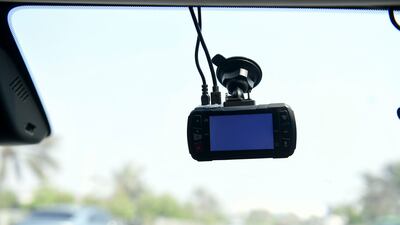
Each car has 10 cameras and 3 lidars - or laser radars. Khushnum Bhandari / The National -
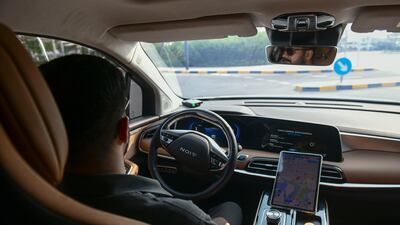
WeRide currently has 10 vehicles, including eight robotaxis and two robobuses operating in the UAE. Khushnum Bhandari / The National -
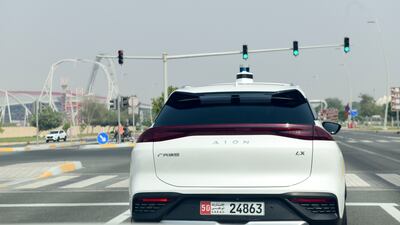
At present, three of its taxis in the UAE are of Nissan make while five are GAC cars. Khushnum Bhandari / The National -
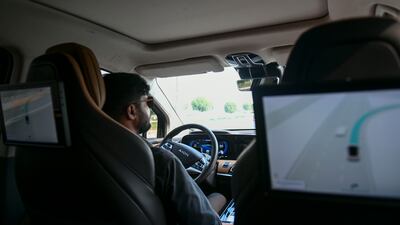
Monitors display the road map in the robotaxi. Khushnum Bhandari / The National -
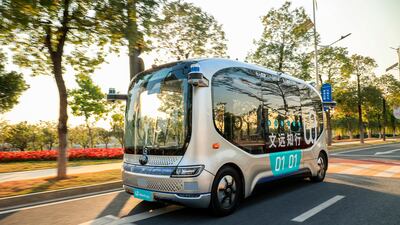
WeRide currently operates its robobus in China. Photo: WeRide -
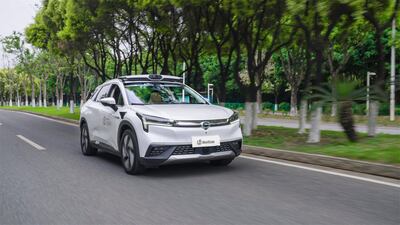
It has permits for testing its vehicles in China and the US. Photo: WeRide -

WeRide's robovans can be customised for commercial operations, including logistics services. Photo: WeRide


Dubai aims to have 25 per cent of its transport fully autonomous by 2030.
The value of the global autonomous vehicle market is forecast to top $1.8 trillion by 2030, from about $94.4 billion in 2021, growing at a compound annual rate of almost 39 per cent, latest data from Precedence Research shows.
Based on consumer interest in autonomous driving features and commercial solutions available in the market, advanced driver-assistance systems and autonomous driving could generate between $300 billion and $400 billion in the passenger car market by 2035, McKinsey analysis indicates.
“The increasing awareness of the various benefits of autonomous driving has accelerated the development of favourable governmental policies relating to the … technology and industry development around the globe,” said Mr Han.
Road testing and commercial operations are under way in many countries.
“Governments in multiple countries have been making legislative efforts to boost the development and paving the way for large-scale commercialisation of self-driving vehicles as well,” Mr Han added.
WeRide, which began operations six years ago, has raised $1.2 billion in funding so far, including $500 million received last year from investors including Abu Dhabi’s Mubadala Investment Company and Carlyle Group. Its investors also include the Renault-Nissan-Mitsubishi Alliance, Bosch, Yutong Group and GAC Group, among others.
The key factors supporting its path to profitability include an increase in revenue from scaling up its fleet size and boosting utilisation; continued cost reduction from lowering hardware cost and reducing labour cost; and further enhancing research and development efficiency, Mr Han said.
The company is also seeking to “improve operational leverage from retaining a lean structure and boosting sales and marketing efficiency”.
Ms Li said: “We are financially in a strong position and … we can be partially self-sustained already. And for this region, we are hoping that we can invest more in this region by ourselves as well, but also with partners.”

WeRide works with original equipment manufacturers to produce its vehicles – at present, three of its taxis in the UAE are of Nissan make while five are GAC cars. The company operates all the software and technology, including localisation, prediction, planning and control, Ms Li said.
The company’s autonomous driving vehicles have been deployed to run testing and commercial pilots in 26 cities and five countries across Asia, the Middle East and North America. It currently offers driverless robotaxis rides in four cities globally.
WeRide currently owns “one of the world’s largest autonomous driving fleets” of more than 600 vehicles and its cumulative autonomous mileage has reached more than 20 million kilometres, according to Mr Han.
“One of the most critical challenges in the development of autonomous driving vehicles and driver assistance systems is their relatively poor performance under adverse weather conditions such as snow and sandstorms,” Mr Han said.
The company’s autonomous driving fleet has completed trials in Heihe, China and Abu Dhabi, operating under an external temperature range of between -25°C to 45°C in 2021.
WeRide has so far received orders for 10,000 L4 autonomous driving vehicles, Mr Han said.
L4 refers to the second-highest of the six levels of vehicle autonomy, which run from 0 to 5, in which vehicles do not require human intervention under most circumstances. Level 5, the highest, requires no human attention and vehicles under this status may not even have steering wheels or pedals.
Safety has been a key concern when it comes to autonomous transportation, with vehicles developed by companies such as Tesla Motors, the world's biggest electric vehicle maker, and Google involved in accidents, some of which have been fatal.
WeRide
“So, for the past six years of our history, WeRide has never had any accidents due to our fault. Safety is the top priority for our firm, and we are proud of the track record and we will try to keep it as long as possible,” Ms Li said.
Locally, once the company moves into the next stage of moving the safety driver outside of the vehicle, the car will be connected to a remote control centre.
The centre will be located in the same city and will have people constantly monitoring the vehicles on the roads to oversee operations, she added.
Looking ahead, the company is seeking to rapidly expand its international footprint, with a focus on the Mena region.
WeRide, which aims to have about 1,000 vehicles across the Middle East in the next two years, is already expanding into Saudi Arabia.
In September last year, WeRide announced its collaboration with the Saudi Artificial Intelligence Company to launch the first dynamic robobus route in the kingdom.
The company also signed a preliminary agreement in December with Ajlan & Brothers Holding Group to jointly promote autonomous driving vehicles in Saudi Arabia.
Saudi Arabia aims to have 15 per cent of its public transport vehicles as autonomous by 2030, Omaimah Bamasag, deputy of transport enablement at the Transport General Authority, said in Arthur D Little's Autonomous Mobility Journal in March.
The kingdom has also set a target of converting a quarter of goods transport vehicles into autonomous vehicles by the start of the next decade.
“We believe that autonomous driving will bring positive change on every aspect of people’s lives, and the autonomous driving market is expected to see tremendous growth,” Mr Han said.

