Tesla's Model Y and Model 3 vehicles at an official launch in Thailand in December. EPA

Tesla's annual deliveries surge 40% in 2022 to cross a million for the first time


Alvin R Cabral
  • English
  • Arabic

Tesla, the world's biggest electric vehicle manufacturer, set another record for annual deliveries as it shipped 1.31 million cars in 2022, up more than 40 per cent year on year.

The jump in deliveries was buoyed by a record fourth quarter, despite production challenges and concerns about weakening demand.

Deliveries for the three-month period ended December 31, 2022 were up by about a third to 405,278, from 308,600 a year earlier, and about 18 per cent higher from 180,570 in the third quarter, the Texas-based company said on Monday.

However, Tesla's deliveries missed Wall Street estimates and even the company's own growth projection of 50 per cent, despite opening two new factories last year.

Fourth-quarter deliveries were also short of the Bloomberg estimate of about 420,760 vehicles.

The company was close to matching its full-year performance in 2021 through the third quarter as it delivered 908,573 vehicles in the first nine months of 2022, compared to 936,172 in all of last year.

In 2021, Tesla was able to beat its 2020 annual delivery numbers in the third quarter.

Total production in the fourth quarter of 2022 grew by about 44 per cent to 439,701, from 305,840, bringing 2022's full-year total to 1.37 million, up by about 48 per cent from 930,422 a year earlier, the company said.

The “great 2022" was achieved despite “significant Covid and supply chain-related challenges throughout the year”, Tesla said.

“We continued to transition towards a more even regional mix of vehicle builds which again led to a further increase in cars in transit at the end of the quarter,” the electric vehicle maker said.

The company is scheduled to report its full-year financial results on January 25.

Tesla's performance is widely viewed as a barometer of the EV market as more consumers opt for environmentally friendly alternatives to traditional internal combustion vehicles.

However, the company failure to achieve its growth targets could spark more investor concern, given that chief executive Elon Musk had projected an “epic” end to 2022.

The company is already struggling with still-high inflation, high interest rates, supply chain issues and other economic headwinds.

After Mr Musk's declaration, Tesla went on to introduce aggressive moves in two of its key markets: it slashed prices and production in China, and offered $7,500 in discounts to customers in the US.

The news in early December about Tesla planning to suspend output at its factory in Shanghai caused a massive sell-off in the company, sending its stock down 37 per cent at the time and dragging its valuation below the $500 billion mark. The company's shares eventually ended down 69 per cent for all of 2022.

Its market capitalisation continued to decline since then. As of Tuesday, it stood at about $389 billion.

Tesla shares did not trade on Monday due to a New Year holiday in the US. They were down about 3 per cent to $119.61 in pre-market trading on Tuesday.

Investors were also wary of Mr Musk's unorthodox and controversial actions at Twitter, which he bought for $44 billion last year.

Tesla is facing a "significant demand problem" that would persist in 2023, Toni Sacconaghi, an analyst at private wealth management firm Bernstein, wrote in a note following Tesla's report.

“Tesla will need to either reduce its growth targets [and run its factories below capacity], or sustain and potentially increase recent price cuts globally, pressuring margins,” he said.

"We see demand problems remaining until Tesla is able to introduce a lower priced offering in volume, which may only be in 2025."

Tesla's Model 3 and Model Y remained its top-selling vehicles, accounting for 388,131, or about 96 per cent, of total deliveries in the fourth quarter.

The two cars held a similar share in production in the three-month period, with 439,701 units.

For 2022, the vehicles also comprised 95 per cent of deliveries and production, with more than 1.24 million and 1.29 million units, respectively.

Compared with a year ago, fourth-quarter Model 3 and Model Y deliveries surged by more than three quarters and production was up by about 70 per cent.

On an annual basis, deliveries rose 73 per cent and production grew by almost 70 per cent.

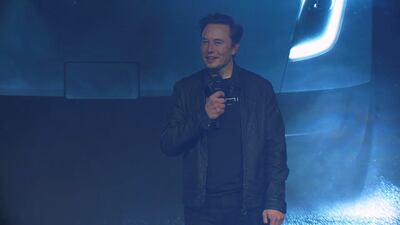
  • Tesla chief executive Elon Musk on stage with Dan Priestly, a senior manager at the company, during the unveiling of the Tesla Semi electric truck. All photos: Reuters
    Tesla chief executive Elon Musk on stage with Dan Priestly, a senior manager at the company, during the unveiling of the Tesla Semi electric truck. All photos: Reuters
  • Mr Musk speaks to the audience in Nevada
    Mr Musk speaks to the audience in Nevada
  • The Tesla Semi is unveiled
    The Tesla Semi is unveiled
  • The event was streamed live
    The event was streamed live
  • Tesla calls its new vehicle 'the future of trucking'
    Tesla calls its new vehicle 'the future of trucking'
  • It has a range of about 800km
    It has a range of about 800km
  • Tesla's new electric semi truck is unveiled during a presentation in Hawthorne, California, US, November 16, 2017. Reuters
    Tesla's new electric semi truck is unveiled during a presentation in Hawthorne, California, US, November 16, 2017. Reuters

Meanwhile, the Model S and Model X posted 17,147 deliveries in the fourth quarter, up 47 per cent annually, and 66,705 for all of 2022, a surge of 167 per cent from 2021.

Production stood at 20,613 in the three-month period and 71,177 for the entire year, increases of 57 per cent and 191 per cent, respectively.

Mr Musk is also aiming to boost the company's portfolio, having delivered the company's first heavy-duty Semi electric lorry to Pepsi early in December, making good on a pledge he made in October.

However, he did not offer any updated forecasts for the lorry's pricing or production plans.

Skoda Superb Specs

Engine: 2-litre TSI petrol

Power: 190hp

Torque: 320Nm

Price: From Dh147,000

Available: Now

if you go

The flights

Etihad, Emirates and Singapore Airlines fly direct from the UAE to Singapore from Dh2,265 return including taxes. The flight takes about 7 hours.

The hotel

Rooms at the M Social Singapore cost from SG $179 (Dh488) per night including taxes.

The tour

Makan Makan Walking group tours costs from SG $90 (Dh245) per person for about three hours. Tailor-made tours can be arranged. For details go to www.woknstroll.com.sg

WHAT IS A BLACK HOLE?

1. Black holes are objects whose gravity is so strong not even light can escape their pull

2. They can be created when massive stars collapse under their own weight

3. Large black holes can also be formed when smaller ones collide and merge

4. The biggest black holes lurk at the centre of many galaxies, including our own

5. Astronomers believe that when the universe was very young, black holes affected how galaxies formed

Mercer, the investment consulting arm of US services company Marsh & McLennan, expects its wealth division to at least double its assets under management (AUM) in the Middle East as wealth in the region continues to grow despite economic headwinds, a company official said.

Mercer Wealth, which globally has $160 billion in AUM, plans to boost its AUM in the region to $2-$3bn in the next 2-3 years from the present $1bn, said Yasir AbuShaban, a Dubai-based principal with Mercer Wealth.

Within the next two to three years, we are looking at reaching $2 to $3 billion as a conservative estimate and we do see an opportunity to do so,” said Mr AbuShaban.

Mercer does not directly make investments, but allocates clients’ money they have discretion to, to professional asset managers. They also provide advice to clients.

“We have buying power. We can negotiate on their (client’s) behalf with asset managers to provide them lower fees than they otherwise would have to get on their own,” he added.

Mercer Wealth’s clients include sovereign wealth funds, family offices, and insurance companies among others.

From its office in Dubai, Mercer also looks after Africa, India and Turkey, where they also see opportunity for growth.

Wealth creation in Middle East and Africa (MEA) grew 8.5 per cent to $8.1 trillion last year from $7.5tn in 2015, higher than last year’s global average of 6 per cent and the second-highest growth in a region after Asia-Pacific which grew 9.9 per cent, according to consultancy Boston Consulting Group (BCG). In the region, where wealth grew just 1.9 per cent in 2015 compared with 2014, a pickup in oil prices has helped in wealth generation.

BCG is forecasting MEA wealth will rise to $12tn by 2021, growing at an annual average of 8 per cent.

Drivers of wealth generation in the region will be split evenly between new wealth creation and growth of performance of existing assets, according to BCG.

Another general trend in the region is clients’ looking for a comprehensive approach to investing, according to Mr AbuShaban.

“Institutional investors or some of the families are seeing a slowdown in the available capital they have to invest and in that sense they are looking at optimizing the way they manage their portfolios and making sure they are not investing haphazardly and different parts of their investment are working together,” said Mr AbuShaban.

Some clients also have a higher appetite for risk, given the low interest-rate environment that does not provide enough yield for some institutional investors. These clients are keen to invest in illiquid assets, such as private equity and infrastructure.

“What we have seen is a desire for higher returns in what has been a low-return environment specifically in various fixed income or bonds,” he said.

“In this environment, we have seen a de facto increase in the risk that clients are taking in things like illiquid investments, private equity investments, infrastructure and private debt, those kind of investments were higher illiquidity results in incrementally higher returns.”

The Abu Dhabi Investment Authority, one of the largest sovereign wealth funds, said in its 2016 report that has gradually increased its exposure in direct private equity and private credit transactions, mainly in Asian markets and especially in China and India. The authority’s private equity department focused on structured equities owing to “their defensive characteristics.”

Updated: January 03, 2023, 11:47 AM