A man walks past a sign that reads 'Google for India'. Google Street View is now available in parts of the country. Reuters

Google Street View launches in India 11 years after first attempt


Ian Oxborrow
  • English
  • Arabic

Google Maps launched Street View in 10 Indian cities on Wednesday, covering 150,000 kilometres.

Imagery has been licensed to Genesys International and Tech Mahindra in what Google said was the first time that Street View data collection is being brought to life completely by local partners.

The 10 cities to feature at launch are Bengaluru, Chennai, Delhi, Mumbai, Hyderabad, Pune, Nashik, Vadodara, Ahmednagar and Amritsar. Google plans to expand this to more than 50 cities by the end of 2022.

"India’s digital adoption continues to move at a phenomenal pace, and we remain focused on accurately modelling, reflecting, and solving for today’s rapidly-evolving India," Miriam Daniel, vice president of Google Maps experiences, said in a blog post.

Google first launched Street View in 2007. The platform can be used to explore places around the world with a 360-degree panoramic view and street-level imagery.

The company has faced privacy complaints and was denied permission at least twice in the past decade by the Indian government over security concerns.

In 2019, Google agreed a $13 million settlement after code in its software gathered samples of payload data from Wi-Fi networks, collecting passwords and emails.

"Our fleet is still swiftly photographing Indian cities, bringing to life our city's amazing tapestry of streets and landmarks and allowing us to comfortably visit our old neighbourhoods or plan our trips," said Sajid Malik, managing director of Genesys International.

"Google Maps has always been at the forefront of geospatial technology, and we are honoured to be an enabler of their efforts by offering the best technology to India and its people."

Google also announced a collaboration with the Central Pollution Control Board to make authoritative air quality information available on Google Maps.

___________________________

10 most-visited Mena sites on Google Street View

  • 10. Dubai International Airport.
    10. Dubai International Airport.
  • 9. The Dubai Fountain.
    9. The Dubai Fountain.
  • 8. The Sphinx of Giza, Egypt.
    8. The Sphinx of Giza, Egypt.
  • 7. Dubai's Burj Al Arab.
    7. Dubai's Burj Al Arab.
  • 6. Al Masjid an-Nabawi, Saudi Arabia.
    6. Al Masjid an-Nabawi, Saudi Arabia.
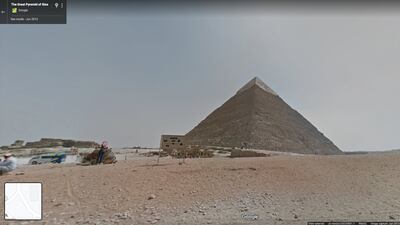
  • 5. The Great Pyramid of Giza, Egypt.
    5. The Great Pyramid of Giza, Egypt.
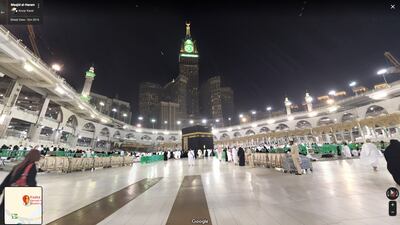
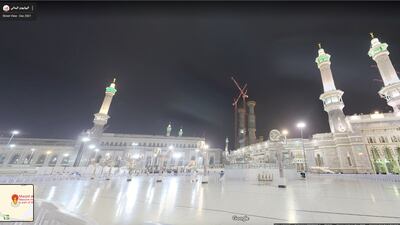
  • 4. Masjid al-Haram, Saudi Arabia.
    4. Masjid al-Haram, Saudi Arabia.
  • 3. Giza Necropolis, Egypt.
    3. Giza Necropolis, Egypt.
  • 2. Kaaba, Saudi Arabia.
    2. Kaaba, Saudi Arabia.
  • 1. Burj Khalifa is Google Street View's most-visited landmark. All photos: Google
    1. Burj Khalifa is Google Street View's most-visited landmark. All photos: Google
Living in...

This article is part of a guide on where to live in the UAE. Our reporters will profile some of the country’s most desirable districts, provide an estimate of rental prices and introduce you to some of the residents who call each area home. 

Mercer, the investment consulting arm of US services company Marsh & McLennan, expects its wealth division to at least double its assets under management (AUM) in the Middle East as wealth in the region continues to grow despite economic headwinds, a company official said.

Mercer Wealth, which globally has $160 billion in AUM, plans to boost its AUM in the region to $2-$3bn in the next 2-3 years from the present $1bn, said Yasir AbuShaban, a Dubai-based principal with Mercer Wealth.

Within the next two to three years, we are looking at reaching $2 to $3 billion as a conservative estimate and we do see an opportunity to do so,” said Mr AbuShaban.

Mercer does not directly make investments, but allocates clients’ money they have discretion to, to professional asset managers. They also provide advice to clients.

“We have buying power. We can negotiate on their (client’s) behalf with asset managers to provide them lower fees than they otherwise would have to get on their own,” he added.

Mercer Wealth’s clients include sovereign wealth funds, family offices, and insurance companies among others.

From its office in Dubai, Mercer also looks after Africa, India and Turkey, where they also see opportunity for growth.

Wealth creation in Middle East and Africa (MEA) grew 8.5 per cent to $8.1 trillion last year from $7.5tn in 2015, higher than last year’s global average of 6 per cent and the second-highest growth in a region after Asia-Pacific which grew 9.9 per cent, according to consultancy Boston Consulting Group (BCG). In the region, where wealth grew just 1.9 per cent in 2015 compared with 2014, a pickup in oil prices has helped in wealth generation.

BCG is forecasting MEA wealth will rise to $12tn by 2021, growing at an annual average of 8 per cent.

Drivers of wealth generation in the region will be split evenly between new wealth creation and growth of performance of existing assets, according to BCG.

Another general trend in the region is clients’ looking for a comprehensive approach to investing, according to Mr AbuShaban.

“Institutional investors or some of the families are seeing a slowdown in the available capital they have to invest and in that sense they are looking at optimizing the way they manage their portfolios and making sure they are not investing haphazardly and different parts of their investment are working together,” said Mr AbuShaban.

Some clients also have a higher appetite for risk, given the low interest-rate environment that does not provide enough yield for some institutional investors. These clients are keen to invest in illiquid assets, such as private equity and infrastructure.

“What we have seen is a desire for higher returns in what has been a low-return environment specifically in various fixed income or bonds,” he said.

“In this environment, we have seen a de facto increase in the risk that clients are taking in things like illiquid investments, private equity investments, infrastructure and private debt, those kind of investments were higher illiquidity results in incrementally higher returns.”

The Abu Dhabi Investment Authority, one of the largest sovereign wealth funds, said in its 2016 report that has gradually increased its exposure in direct private equity and private credit transactions, mainly in Asian markets and especially in China and India. The authority’s private equity department focused on structured equities owing to “their defensive characteristics.”

UAE currency: the story behind the money in your pockets
Updated: July 27, 2022, 2:19 PM