


Abu Dhabi start-up Pure Harvest Smart Farms and the Singapore Food Agency have signed a preliminary agreement to develop the city-state's first hybrid greenhouse tomato farm that is aimed at boosting sustainable food security.
The initiative, which will contribute to Singapore's key “30 by 30" national food security goal, will make use of innovation in the agricultural technology (AgTech) sector and boost research and development opportunities for local partners, Pure Harvest said on Thursday.
The agreement was signed by Sky Kurtz, chief executive of Pure Harvest, and Lim Kok Thai, chief executive of the SFA.
__________
Food used to raise sustainability awareness — in pictures
-

In Dubai, executive chef at Teible restaurant, Carlos Frunze De Garza, saves left-over fruit and vegetables and incorporates the items into new recipes. All photos: Reuters -

From making sauces to vinegars, oils and kombucha tea, the chef describes sustainability as a “lifestyle in the kitchen”. -

'Look at one ingredient or one vegetable, look at how you can use it, from the seeds to the core, and make everything out of it, you can make peels, you can make salad,' De Garza says. -

'The seeds you can give back to the farmers, who can regrow the seeds, then the cores or the peels, we can make something out of it, we can make oils, we can make vinegars, we can make sauces,' the chef says. -

Large jars of fermented fruits and vegetables are lined up in the kitchen, where the chef uses his creations to add a twist to his dishes. -
!['We ferment and make our kombucha [pictured]. The liquid we use to make granita [semi-frozen dessert], the core we make into a powder, which we use for dessert. Basically everything, the zaatar and the blueberry, are used 100 per cent with the powder and granita," De Garza says.](https://www.thenationalnews.com/resizer/v2/PLUVQW4CE5XDQOIRTMBB6ZY4G4.jpg?smart=true&auth=359efe3fb60e53b4e5e3a4006b610bca89a66f95d84b93c36d56196838d27bbe&width=400&height=225)
'We ferment and make our kombucha [pictured]. The liquid we use to make granita [semi-frozen dessert], the core we make into a powder, which we use for dessert. Basically everything, the zaatar and the blueberry, are used 100 per cent with the powder and granita," De Garza says. -
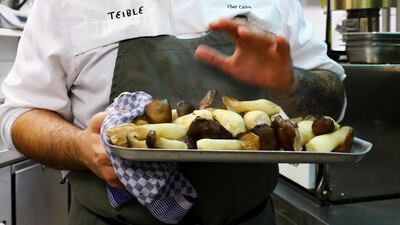
Not only does he cook sustainably, De Garza works closely with farmers as an advocate for sourcing ingredients locally and to make use crops that would otherwise go to waste.


!['We ferment and make our kombucha [pictured]. The liquid we use to make granita [semi-frozen dessert], the core we make into a powder, which we use for dessert. Basically everything, the zaatar and the blueberry, are used 100 per cent with the powder and granita," De Garza says.](https://www.thenationalnews.com/resizer/v2/PLUVQW4CE5XDQOIRTMBB6ZY4G4.jpg?smart=true&auth=359efe3fb60e53b4e5e3a4006b610bca89a66f95d84b93c36d56196838d27bbe&width=800&height=450)

“The planned hybrid greenhouse project is another critical step in this region’s efforts to safeguard our communities against threats to climate and food security,” Mr Kurtz said.
“We hope that this project pushes the boundaries of the agri-tech industry, so that we may provide the Singaporean people with the benefits that innovative controlled-environment agriculture solutions can bring.”
Singapore, which has a population of about 5.5 million, is a regional economic centre but lacks natural resources needed to produce food compared with its Asian neighbours.
More than 90 per cent of the country's food is imported from 180 countries and only 1 per cent of the country's land is set aside for agricultural use, SFA data shows.
The “30 by 30" initiative, which was launched in 2019, aims to boost Singapore's agri-food industry, helping it produce 30 per cent of the nation's nutritional needs locally and sustainably by 2030.
The project has also spurred the growth of local farms, which increased by about 18 per cent to 260 in 2021, from 221 in 2019, the SFA said.
The partnership between Pure Harvest and the SFA will also contribute to creating jobs in the AgTech sector, Mr Lim said.
“The partnership in key areas of R&D creates exciting potential career opportunities. This will support us in our push towards strengthening Singapore’s overall food security in a productive, climate-resilient and sustainable manner,” he said.
____________
Watch: the future of Middle East food security — Business Extra
The hybrid farm will use advanced controlled-environment production systems, which will allow year-round production, even in tropical equatorial climates, Pure Harvest said.
Learning how to operate in harsh climates — particularly in the Middle East, the countries of which also have robust food security programmes — has allowed Pure Harvest to share its expertise to other parts of the world, the company said.
“While the arid deserts of the Arab Gulf and the lush greenery of South-east Asia may seem a world apart, this region has no less a need for a sustainable means to provide consistent, high-quality, sustainably-farmed fresh produce all year round,” Mr Kurtz said.
In June, Pure Harvest raised $181 million in a new funding round as it aims to expand further into the GCC and Asia. That brought the AgTech company's total funding to $387.1m, making it among the most-funded start-ups in the region.

