The Al Damani Electric Vehicle Manufacturing Factory by M Glory will meet the rising demand for green mobility. Photo: M Glory

M Glory's electric vehicle manufacturing plant opens in Dubai


Ian Oxborrow
  • English
  • Arabic

A new Dh1.5 billion ($408 million) electric vehicle factory with the capacity to produce 10,000 cars a year has opened in Dubai.

The Al Damani Electric Vehicle Manufacturing Factory by M Glory, in Dubai Industrial City, covers 45,000 square feet.

It will house a temporary assembly line until a more comprehensive plant is completed, to be operational within two years. Once ready, it will have a production capacity of 55,000 electric cars per year, the company said in a statement on Wednesday.

"This historic milestone will provide another low-emission energy source and contribute to creating a more sustainable future for the UAE and the region," said Saud Abu Al Shawareb, executive vice president of Industrial Leasing at Tecom Group.

"By delivering cutting-edge, technologically supported solutions in line with Operation 300bn and driven by our partnership with the Ministry of Industry and Advanced Technology, the manufacturing sector can play a crucial role in supporting the national net zero strategy."

M Glory this year said its EVs will be exported to the wider GCC region, as well as Egypt, Tanzania, Senegal, Mali and Kenya.

It has already revealed its first electric car, the Al Damani DMV300. Two models have been built using European specifications, with a battery capacity of 52.7 kWh and the ability to cover more than 405km on a single charge.

The Al Damani DMV300 electric car from M Glory Group. Photo: M Glory

The UAE is expanding efforts to shift to greener technology, most notably under its Net Zero 2050 Strategic Initiative, which calls Dh600bn investment in clean and renewable energy sources in the next three decades.

The factory is "the first and only facility of its kind in the UAE to meet international specifications where we will manufacture environmentally friendly electric cars, contributing to global efforts to reduce carbon emissions and support sustainable development", said Majida Al Azazi, chairwoman of M Glory Holding Group.

Global sales of electric vehicles doubled last year to represent nearly 9 per cent of the car market, the International Energy Agency said.

In the first quarter of 2022, EV sales reached 2 million, a 75 per cent increase on the first quarter of 2021.

The UAE is among the world's top 10 countries as a market geared towards electric mobility, consultancy Arthur D Little said.

Under the UAE Vision 2021, the government has promoted EV adoption across the nation. It has converted 20 per cent of the government agency cars to EVs and is aiming for 42,000 on the streets by 2030.

About 52 per cent of UAE residents are considering a switch to hybrid or electric motoring as the increase in fuel prices this year affects the way consumers think about transport, a survey in May by Audi Abu Dhabi showed.

Tesla engineers hit Dubai desert for 'extreme heat and durability testing'

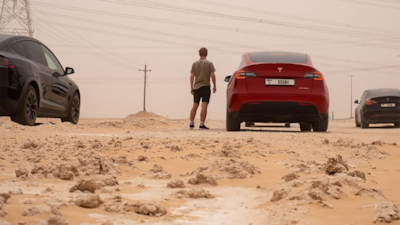
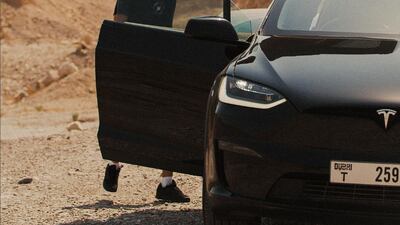
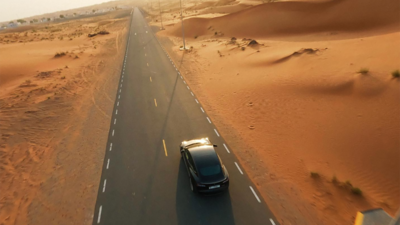
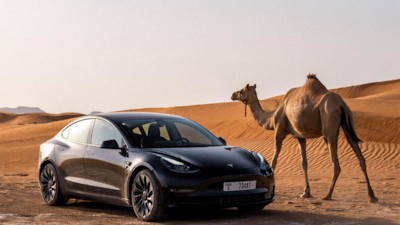
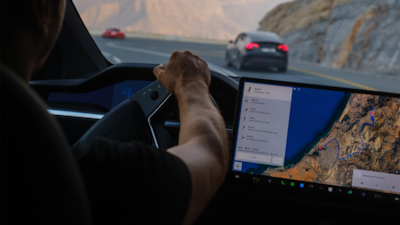
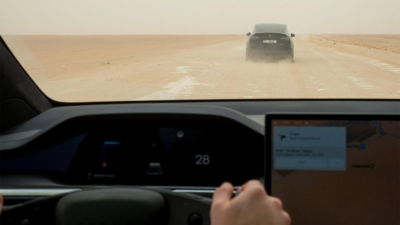
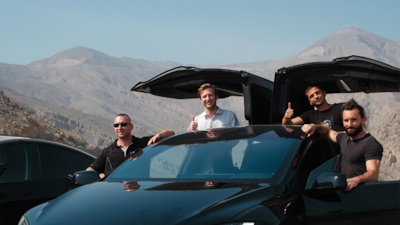
  • Tesla field quality engineers have been in Dubai at the hottest time of the year, analysing the electric cars for their durability and performance in extreme temperatures. All photos: Tesla
    Tesla field quality engineers have been in Dubai at the hottest time of the year, analysing the electric cars for their durability and performance in extreme temperatures. All photos: Tesla
  • Tesla posted about the tests on Instagram, saying the cars had experienced temperatures greater than 50°C.
    Tesla posted about the tests on Instagram, saying the cars had experienced temperatures greater than 50°C.
  • The line-up of cars tested includes the Model Y, the refreshed Model X and the Model 3.
    The line-up of cars tested includes the Model Y, the refreshed Model X and the Model 3.
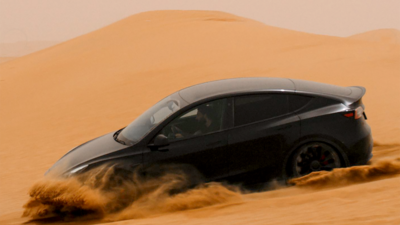
  • The engineers took on sand, mountain roads and gravel-strewn tracks.
    The engineers took on sand, mountain roads and gravel-strewn tracks.
  • Testing a car for durability requires it to be pushed to the limit.
    Testing a car for durability requires it to be pushed to the limit.
  • The company does its cold weather testing in Alaska, the US.
    The company does its cold weather testing in Alaska, the US.
  • The engineers may also have looked at the performance of the new heat pump, which was introduced into the Model Y last year.
    The engineers may also have looked at the performance of the new heat pump, which was introduced into the Model Y last year.
  • Hitting the dunes.
    Hitting the dunes.
  • Tesla field quality engineers will study the data to help improve the performance of the electric vehicles.
    Tesla field quality engineers will study the data to help improve the performance of the electric vehicles.
Tomb%20Raider%20I%E2%80%93III%20Remastered
%3Cp%3EDeveloper%3A%20Aspyr%0D%3Cbr%3EPublisher%3A%20Aspyr%0D%3Cbr%3EConsole%3A%20Nintendo%20Switch%2C%20PlayStation%204%26amp%3B5%2C%20PC%20and%20Xbox%20series%20X%2FS%0D%3Cbr%3ERating%3A%203%2F5%3C%2Fp%3E%0A

Mercer, the investment consulting arm of US services company Marsh & McLennan, expects its wealth division to at least double its assets under management (AUM) in the Middle East as wealth in the region continues to grow despite economic headwinds, a company official said.

Mercer Wealth, which globally has $160 billion in AUM, plans to boost its AUM in the region to $2-$3bn in the next 2-3 years from the present $1bn, said Yasir AbuShaban, a Dubai-based principal with Mercer Wealth.

Within the next two to three years, we are looking at reaching $2 to $3 billion as a conservative estimate and we do see an opportunity to do so,” said Mr AbuShaban.

Mercer does not directly make investments, but allocates clients’ money they have discretion to, to professional asset managers. They also provide advice to clients.

“We have buying power. We can negotiate on their (client’s) behalf with asset managers to provide them lower fees than they otherwise would have to get on their own,” he added.

Mercer Wealth’s clients include sovereign wealth funds, family offices, and insurance companies among others.

From its office in Dubai, Mercer also looks after Africa, India and Turkey, where they also see opportunity for growth.

Wealth creation in Middle East and Africa (MEA) grew 8.5 per cent to $8.1 trillion last year from $7.5tn in 2015, higher than last year’s global average of 6 per cent and the second-highest growth in a region after Asia-Pacific which grew 9.9 per cent, according to consultancy Boston Consulting Group (BCG). In the region, where wealth grew just 1.9 per cent in 2015 compared with 2014, a pickup in oil prices has helped in wealth generation.

BCG is forecasting MEA wealth will rise to $12tn by 2021, growing at an annual average of 8 per cent.

Drivers of wealth generation in the region will be split evenly between new wealth creation and growth of performance of existing assets, according to BCG.

Another general trend in the region is clients’ looking for a comprehensive approach to investing, according to Mr AbuShaban.

“Institutional investors or some of the families are seeing a slowdown in the available capital they have to invest and in that sense they are looking at optimizing the way they manage their portfolios and making sure they are not investing haphazardly and different parts of their investment are working together,” said Mr AbuShaban.

Some clients also have a higher appetite for risk, given the low interest-rate environment that does not provide enough yield for some institutional investors. These clients are keen to invest in illiquid assets, such as private equity and infrastructure.

“What we have seen is a desire for higher returns in what has been a low-return environment specifically in various fixed income or bonds,” he said.

“In this environment, we have seen a de facto increase in the risk that clients are taking in things like illiquid investments, private equity investments, infrastructure and private debt, those kind of investments were higher illiquidity results in incrementally higher returns.”

The Abu Dhabi Investment Authority, one of the largest sovereign wealth funds, said in its 2016 report that has gradually increased its exposure in direct private equity and private credit transactions, mainly in Asian markets and especially in China and India. The authority’s private equity department focused on structured equities owing to “their defensive characteristics.”

Most sought after workplace benefits in the UAE
  • Flexible work arrangements
  • Pension support
  • Mental well-being assistance
  • Insurance coverage for optical, dental, alternative medicine, cancer screening
  • Financial well-being incentives 
The alternatives

• Founded in 2014, Telr is a payment aggregator and gateway with an office in Silicon Oasis. It’s e-commerce entry plan costs Dh349 monthly (plus VAT). QR codes direct customers to an online payment page and merchants can generate payments through messaging apps.

• Business Bay’s Pallapay claims 40,000-plus active merchants who can invoice customers and receive payment by card. Fees range from 1.99 per cent plus Dh1 per transaction depending on payment method and location, such as online or via UAE mobile.

• Tap started in May 2013 in Kuwait, allowing Middle East businesses to bill, accept, receive and make payments online “easier, faster and smoother” via goSell and goCollect. It supports more than 10,000 merchants. Monthly fees range from US$65-100, plus card charges of 2.75-3.75 per cent and Dh1.2 per sale.

2checkout’s “all-in-one payment gateway and merchant account” accepts payments in 200-plus markets for 2.4-3.9 per cent, plus a Dh1.2-Dh1.8 currency conversion charge. The US provider processes online shop and mobile transactions and has 17,000-plus active digital commerce users.

• PayPal is probably the best-known online goods payment method - usually used for eBay purchases -  but can be used to receive funds, providing everyone’s signed up. Costs from 2.9 per cent plus Dh1.2 per transaction.

57%20Seconds
%3Cp%3E%3Cstrong%3EDirector%3A%3C%2Fstrong%3E%20Rusty%20Cundieff%0D%3Cbr%3E%3Cstrong%3EStars%3A%20%3C%2Fstrong%3EJosh%20Hutcherson%2C%20Morgan%20Freeman%2C%20Greg%20Germann%2C%20Lovie%20Simone%0D%3Cbr%3E%3Cstrong%3ERating%3A%20%3C%2Fstrong%3E2%2F5%0D%3Cbr%3E%0D%3Cbr%3E%3C%2Fp%3E%0A
Fight card

1. Bantamweight: Victor Nunes (BRA) v Siyovush Gulmamadov (TJK)

2. Featherweight: Hussein Salim (IRQ) v Shakhriyor Juraev (UZB)

3. Catchweight 80kg: Rashed Dawood (UAE) v Khamza Yamadaev (RUS)

4. Lightweight: Ho Taek-oh (KOR) v Ronald Girones (CUB)

5. Lightweight: Arthur Zaynukov (RUS) v Damien Lapilus (FRA)

6. Bantamweight: Vinicius de Oliveira (BRA) v Furkatbek Yokubov (RUS)

7. Featherweight: Movlid Khaybulaev (RUS) v Zaka Fatullazade (AZE)

8. Flyweight: Shannon Ross (TUR) v Donovon Freelow (USA)

9. Lightweight: Mohammad Yahya (UAE) v Dan Collins (GBR)

10. Catchweight 73kg: Islam Mamedov (RUS) v Martun Mezhulmyan (ARM)

11. Bantamweight World title: Jaures Dea (CAM) v Xavier Alaoui (MAR)

12. Flyweight World title: Manon Fiorot (FRA) v Gabriela Campo (ARG)

Living in...

This article is part of a guide on where to live in the UAE. Our reporters will profile some of the country’s most desirable districts, provide an estimate of rental prices and introduce you to some of the residents who call each area home.

Updated: October 05, 2022, 1:36 PM