

India needs to ramp up investment in green energy to achieve its ambitious renewable energy targets, as it is unlikely to meet these at the current pace of expansion, analysts say.
Last year, the Indian government said it was boosting its target to 500 gigawatts of non-fossil fuel capacity by 2030 to meet half of its energy demand through renewables.
Industry insiders say that India — the world’s third largest importer of crude oil — can hit that target, but several hurdles need to be addressed to attract more investment and allow the sector to reach its full potential.
This includes addressing challenges related to land acquisition and regulatory hurdles.
“As per the current market scenario and growth trend, India is likely to fall short of the 2030 target by over 104 gigawatts,” says Attaurrahman Ojindaram Saibasan, a power analyst at GlobalData, a data analytics and consulting company.
India will require $223 billion of investment in order to deliver on the solar and wind capacity installation for its 2030 target of 500 gigawatts of renewables capacity — up from 158 gigawatts at the end of 2021, according to a BloombergNEF report.
“To achieve this target, India needs to massively scale up funding for renewables,” says the report.
“The country now needs to scale up its financing activities by tapping into alternative sources of financing and by learning from international experiences to raise $223 billion in the next eight years.”
India is one of the largest renewable energy markets in the world and an attractive investment destination for green energy, but there are also a number of risks, according to BloombergNEF.
“Several issues, such as the financial crisis in India's state-owned distribution, payment delays by stakeholders and land acquisition, may hamper meeting the target,” says Utkarsh Singh, the chief executive of BatX Energies, an Indian lithium ion battery recycling company.
But “favourable government policies and the participation of domestic and international investors are encouraging and supporting India in achieving its renewable targets”, he says.
It is critical for India to boost its renewable energy production as its energy demands are expected to surge over the coming years, as the economy expands.
The country is set to overtake the EU as the third biggest consumer of all forms of energy globally by 2030, according to the International Energy Agency.
India also has some of the world's most polluted cities. As part of its global commitments to tackling climate change, prime minister Narendra Modi's government has pledged that the country will achieve net zero carbon emissions by 2070.
It is heavily dependent on coal — which is highly polluting — for most of its electricity generation.

The importance of accelerating India's transition to green energy has also come into sharper focus amid the current challenges being faced globally with rising energy prices and supply shocks.
“The demand for renewable power has become all the more urgent in light of the challenging geopolitical scenario, full of uncertainties and volatility in fuel prices,” says Jyoti Prakash Gadia, the managing director of Resurgent India, an investment bank.
“Our use of coal-based power generation can't be increased in a big way because of production and transport constraints, and therefore, boosting renewable power generation is the need of the hour.”
Despite the hurdles, experts note that India's progress so far in the green energy space has been commendable. The country was ranked as the most attractive emerging market for renewable energy investment in 2021 by BloombergNEF's index and ClimateScope assessment.
There are many government initiatives in place to support the sector, which are encouraging investment.
“Regulatory bodies in India have drafted attractive policies and schemes to boost the renewable energy sector,” says Mr Saibasan. “For instance, custom and excise duty benefits to the solar rooftop sector to propel growth.”
The government is also supporting wind power projects with various fiscal and promotional incentives, including excise duty exemptions to manufacturers and a tax holiday on income generated from wind power projects, as the country makes efforts to accelerate the development of green energy solutions, says Mr Saibasan.
Switching to renewables brings a host of benefits, including improving energy security and reducing costly fuel imports, says Shailendra Singh Rao, the founder of Creduce, a carbon credits trading and net zero advisory firm based in Ahmedabad in the western state of Gujarat.
India imports some 85 per cent of its crude oil requirement, which is weighing on the country's trade deficit.
But Mr Singh highlights several roadblocks to switching to green energy.
“The renewable energy industry lacks a coherent policy and regulatory structure,” he says. “Investments are at a higher risk as a result of the unique regulatory structures and practices that each state has.”
He says “the government does not make enough provisions for the renewable energy sector”, and that it needs to inject more funds and provide more incentives, such as tax breaks.
-
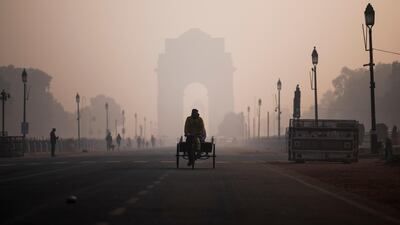
India's capital New Delhi experiences off-the-chart pollution levels in winter months, prompting calls for the economy to phase out fossil fuels. AFP -
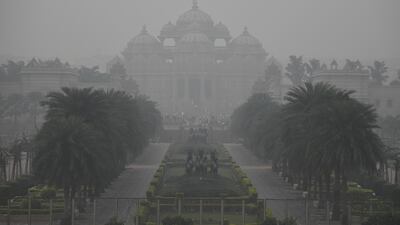
The Akshardham temple seen under heavy smog conditions in New Delhi during winter in 2019. The Indian capital was the most polluted city in the world for the second year in a row in 2019. AFP -

Traffic chokes a busy road in Amritsar in the country's Punjab state. Four Indian cities are among the top ten congested globally, according to TomTom Traffic Index 2019 .AFP -
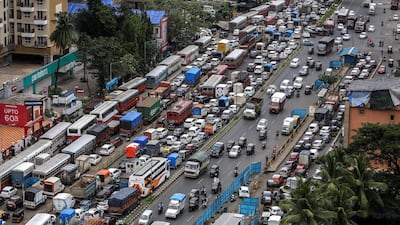
A general view of huge traffic jam on the Western Express Highway near Mumbai in June. The Indian commercial capital is the second most congested city in the country. EPA -
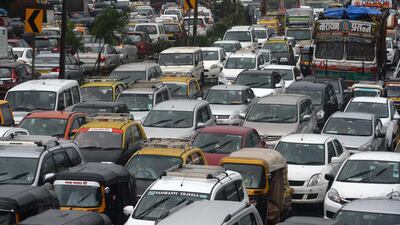
Heavy traffic is seen on a highway during heavy monsoon showers in Mumbai. India's most populous city surprisingly scores low on pollution rankings in the country, finishing 37th in a poll in 2018. AFP -

A visitor interacts with a representative next to a display of solar panels at a stall during "Inter Solar 2018", an international exhibition on solar technology and energy held in Bangalore. AFP -
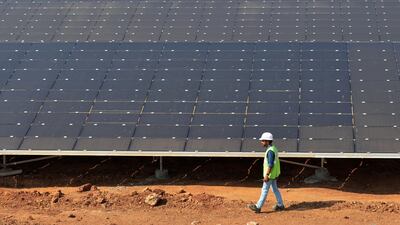
A worker conducts routine checks of solar panels at Shakti Sthala, the 2000MW solar power park in Pavagada Taluk, situated about 150 kms from the South Indian city of Bangalore. AFP -
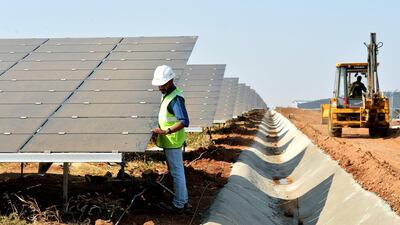
India, Asia's third-largest economy plans to add 100GW of solar capacity by 2022. AFP -

Commuters board the solar-powered DEMU (diesel electrical multiple unit) train at Sarai Rohilla railway station in New Delhi. AFP -
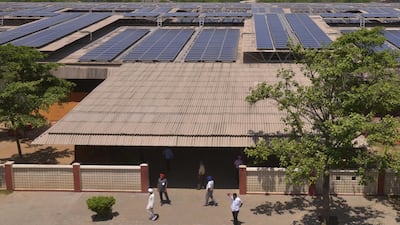
Rooftops covered in solar panels are seen at the Indian Solar Photovoltaic Power Plant, some 45kms from Amritsar. India generates just over a fifth of its power from renewables. AFP -

Kusumben Parmar works near recently installed solar panels, which help to pump water to irrigate her fields in the village of Dhundi, some 90kms from Ahmedabad in Gujarat state. AFP -
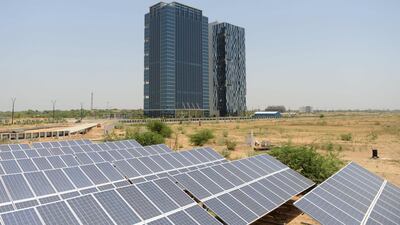
Buildings and solar panels, part of the Gujarat International Finance Tec-City are seen on the outskirts of Gandhinagar in Gujarat. India plans to derive 57% of electricity generation from renewables by 2027. AFP


“This sector is extremely capital intensive and has very long gestation periods to generate returns on capital deployed,” says Amit Jain, the co-founder at Ashika Global Family Office Services, based in the west coast city of Mumbai.
“This is the biggest pull back when it comes to private sector investment in this space.”
Finance into the renewables space in India has come from a variety of domestic and international sources. These include equity from Indian conglomerates, global investment funds, government companies, and multinational oil and gas firms, along with debt for projects from international and Indian banks, as well as development finance institutions.
But there is still much more to be done to boost funds flowing into the next phase of development, experts say.
“While large corporate houses are now showing interest in this sector, foreign funds need to be attracted with suitable incentives, particularly for investment in completed projects — through monetisation and fresh funds for large-sized projects,” says Mr Gadia.
“The customs duty on imported solar [equipment] has proved to be a deterrent for the setting up of new projects and needs to be reviewed.”
He remains confident, however, that these issues that can be ironed out and that India can achieve its 2030 green energy targets.
“Considering the overall growth rate already achieved in the last five years and the plans laid down … we are likely to achieve the target set for 2030,” says Mr Gadia. He adds that the Covid-19 pandemic has played a role in holding India back temporarily.
“We see great potential for new investment opportunities in the emerging field of battery storage, green hydrogen, and indigenous manufacturing of solar modules in the realm of renewable energy. All these activities will take us forward toward our desired goals in sustainable energy.”
In the near term, though, factors including rising interest rates, the depreciating rupee — which has hit a series of record lows — and high inflation, could hinder financing for the green energy sector, according to BloombergNEF.
“One of the key challenges which India faces is overcoming the hurdles in domestic manufacturing of essential components and equipment for developing a robust renewable energy ecosystem,” says Ashwini Kumar, a green hydrogen expert.
“India requires investments not only in expanding its renewable energy capacities but also in upgrading its grid infrastructure which would entail massive costs.”
These are all issues that need to addressed, but Mr Kumar remains optimistic that India will ultimately hit the green energy goals it is striving towards.

