

Three competing plans to curb companies from exaggerating their green credentials could lead to more frustration and costs for businesses, especially starting next year.
More than $3 trillion has flowed into investments specifically touting their environmental, social and governance (ESG) credentials reported under scores of voluntary disclosures, stoking regulatory concerns about greenwashing.
While investors and companies want a single set of mandatory disclosures to aid comparison between companies and keep down reporting costs, three draft sets of disclosure rules are currently out for public consultation from the EU, the US Securities and Exchange Commission and a new G20-backed International Sustainability Standards Board (ISSB).
Companies could apply them in annual reports for 2023 or shortly thereafter, but the speed of rule-making, differences between the standards and political aims to break new ground are raising concerns among those tasked with using them.
-

Engineers carry solar panels on to the roof of a property in Barcelona in September 2022. Spain and other Mediterranean countries have generated record amounts of power from wind and solar farms. Bloomberg -
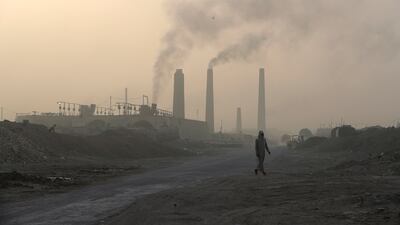
Smoke rises from brick factory stacks in Nahrawan, Baghdad. Tackling emissions from heavy industry is crucial to tackling global warming. Reuters -

A boy stands near a flock of sheep as a sandstorm approaches in the Syrian countryside of Tabqa. Syria is among the countries most vulnerable and poorly prepared for climate change, which is expected to worsen. AFP -

Mountains of smouldering rubbish at the Bhalswa landfill in New Delhi, India. Reuters -
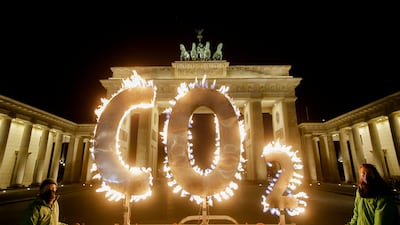
Greenpeace activists take part in a climate change protest in front of the Brandenburg Gate in Berlin in May. AP -
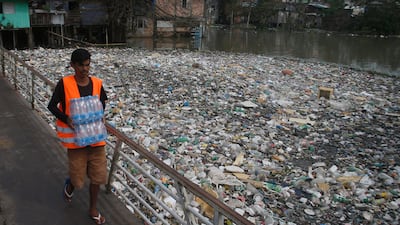
A man carries water bottles across the heavily polluted Negro River in Manaus, Brazil. About 35 tonnes of rubbish are removed daily from the river. AP -
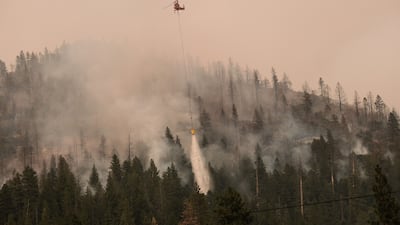
A helicopter drops water on a brush fire in California. Bloomberg -
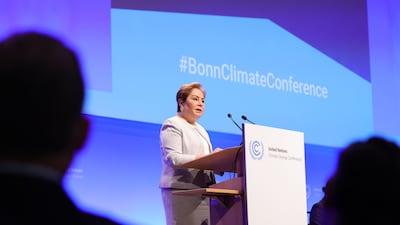
UN climate chief Patricia Espinosa speaks on the opening day of the Bonn climate change conference in Germany. Getty -
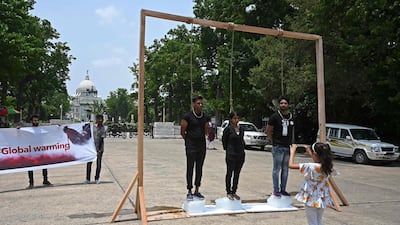
Activists take part in a demonstration to raise awareness of global warming, during an event to mark World Environment Day in Kolkata. AFP -

A helicopter drops water on a bushfire near a residential district in Athens. The fire forced residents to flee. AFP -
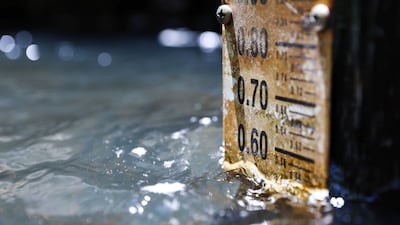
A gauge measures water levels in the Rio Nambe river, in New Mexico. Ninety per cent of the state is experiencing extreme drought. Getty -

Afghan refugees search for recyclable material from heaps of rubbish in Karachi, Pakistan. AP -
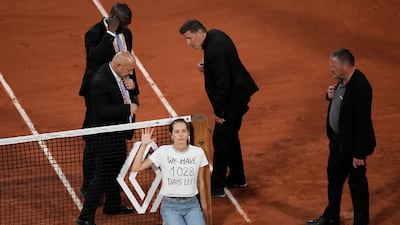
A climate activist ties herself to the net during the semi-final tennis match between Croatia's Marin Cilic and Norway's Casper Ruud at the French Open in Roland Garros in Paris. AP -
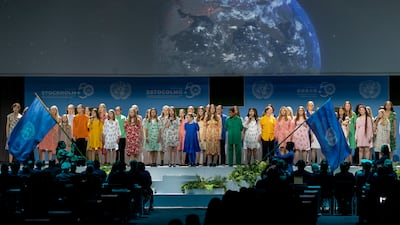
A dance group performs at a climate summit in Stockholm, Sweden. Getty -

US climate envoy John Kerry talks to a delegate at the Stockholm 50 climate summit. Getty -
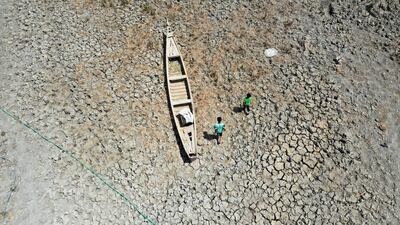
A boat is stranded during low tide at the Chebayesh marsh in Dhi Qar province, Iraq. Reuters -
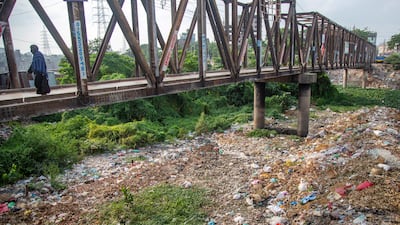
A woman crosses a polluted river in Dhaka, Bangladesh. EPA -
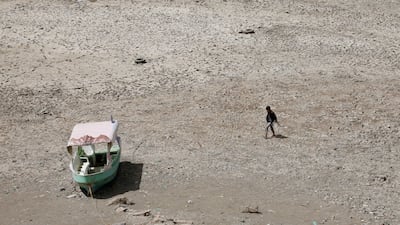
A man walks past an abandoned boat in the bed of a drought-affected reservoir on the outskirts of Sana'a, Yemen. EPA


The “We Mean Business” coalition of 7,000 global companies is calling on the regulators to converge their definitions, terminology and concepts before finalising the rules later this year, and not in the months and years after that.
“It is uncertainty over what will be the outcome of it, and we can see that, especially if companies are dual-listed in the United States and EU, they will have an issue,” said Jane Thostrup Jagd, deputy director for net zero finance at We Mean Business.
“We will end up in a situation which is potentially even worse than what we have financially,” she said, referring to failed attempts at deeper convergence between accounting rules in the US and those from a sister body of the ISSB.
As it stands, the EU rules are the most comprehensive, covering the full range of ESG risks to a company, as well as its impact on both the environment and society.
The ISSB aims to be a global “baseline”, focusing on risks to companies from climate issues, with some consideration of wider factors, while the SEC rules also look at climate risks to companies.
The lack of comparability between the three standards would weaken the ability of markets to direct capital to green investments, said Daniel Klier, chief executive of data company ESG Book, whose clients manage $120tn.
“If you believe in the capability of a financial market to take information as a signal to allocate capital effectively, getting inconsistent signals just weakens the system,” he said.
“The second problem is that you frustrate companies because if you are an international firm, you need to do slightly different disclosures in different jurisdictions, which goes against the entire notion of easing the reporting burden to allow more information into the public domain.”
Mark Spiers, partner at regulatory consultants Bovill, said the different speeds at which the three standards were being written creates challenges for international companies.
“There are so many jurisdictional specific regimes and trying to satisfy all of them will be a Herculean task,” Mr Spiers said.
“It means firms operating [in] many jurisdictions have to continually adjust their systems. And there is a big question as to whether they will start to converge to a common set of standards.”
The ISSB and EU say their officials and those from the SEC are talking regularly.
“The key point here is that we will not get perfect harmonisations,” Ashley Alder, chair of Iosco, the global forum for securities regulators such as the SEC and a driving force behind the ISSB, told a conference this month.
“Nevertheless, we should not have an outcome where you have three competing major standards. They need to be sufficiently interoperable,” Mr Alder said, adding that co-ordination should mean investors having meaningful comparisons between companies.
partner at regulatory consultants Bovill
ISSB chair Emmanuel Faber said the board had set up a working group to aid dialogue with China, the EU, Japan, Britain and the US on disclosures.
“Continued engagement by jurisdictions and market participants across the world will be critical,” Mr Faber said.
Saskia Slomp, chief executive of Efrag, the body drafting EU disclosures, said everyone was working towards a common goal.
“There is a willingness to co-operate and move all together ahead, but we have to realise that there are different speeds and different topics,” Ms Slomp told a conference last month.
“The ISSB has now published general principles and a climate change one. We have to do the whole scope, the environment, social, and governance. It is a much wider thing.”
The SEC has left the door open to recognising international disclosure standards, but the EU has only said it will review compatibility international norms after three years.
“These EU standards will build on and will be compatible with global standards,” EU financial services chief Mairead McGuinness said last month.
Marie-Laure Delarue, EY's global vice chair of assurance, said three standards were still an improvement on the scores of private sector sustainability frameworks unveiled in the past.
“I do believe that we have less confusion now than before, because before it was only the private sector, and it was voluntary,” she said.

