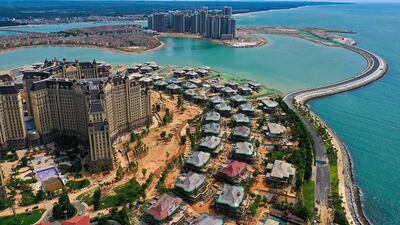
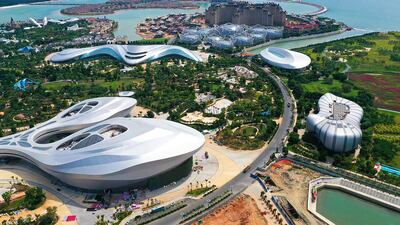
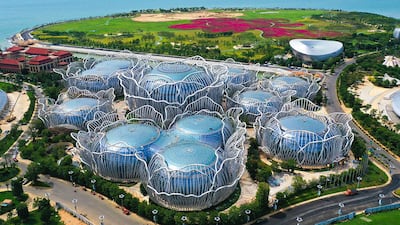
Evergrande, one of China's biggest developers, has been embroiled in a liquidity crisis as property sales dived in 2021. AFP

China's Evergrande fires senior executives after inquiry into property services unit


Alvin R Cabral
  • English
  • Arabic

China's Evergrande Group, the property developer at the centre of a $300 billion liquidity firestorm, announced that it has fired its senior executives in the aftermath of an internal investigation into why banks seized more than 13.4bn yuan ($2bn) from the company's property services arm.

The company forced out chief executive Xia Haijun and chief financial officer Pan Darong, who were both involved in the “deposits”, which were used as “security for third party pledge guarantees”, the company said in statements to the Hong Kong Stock Exchange, where its shares are listed.

Investigators had established that the money was taken because it was being used as a guarantee to allow a third party to obtain a loan, one statement said.

“Based on the preliminary findings of the independent investigation committee of the company, the loans secured by the pledges [after deduction of fees] were transferred and diverted back to the group via third parties and were used for the general operations of the group,” it said.

It further found that Mr Xia and Mr Pan “participated in the above arrangement. In view of this, the board resolved to request such persons to resign from their positions within the group”.

The pledges involved three sets of deposit certificate pledges, including a 2bn yuan deposit certificate pledge guarantee, an 8.7bn yuan deposit certificate pledge guarantee and a 2.7bn deposit certificate pledge guarantee, the statement said.

Evergrande appointed Siu Shawn as its chief executive, who will also remain in his current role as an executive director.

Qian Cheng, a current vice president, was named chief financial officer and executive director, while Liu Zhen, another vice president, was also appointed as an executive director.

Evergrande, one of China's biggest developers, has been embroiled in a liquidity crisis afree property sales dived in 2021, the first annual drop in at least a decade, as the builder slipped into default and buyer confidence faded.

The resignations come as Evergrande is fighting for survival and working to reach a restructuring agreement with debtors, to whom it owes an estimated $300bn.

Contracted sales dropped 39 per cent to 443bn yuan last year, according to Bloomberg calculations, making it the world’s most indebted developer and one whose sales have been believed to be almost frozen since October, when its liquidity woes intensified.

The company's troubles have had a domino effect throughout China's vast property sector, with some smaller firms also defaulting on loans and others struggling to gain enough funding.

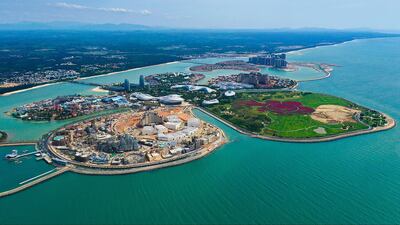
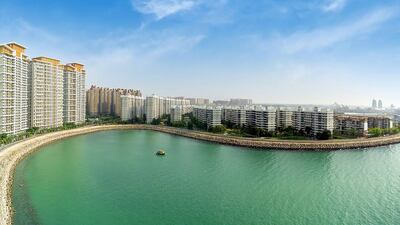
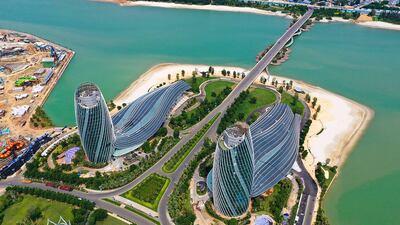
  • Ocean Flower Island, the artificial archipelago off the north coast of Danzhou in Hainan, China. All photos: Alamy
    Ocean Flower Island, the artificial archipelago off the north coast of Danzhou in Hainan, China. All photos: Alamy
  • The group of islands was built by the Evergrande Group.
    The group of islands was built by the Evergrande Group.
  • The artificial archipelago off the coast of Danzhou is made up of three islets with a total area of 381 hectares.
    The artificial archipelago off the coast of Danzhou is made up of three islets with a total area of 381 hectares.
  • A local politician, who was later convicted of corruption charges, approved the reclamation project despite it conflicting with environmental laws.
    A local politician, who was later convicted of corruption charges, approved the reclamation project despite it conflicting with environmental laws.
  • Building the archipelago damaged coral reefs and oyster populations.
    Building the archipelago damaged coral reefs and oyster populations.
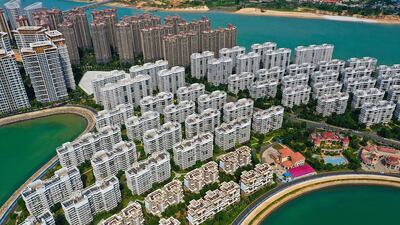
  • In December last year, about 40 buildings were demolished because they flouted planning regulations.
    In December last year, about 40 buildings were demolished because they flouted planning regulations.
  • Evergrande said the demolitions would not affect further development on the islands.
    Evergrande said the demolitions would not affect further development on the islands.
  • Evergrande shares climbed in January 4 trading after the company announcement that the demolitions would not stop progrees.
    Evergrande shares climbed in January 4 trading after the company announcement that the demolitions would not stop progrees.

China's real estate firms have long been heavily dependent on loans to finance their massive developments, but Beijing's push to rein in indebtedness has cut cash flows, leaving these companies in serious problems.

This month, Shimao Group Holdings missed payment on a $1bn bond, its first default on a public bond after months of mounting stress. Its delinquency is among the biggest dollar payment failures so far this year in China.

In a separate statement, Evergrande said there was “no disagreement” between Mr Zia and Mr Pan and its board of directors, and that there was no need to further escalate the matter to its shareholders.

In recent months, Evergrande has rushed to offload its assets, with its chairman Hui Ka Yan resorting to his personal wealth to pay off some of its debts.

Evergrande halted trading in its shares on January 3 after local media reported that the company has been ordered to tear down apartment blocks in a development in Hainan province. It resumed trading the following day.


The more serious side of specialty coffee

While the taste of beans and freshness of roast is paramount to the specialty coffee scene, so is sustainability and workers’ rights.

The bulk of genuine specialty coffee companies aim to improve on these elements in every stage of production via direct relationships with farmers. For instance, Mokha 1450 on Al Wasl Road strives to work predominantly with women-owned and -operated coffee organisations, including female farmers in the Sabree mountains of Yemen.

Because, as the boutique’s owner, Garfield Kerr, points out: “women represent over 90 per cent of the coffee value chain, but are woefully underrepresented in less than 10 per cent of ownership and management throughout the global coffee industry.”

One of the UAE’s largest suppliers of green (meaning not-yet-roasted) beans, Raw Coffee, is a founding member of the Partnership of Gender Equity, which aims to empower female coffee farmers and harvesters.

Also, globally, many companies have found the perfect way to recycle old coffee grounds: they create the perfect fertile soil in which to grow mushrooms. 

Real estate tokenisation project

Dubai launched the pilot phase of its real estate tokenisation project last month.

The initiative focuses on converting real estate assets into digital tokens recorded on blockchain technology and helps in streamlining the process of buying, selling and investing, the Dubai Land Department said.

Dubai’s real estate tokenisation market is projected to reach Dh60 billion ($16.33 billion) by 2033, representing 7 per cent of the emirate’s total property transactions, according to the DLD.

How much sugar is in chocolate Easter eggs?
  • The 169g Crunchie egg has 15.9g of sugar per 25g serving, working out at around 107g of sugar per egg
  • The 190g Maltesers Teasers egg contains 58g of sugar per 100g for the egg and 19.6g of sugar in each of the two Teasers bars that come with it
  • The 188g Smarties egg has 113g of sugar per egg and 22.8g in the tube of Smarties it contains
  • The Milky Bar white chocolate Egg Hunt Pack contains eight eggs at 7.7g of sugar per egg
  • The Cadbury Creme Egg contains 26g of sugar per 40g egg
COMPANY%20PROFILE
%3Cp%3E%3Cstrong%3ECompany%20name%3A%3C%2Fstrong%3E%20Revibe%20%0D%3Cbr%3E%3Cstrong%3EStarted%3A%3C%2Fstrong%3E%202022%0D%3Cbr%3E%3Cstrong%3EFounders%3A%3C%2Fstrong%3E%20Hamza%20Iraqui%20and%20Abdessamad%20Ben%20Zakour%20%0D%3Cbr%3E%3Cstrong%3EBased%3A%3C%2Fstrong%3E%20UAE%20%0D%3Cbr%3E%3Cstrong%3EIndustry%3A%3C%2Fstrong%3E%20Refurbished%20electronics%20%0D%3Cbr%3E%3Cstrong%3EFunds%20raised%20so%20far%3A%3C%2Fstrong%3E%20%2410m%20%0D%3Cbr%3E%3Cstrong%3EInvestors%3A%20%3C%2Fstrong%3EFlat6Labs%2C%20Resonance%20and%20various%20others%0D%3C%2Fp%3E%0A

Mercer, the investment consulting arm of US services company Marsh & McLennan, expects its wealth division to at least double its assets under management (AUM) in the Middle East as wealth in the region continues to grow despite economic headwinds, a company official said.

Mercer Wealth, which globally has $160 billion in AUM, plans to boost its AUM in the region to $2-$3bn in the next 2-3 years from the present $1bn, said Yasir AbuShaban, a Dubai-based principal with Mercer Wealth.

Within the next two to three years, we are looking at reaching $2 to $3 billion as a conservative estimate and we do see an opportunity to do so,” said Mr AbuShaban.

Mercer does not directly make investments, but allocates clients’ money they have discretion to, to professional asset managers. They also provide advice to clients.

“We have buying power. We can negotiate on their (client’s) behalf with asset managers to provide them lower fees than they otherwise would have to get on their own,” he added.

Mercer Wealth’s clients include sovereign wealth funds, family offices, and insurance companies among others.

From its office in Dubai, Mercer also looks after Africa, India and Turkey, where they also see opportunity for growth.

Wealth creation in Middle East and Africa (MEA) grew 8.5 per cent to $8.1 trillion last year from $7.5tn in 2015, higher than last year’s global average of 6 per cent and the second-highest growth in a region after Asia-Pacific which grew 9.9 per cent, according to consultancy Boston Consulting Group (BCG). In the region, where wealth grew just 1.9 per cent in 2015 compared with 2014, a pickup in oil prices has helped in wealth generation.

BCG is forecasting MEA wealth will rise to $12tn by 2021, growing at an annual average of 8 per cent.

Drivers of wealth generation in the region will be split evenly between new wealth creation and growth of performance of existing assets, according to BCG.

Another general trend in the region is clients’ looking for a comprehensive approach to investing, according to Mr AbuShaban.

“Institutional investors or some of the families are seeing a slowdown in the available capital they have to invest and in that sense they are looking at optimizing the way they manage their portfolios and making sure they are not investing haphazardly and different parts of their investment are working together,” said Mr AbuShaban.

Some clients also have a higher appetite for risk, given the low interest-rate environment that does not provide enough yield for some institutional investors. These clients are keen to invest in illiquid assets, such as private equity and infrastructure.

“What we have seen is a desire for higher returns in what has been a low-return environment specifically in various fixed income or bonds,” he said.

“In this environment, we have seen a de facto increase in the risk that clients are taking in things like illiquid investments, private equity investments, infrastructure and private debt, those kind of investments were higher illiquidity results in incrementally higher returns.”

The Abu Dhabi Investment Authority, one of the largest sovereign wealth funds, said in its 2016 report that has gradually increased its exposure in direct private equity and private credit transactions, mainly in Asian markets and especially in China and India. The authority’s private equity department focused on structured equities owing to “their defensive characteristics.”

Tell Me Who I Am

Director: Ed Perkins

Stars: Alex and Marcus Lewis

Four stars

Stage results

1. Julian Alaphilippe (FRA) Deceuninck-QuickStep  4:39:05

2. Michael Matthews (AUS) Team BikeExchange 0:00:08

3. Primoz Roglic (SLV) Jumbo-Visma same time 

4. Jack Haig (AUS) Bahrain Victorious s.t  

5. Wilco Kelderman (NED) Bora-Hansgrohe s.t  

6. Tadej Pogacar (SLV) UAE Team Emirates s.t 

7. David Gaudu (FRA) Groupama-FDJ s.t

8. Sergio Higuita Garcia (COL) EF Education-Nippo s.t     

9. Bauke Mollema (NED) Trek-Segafredo  s.t

10. Geraint Thomas (GBR) Ineos Grenadiers s.t

Results
%3Cp%3E%0D%3Cstrong%3EElite%20men%3C%2Fstrong%3E%0D%3Cbr%3E1.%20Amare%20Hailemichael%20Samson%20(ERI)%202%3A07%3A10%0D%3Cbr%3E2.%20Leornard%20Barsoton%20(KEN)%202%3A09%3A37%0D%3Cbr%3E3.%20Ilham%20Ozbilan%20(TUR)%202%3A10%3A16%0D%3Cbr%3E4.%20Gideon%20Chepkonga%20(KEN)%202%3A11%3A17%0D%3Cbr%3E5.%20Isaac%20Timoi%20(KEN)%202%3A11%3A34%0D%3Cbr%3E%3Cstrong%3EElite%20women%3C%2Fstrong%3E%0D%3Cbr%3E1.%20Brigid%20Kosgei%20(KEN)%202%3A19%3A15%0D%3Cbr%3E2.%20Hawi%20Feysa%20Gejia%20(ETH)%202%3A24%3A03%0D%3Cbr%3E3.%20Sintayehu%20Dessi%20(ETH)%202%3A25%3A36%0D%3Cbr%3E4.%20Aurelia%20Kiptui%20(KEN)%202%3A28%3A59%0D%3Cbr%3E5.%20Emily%20Kipchumba%20(KEN)%202%3A29%3A52%3C%2Fp%3E%0A
Updated: July 23, 2022, 12:30 PM