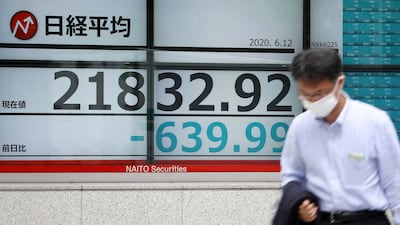
A man walks past a stock market indicator board in Tokyo, Japan. Experts say entire stock markets can be swayed by emotional extremes. EPA

Why investors need to keep their emotions under control in this volatile market


  • English
  • Arabic

What is the single biggest threat facing investors right now? Forget volatile stock markets, crashing economies, social unrest, trade wars or even Covid-19, and take a look in the mirror instead.

The greatest obstacle standing in the way of building long-term investment wealth for your retirement is you. The human brain is poorly adapted to investing, as it is apt to make emotional decisions, rather than rational ones.

Fear is a major threat to your wealth. It can take over during a stock market crash, persuading you to sell shares at the bottom of the market. Investors who panicked and sold during the March collapse lost out as share prices recovered almost as quickly.

Primal responses can overwhelm rational thinking, making markets prone to bubbles and runaway crashes.

Greed can be just as dangerous. It can trick you into gambling on high-risk investments such as Bitcoin in the hope of getting wealthy overnight, or lure you into get-rich-quick schemes designed to swallow your money.

Fabian Chui, global head of front office and risk at Abu Dhabi-based financial services firm ADSS, says entire stock markets can be swayed by emotional extremes. "Primal responses can overwhelm rational thinking, making markets prone to bubbles and runaway crashes," he says.

Exuberance, overconfidence and greed combine to fuel asset bubbles, while fear creates self-fulfilling crashes, Mr Chui says. “In both cases, investors lose all objectivity. The ability to determine the fair value of an asset gives way to emotions,” he adds.

Justin Waring, investment strategist at UBS Global Wealth Management, says despite thousands of years of evolution, humans still haven't outgrown our "fight or flight" response, and overreact to short-term market threats and opportunities. “As a result, investors buy high and sell low, sometimes with disastrous consequences,” he says.

Professor Stephen Thomas, associate dean, MBA Programmes at Cass Business School in Dubai and London, says a study by investor behaviour specialists Dalbar found that between 1986 and 2015, the US S&P 500 produced an average annual return of 10.35 per cent, but the average investor generated just 3.66 per cent a year.

He blames the discrepancy on investors making emotionally driven decisions in volatile markets. “At the height of the financial crisis in October 2008, the S&P500 dropped 16.8 per cent but the average investor lost more than 24 per cent as they panicked and bailed out, missing the recovery towards the end of the month,” he says.

Private investors respond the same way every time markets crash, Mr Thomas says. “They are prone to selling too late, in other words after share prices have crashed, then buying too late, after the recovery. Ultimately it culminates in yet another very human emotion. Regret.”

Demos Kyprianou, a board member of SimplyFI, a non-profit community of personal finance and investing enthusiasts in Dubai, says pride and overconfidence are also deadly: “Too many investors think they are cleverer than other people, and have the skills to beat the market. In the vast majority of cases, they are kidding themselves.”

Overconfident investors typically trade too often, buying and selling shares in a bid to beat the market, when history shows that almost nobody can reliably do that for long periods. In 2019, more than 70 per cent of large-cap fund managers underperformed the S&P 500. The longer they invest, the worse they perform, according to the Spiva scorecard, which measures actively managed funds against their relevant index benchmarks worldwide. Measured over five years, 80 per cent underperformed, the scorecard found. So, if the experts cannot reliably beat the market, then what chance do you have?

You also have to overcome your own apathy and fear of the unknown, which deters many from investing until it is too late to accumulate the wealth they need to retire in comfort, Mr Kyprianou says. “Too many people think it is too difficult, when in fact it is surprisingly simple, provided you keep your emotions out of it.”

So how do you master your emotions? Mr Kyprianou recommends investing in passive exchange traded funds (ETFs) that simply track the performance of global stock markets.

That way you are not trying to beat the market, which means your ego is not on the line.

He says you can build a diversified range of shares through a one-stop global equity ETF such as the Vanguard FTSE All-World UCITS ETF (VWRL). “You will never beat the market but you will never underperform, either, while keeping fees and other trading charges to a minimum, so you keep more of the growth for yourself,” he says.

Mr Kyprianou suggests balancing it with a bond ETF, to reduce the overall volatility of your portfolio when share prices crash. A popular option is the iShares Global Govt Bond UCITS ETF (IGLA), which invests in government bonds from G7 countries Canada, France, Germany, Italy, Japan, UK and the US.

Mr Chui says o avoid becoming prey to your own emotions you need to set clear investment objectives from the outset, then remember them when markets go haywire. "Ask whether you are buying a dip because of fear of missing out, or because you really see value from oversold conditions,” Mr Chui says.

Holding a diversified spread of investments can also help, by limiting your losses in a crash. If you invest purely in shares, your portfolio will be more volatile than if you balance this out with other asset classes such as bonds, gold, property and cash.

Taking a long-term view can also help soothe your emotions. If you are investing over 30 or 40 years, as you should be, then a short-term crash is nothing to panic about.

In fact, it is an opportunity to buy shares at a reduced price with the aim of holding for the long term, as markets always recover if you can stay calm and give them enough time.

Mr Waring says another way to keep your emotions in check is to "quarantine" your decisions, by thinking them over for a week or two as "this can help you filter out decisions driven by emotions".

Automating your portfolio can also help, he says. “Commit to an asset allocation strategy, say, investing 60 per cent in stocks and 40 per cent in bonds, with an automatic rebalancing system to keep your portfolio in line with this strategy,” Mr Waring says.

So if shares rise, you take your profits and buy bonds, or vice versa. This has the further advantage of selling high and buying low.

Mr Waring says beware of another dangerous emotion – loss aversion – because "people feel the pain of losses about twice as powerfully, as they feel the pleasure from making gains".

As we saw in March, most losses happen over short periods, and you need to hold your nerve to give them time to recover. To help you stand firm, Mr Waring recommends setting aside a pool of safer investments to meet everyday spending, so you do not have to sell shares during a short-term crash. "As we have seen this year, being forced to sell risk assets in a dip means you can miss out on powerful gains when markets recover,” he adds.

You will never be able to completely curb your emotions, but the more you can control them, the wealthier you should ultimately become. If you can do that, your overriding emotion should be happiness.


Command%20Z
%3Cp%3E%3Cstrong%3EDirector%3A%C2%A0%3C%2Fstrong%3ESteven%20Soderbergh%3C%2Fp%3E%0A%3Cp%3E%3Cstrong%3EStars%3A%C2%A0%3C%2Fstrong%3EMichael%20Cera%2C%20Liev%20Schreiber%2C%20Chloe%20Radcliffe%3C%2Fp%3E%0A%3Cp%3E%3Cstrong%3ERating%3A%3C%2Fstrong%3E%C2%A03%2F5%3C%2Fp%3E%0A
Milestones on the road to union

1970

October 26: Bahrain withdraws from a proposal to create a federation of nine with the seven Trucial States and Qatar. 

December: Ahmed Al Suwaidi visits New York to discuss potential UN membership.

1971

March 1:  Alex Douglas Hume, Conservative foreign secretary confirms that Britain will leave the Gulf and “strongly supports” the creation of a Union of Arab Emirates.

July 12: Historic meeting at which Sheikh Zayed and Sheikh Rashid make a binding agreement to create what will become the UAE.

July 18: It is announced that the UAE will be formed from six emirates, with a proposed constitution signed. RAK is not yet part of the agreement.

August 6:  The fifth anniversary of Sheikh Zayed becoming Ruler of Abu Dhabi, with official celebrations deferred until later in the year.

August 15: Bahrain becomes independent.

September 3: Qatar becomes independent.

November 23-25: Meeting with Sheikh Zayed and Sheikh Rashid and senior British officials to fix December 2 as date of creation of the UAE.

November 29:  At 5.30pm Iranian forces seize the Greater and Lesser Tunbs by force.

November 30: Despite  a power sharing agreement, Tehran takes full control of Abu Musa. 

November 31: UK officials visit all six participating Emirates to formally end the Trucial States treaties

December 2: 11am, Dubai. New Supreme Council formally elects Sheikh Zayed as President. Treaty of Friendship signed with the UK. 11.30am. Flag raising ceremony at Union House and Al Manhal Palace in Abu Dhabi witnessed by Sheikh Khalifa, then Crown Prince of Abu Dhabi.

December 6: Arab League formally admits the UAE. The first British Ambassador presents his credentials to Sheikh Zayed.

December 9: UAE joins the United Nations.

WHAT%20ARE%20THE%20PRODUCTS%20WITHIN%20THE%20THREE%20MAJOR%20CATEGORIES%3F
%3Cp%3E%3Cstrong%3EAdvanced%20materials%3A%3C%2Fstrong%3E%20specifically%20engineered%20to%20exhibit%20novel%20or%20enhanced%20properties%2C%20that%20confer%20superior%20performance%20relative%20to%20conventional%20materials%3C%2Fp%3E%0A%3Cp%3E%3Cstrong%3EAdvanced%20components%3A%3C%2Fstrong%3E%20includes%20semiconductor%20components%2C%20such%20as%20microprocessors%20and%20other%20computer%20chips%2C%20and%20computer%20vision%20components%20such%20as%20lenses%20and%20image%20sensors%3C%2Fp%3E%0A%3Cp%3E%3Cstrong%3EAdvanced%20products%3A%3C%2Fstrong%3E%20includes%20personal%20electronics%2C%20smart%20home%20devices%20and%20space%20technologies%2C%20along%20with%20industry-enabling%20products%20such%20as%20robots%2C%203D%20printing%20equipment%20and%20exoskeletons%3C%2Fp%3E%0A%3Cp%3E%3Cem%3ESource%3A%20Strategy%26amp%3B%3C%2Fem%3E%3C%2Fp%3E%0A
SECRET%20INVASION
%3Cp%3E%3Cstrong%3EDirector%3A%3C%2Fstrong%3E%20Ali%20Selim%20%3Cbr%3E%3Cstrong%3EStars%3A%3C%2Fstrong%3E%20Samuel%20L%20Jackson%2C%20Olivia%20Coleman%2C%20Kingsley%20Ben-Adir%2C%20Emilia%20Clarke%20%3Cbr%3E%3Cstrong%3ERating%3A%3C%2Fstrong%3E%203%2F5%26nbsp%3B%3C%2Fp%3E%0A
The specs

Engine: 2.0-litre 4-cylturbo

Transmission: seven-speed DSG automatic

Power: 242bhp

Torque: 370Nm

Price: Dh136,814

Mercer, the investment consulting arm of US services company Marsh & McLennan, expects its wealth division to at least double its assets under management (AUM) in the Middle East as wealth in the region continues to grow despite economic headwinds, a company official said.

Mercer Wealth, which globally has $160 billion in AUM, plans to boost its AUM in the region to $2-$3bn in the next 2-3 years from the present $1bn, said Yasir AbuShaban, a Dubai-based principal with Mercer Wealth.

Within the next two to three years, we are looking at reaching $2 to $3 billion as a conservative estimate and we do see an opportunity to do so,” said Mr AbuShaban.

Mercer does not directly make investments, but allocates clients’ money they have discretion to, to professional asset managers. They also provide advice to clients.

“We have buying power. We can negotiate on their (client’s) behalf with asset managers to provide them lower fees than they otherwise would have to get on their own,” he added.

Mercer Wealth’s clients include sovereign wealth funds, family offices, and insurance companies among others.

From its office in Dubai, Mercer also looks after Africa, India and Turkey, where they also see opportunity for growth.

Wealth creation in Middle East and Africa (MEA) grew 8.5 per cent to $8.1 trillion last year from $7.5tn in 2015, higher than last year’s global average of 6 per cent and the second-highest growth in a region after Asia-Pacific which grew 9.9 per cent, according to consultancy Boston Consulting Group (BCG). In the region, where wealth grew just 1.9 per cent in 2015 compared with 2014, a pickup in oil prices has helped in wealth generation.

BCG is forecasting MEA wealth will rise to $12tn by 2021, growing at an annual average of 8 per cent.

Drivers of wealth generation in the region will be split evenly between new wealth creation and growth of performance of existing assets, according to BCG.

Another general trend in the region is clients’ looking for a comprehensive approach to investing, according to Mr AbuShaban.

“Institutional investors or some of the families are seeing a slowdown in the available capital they have to invest and in that sense they are looking at optimizing the way they manage their portfolios and making sure they are not investing haphazardly and different parts of their investment are working together,” said Mr AbuShaban.

Some clients also have a higher appetite for risk, given the low interest-rate environment that does not provide enough yield for some institutional investors. These clients are keen to invest in illiquid assets, such as private equity and infrastructure.

“What we have seen is a desire for higher returns in what has been a low-return environment specifically in various fixed income or bonds,” he said.

“In this environment, we have seen a de facto increase in the risk that clients are taking in things like illiquid investments, private equity investments, infrastructure and private debt, those kind of investments were higher illiquidity results in incrementally higher returns.”

The Abu Dhabi Investment Authority, one of the largest sovereign wealth funds, said in its 2016 report that has gradually increased its exposure in direct private equity and private credit transactions, mainly in Asian markets and especially in China and India. The authority’s private equity department focused on structured equities owing to “their defensive characteristics.”

Wallabies

Updated team: 15-Israel Folau, 14-Dane Haylett-Petty, 13-Reece Hodge, 12-Matt Toomua, 11-Marika Koroibete, 10-Kurtley Beale, 9-Will Genia, 8-Pete Samu, 7-Michael Hooper (captain), 6-Lukhan Tui, 5-Adam Coleman, 4-Rory Arnold, 3-Allan Alaalatoa, 2-Tatafu Polota-Nau, 1-Scott Sio.

Replacements: 16-Folau Faingaa, 17-Tom Robertson, 18-Taniela Tupou, 19-Izack Rodda, 20-Ned Hanigan, 21-Joe Powell, 22-Bernard Foley, 23-Jack Maddocks.

RESULTS
%3Cp%3E%0D5pm%3A%20Al%20Bateen%20%E2%80%93%20Maiden%20(PA)%20Dh80%2C000%20(Turf)%202%2C200m%0D%3Cbr%3EWinner%3A%20Ma%E2%80%99Aly%20Al%20Shahania%2C%20Bernardo%20Pinheiro%20(jockey)%2C%20Mohamed%20Daggash%20(trainer)%0D%3Cbr%3E5.30pm%3A%20Al%20Khaleej%20%E2%80%93%20Maiden%20(PA)%20Dh80%2C000%20(T)%201%2C400m%0D%3Cbr%3EWinner%3A%20AF%20Rami%2C%20Tadhg%20O%E2%80%99Shea%2C%20Ernst%20Oertel%0D%3Cbr%3E6pm%3A%20Wathba%20Stallions%20Cup%20%E2%80%93%20Handicap%20(PA)%20Dh70%2C000%20(T)%201%2C400m%0D%3Cbr%3EWinner%3A%20Bant%20Al%20Emarat%2C%20Bernardo%20Pinheiro%2C%20Qaiss%20Aboud%0D%3Cbr%3E6.30pm%3A%20Al%20Nahyan%20%E2%80%93%20Handicap%20(PA)%20Dh80%2C000%20(T)%201%2C600m%0D%3Cbr%3EWinner%3A%20AF%20Rasam%2C%20Marcelino%20Rodrigues%2C%20Ernst%20Oertel%0D%3Cbr%3E7pm%3A%20Al%20Karamah%20%E2%80%93%20Handicap%20(PA)%20Dh80%2C000%20(T)%201%2C600m%0D%3Cbr%3EWinner%3A%20Zafaranah%2C%20Bernardo%20Pinheiro%2C%20Musabah%20Al%20Muhairi%0D%3Cbr%3E7.30pm%3A%20Al%20Salam%20%E2%80%93%20Handicap%20(TB)%20Dh80%2C000%20(T)%201%2C400m%0D%3Cbr%3EWinner%3A%20Nibras%20Passion%2C%20Tadhg%20O%E2%80%99Shea%2C%20Ismail%20Mohammed%3C%2Fp%3E%0A
Key products and UAE prices

iPhone XS
With a 5.8-inch screen, it will be an advance version of the iPhone X. It will be dual sim and comes with better battery life, a faster processor and better camera. A new gold colour will be available.
Price: Dh4,229

iPhone XS Max
It is expected to be a grander version of the iPhone X with a 6.5-inch screen; an inch bigger than the screen of the iPhone 8 Plus.
Price: Dh4,649

iPhone XR
A low-cost version of the iPhone X with a 6.1-inch screen, it is expected to attract mass attention. According to industry experts, it is likely to have aluminium edges instead of stainless steel.
Price: Dh3,179

Apple Watch Series 4
More comprehensive health device with edge-to-edge displays that are more than 30 per cent bigger than displays on current models.

Gender pay parity on track in the UAE

The UAE has a good record on gender pay parity, according to Mercer's Total Remuneration Study.

"In some of the lower levels of jobs women tend to be paid more than men, primarily because men are employed in blue collar jobs and women tend to be employed in white collar jobs which pay better," said Ted Raffoul, career products leader, Mena at Mercer. "I am yet to see a company in the UAE – particularly when you are looking at a blue chip multinationals or some of the bigger local companies – that actively discriminates when it comes to gender on pay."

Mr Raffoul said most gender issues are actually due to the cultural class, as the population is dominated by Asian and Arab cultures where men are generally expected to work and earn whereas women are meant to start a family.

"For that reason, we see a different gender gap. There are less women in senior roles because women tend to focus less on this but that’s not due to any companies having a policy penalising women for any reasons – it’s a cultural thing," he said.

As a result, Mr Raffoul said many companies in the UAE are coming up with benefit package programmes to help working mothers and the career development of women in general. 

SUZUME
%3Cp%3EDirector%3A%20Makoto%20Shinkai%3C%2Fp%3E%0A%3Cp%3EStars%3A%20Nanoka%20Hara%2C%20Hokuto%20Matsumura%2C%20Eri%20Fukatsu%3C%2Fp%3E%0A%3Cp%3ERating%3A%204%2F5%3C%2Fp%3E%0A
ALRAWABI%20SCHOOL%20FOR%20GIRLS
%3Cp%3ECreator%3A%20Tima%20Shomali%3C%2Fp%3E%0A%3Cp%3EStarring%3A%C2%A0Tara%20Abboud%2C%C2%A0Kira%20Yaghnam%2C%20Tara%20Atalla%3C%2Fp%3E%0A%3Cp%3ERating%3A%204%2F5%3C%2Fp%3E%0A
While you're here
Who has lived at The Bishops Avenue?
  • George Sainsbury of the supermarket dynasty, sugar magnate William Park Lyle and actress Dame Gracie Fields were residents in the 1930s when the street was only known as ‘Millionaires’ Row’.
  • Then came the international super rich, including the last king of Greece, Constantine II, the Sultan of Brunei and Indian steel magnate Lakshmi Mittal who was at one point ranked the third richest person in the world.
  • Turkish tycoon Halis Torprak sold his mansion for £50m in 2008 after spending just two days there. The House of Saud sold 10 properties on the road in 2013 for almost £80m.
  • Other residents have included Iraqi businessman Nemir Kirdar, singer Ariana Grande, holiday camp impresario Sir Billy Butlin, businessman Asil Nadir, Paul McCartney’s former wife Heather Mills. 
Hunting park to luxury living
  • Land was originally the Bishop of London's hunting park, hence the name
  • The road was laid out in the mid 19th Century, meandering through woodland and farmland
  • Its earliest houses at the turn of the 20th Century were substantial detached properties with extensive grounds


Dunki
%3Cp%3E%3Cstrong%3EDirector%3A%3C%2Fstrong%3E%20Rajkumar%20Hirani%C2%A0%3C%2Fp%3E%0A%3Cp%3E%3Cstrong%3EStarring%3A%3C%2Fstrong%3E%20Shah%20Rukh%20Khan%2C%20Taapsee%20Pannu%2C%20Vikram%20Kochhar%20and%20Anil%20Grover%3C%2Fp%3E%0A%3Cp%3E%3Cstrong%3ERating%3A%3C%2Fstrong%3E%204%2F5%3C%2Fp%3E%0A
The Indoor Cricket World Cup

When: September 16-23

Where: Insportz, Dubai

Indoor cricket World Cup:
Insportz, Dubai, September 16-23

UAE fixtures:
Men

Saturday, September 16 – 1.45pm, v New Zealand
Sunday, September 17 – 10.30am, v Australia; 3.45pm, v South Africa
Monday, September 18 – 2pm, v England; 7.15pm, v India
Tuesday, September 19 – 12.15pm, v Singapore; 5.30pm, v Sri Lanka
Thursday, September 21 – 2pm v Malaysia
Friday, September 22 – 3.30pm, semi-final
Saturday, September 23 – 3pm, grand final

Women
Saturday, September 16 – 5.15pm, v Australia
Sunday, September 17 – 2pm, v South Africa; 7.15pm, v New Zealand
Monday, September 18 – 5.30pm, v England
Tuesday, September 19 – 10.30am, v New Zealand; 3.45pm, v South Africa
Thursday, September 21 – 12.15pm, v Australia
Friday, September 22 – 1.30pm, semi-final
Saturday, September 23 – 1pm, grand final

Profile Box

Company/date started: 2015

Founder/CEO: Mohammed Toraif

Based: Manama, Bahrain

Sector: Sales, Technology, Conservation

Size: (employees/revenue) 4/ 5,000 downloads

Stage: 1 ($100,000)

Investors: Two first-round investors including, 500 Startups, Fawaz Al Gosaibi Holding (Saudi Arabia)