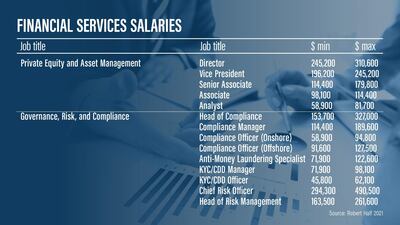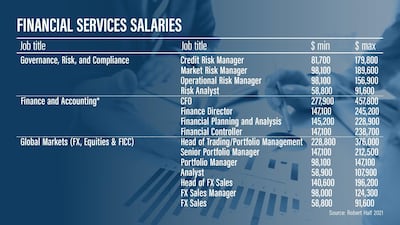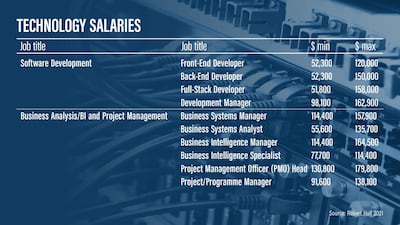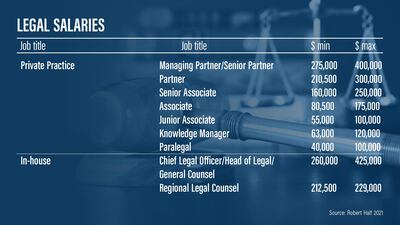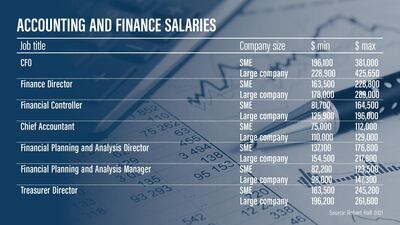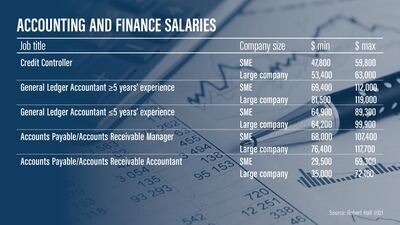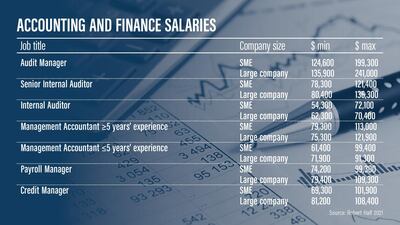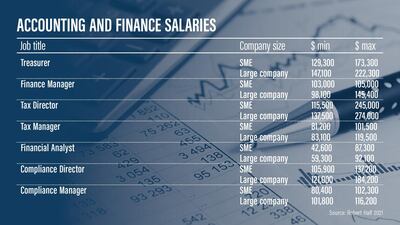
Salaries in the UAE will remain stable in 2021 and are expected to withstand the economic challenges caused by the Covid-19 pandemic, according to a new report.
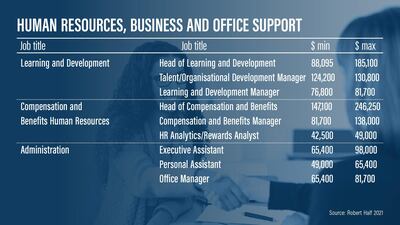
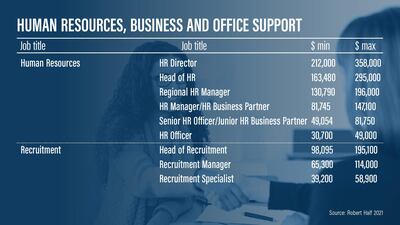
However, resilient sectors such as technology, pharmaceuticals, finance, government and human resources will offer the biggest wage increases, bonuses and benefits to employees in an effort to retain top talent, according to the 2021 Salary Guide from global recruitment consultancy Robert Half.
While retaining talent is a major concern for nearly 90 per cent of employers in the UAE, 73 per cent of companies are offering annual remuneration packages that meet or exceed pre-pandemic numbers, it added.
"It's been a tough second and third quarter but we are starting to see green shoots in some sectors," Gareth El Mettouri, associate director at Dubai-based Robert Half Middle East, told The National.
“Certain sectors have been hit more than others, such as tourism, hospitality and retail, but there is definitely more competition for top talent … that is driving salaries.”
According to the Robert Half report, 47 per cent of senior managers said salaries remained steady since Covid-19 movement restrictions were introduced in March, which forced many companies to deploy remote and flexible working measures.
It also found that 26 per cent of respondents said there had been an increase in base compensation for key roles spanning accounting and finance, financial services, technology, human resources and administration roles.
In October, a study by global human resources consulting company Mercer found that salaries in the UAE increased by an average of 3.8 per cent this year. While 10 per cent of UAE companies reduced salaries temporarily this year due to the pandemic, the overall market still experienced positive salary inflation, the Mercer Total Remuneration Survey said.
It added that salaries for workers in the UAE’s life sciences sector (pharmaceuticals and health care) registered the highest increase, rising 4.5 per cent. This was followed by a 3.5 per cent increase for workers in consumer goods, 3 per cent for high-tech employees and 2.6 per cent in the energy industry.
Meanwhile, the Robert Half report found that some companies were still paying bonuses of up to 25 per cent this year. Fifty-two per cent of managers said they are making bonus payments that either meet or exceed their pre-Covid-19 equivalents. However, 38 per cent said they are offering lower bonuses compared with the previous year.
Certain sectors have been hit more than others, such as tourism, hospitality and retail, but there is definitely more competition for top talent … and that is driving salaries and other benefits
“Bonuses are being paid, but I would say they are all lower compared to last year,” Mr El Mettouri said. “Company performance isn't what it was last year, but those that haven't been hit as hard or actually excelled during this time are paying bonuses at the 25 per cent level and above in some cases.
“For individuals that performed this year, they will be expecting bonuses or an increase in salary. [But] if employers aren't paying, then those candidates obviously are at risk of moving into the open market and looking for new opportunities.”
According to the report, the pandemic is also changing the employee benefits landscape, with remote and flexible working options, childcare subsidies and training support now being offered as part of remuneration packages.
Mr El Mettouri said employers are willing to be more flexible to retain top talent and are more aware of the importance of a work-life balance and health and well-being, but it remains to be seen if Covid-19 has permanently changed these types of benefits for employees.
“I think it’s still too early to tell,” he said. “But ... employers are more open to candidates working remotely and having more flexibility because the jobs are still being done.”
Technologically savvy employees remain the most in demand for employers, but they are also looking for soft skills that include adaptability, resilience, communication, leadership and empathy.
“Today’s workplace isn’t the same as it was 12 months ago. Demand has risen for digital experts as companies undergo rapid digital transformation to remodel and implement processes which will set them in good stead for the fast pace of innovation,” the Robert Half report said.
“Expedited digitisation has also given rise to a number of other skill requirements, such as resilience and adaptability. Remote working has placed even greater emphasis on the need for elevated communication skills as interactions move into the digital world.”
Mr El Mettouri added that adaptability and productivity are two of the most important skills for the workplace of the future as the business climate will remain challenging and remote working will continue for the foreseeable future.
He also advised jobseekers to tailor their CVs to the current climate, such as including key achievements on cost-saving exercises, and highlighting technical and software skills.
“Tech is a key focus for many companies at the moment,” Mr El Mettouri said. “Ensure your LinkedIn profile is up to date and continue learning and upskilling. Our clients are requesting tech-savvy candidates who can hit the ground running from day one.”

Ten tax points to be aware of in 2026
1. Domestic VAT refund amendments: request your refund within five years
If a business does not apply for the refund on time, they lose their credit.
2. E-invoicing in the UAE
Businesses should continue preparing for the implementation of e-invoicing in the UAE, with 2026 a preparation and transition period ahead of phased mandatory adoption.
3. More tax audits
Tax authorities are increasingly using data already available across multiple filings to identify audit risks.
4. More beneficial VAT and excise tax penalty regime
Tax disputes are expected to become more frequent and more structured, with clearer administrative objection and appeal processes. The UAE has adopted a new penalty regime for VAT and excise disputes, which now mirrors the penalty regime for corporate tax.
5. Greater emphasis on statutory audit
There is a greater need for the accuracy of financial statements. The International Financial Reporting Standards standards need to be strictly adhered to and, as a result, the quality of the audits will need to increase.
6. Further transfer pricing enforcement
Transfer pricing enforcement, which refers to the practice of establishing prices for internal transactions between related entities, is expected to broaden in scope. The UAE will shortly open the possibility to negotiate advance pricing agreements, or essentially rulings for transfer pricing purposes.
7. Limited time periods for audits
Recent amendments also introduce a default five-year limitation period for tax audits and assessments, subject to specific statutory exceptions. While the standard audit and assessment period is five years, this may be extended to up to 15 years in cases involving fraud or tax evasion.
8. Pillar 2 implementation
Many multinational groups will begin to feel the practical effect of the Domestic Minimum Top-Up Tax (DMTT), the UAE's implementation of the OECD’s global minimum tax under Pillar 2. While the rules apply for financial years starting on or after January 1, 2025, it is 2026 that marks the transition to an operational phase.
9. Reduced compliance obligations for imported goods and services
Businesses that apply the reverse-charge mechanism for VAT purposes in the UAE may benefit from reduced compliance obligations.
10. Substance and CbC reporting focus
Tax authorities are expected to continue strengthening the enforcement of economic substance and Country-by-Country (CbC) reporting frameworks. In the UAE, these regimes are increasingly being used as risk-assessment tools, providing tax authorities with a comprehensive view of multinational groups’ global footprints and enabling them to assess whether profits are aligned with real economic activity.
Contributed by Thomas Vanhee and Hend Rashwan, Aurifer
Avatar: Fire and Ash
Director: James Cameron
Starring: Sam Worthington, Sigourney Weaver, Zoe Saldana
Rating: 4.5/5
Mercer, the investment consulting arm of US services company Marsh & McLennan, expects its wealth division to at least double its assets under management (AUM) in the Middle East as wealth in the region continues to grow despite economic headwinds, a company official said.
Mercer Wealth, which globally has $160 billion in AUM, plans to boost its AUM in the region to $2-$3bn in the next 2-3 years from the present $1bn, said Yasir AbuShaban, a Dubai-based principal with Mercer Wealth.
“Within the next two to three years, we are looking at reaching $2 to $3 billion as a conservative estimate and we do see an opportunity to do so,” said Mr AbuShaban.
Mercer does not directly make investments, but allocates clients’ money they have discretion to, to professional asset managers. They also provide advice to clients.
“We have buying power. We can negotiate on their (client’s) behalf with asset managers to provide them lower fees than they otherwise would have to get on their own,” he added.
Mercer Wealth’s clients include sovereign wealth funds, family offices, and insurance companies among others.
From its office in Dubai, Mercer also looks after Africa, India and Turkey, where they also see opportunity for growth.
Wealth creation in Middle East and Africa (MEA) grew 8.5 per cent to $8.1 trillion last year from $7.5tn in 2015, higher than last year’s global average of 6 per cent and the second-highest growth in a region after Asia-Pacific which grew 9.9 per cent, according to consultancy Boston Consulting Group (BCG). In the region, where wealth grew just 1.9 per cent in 2015 compared with 2014, a pickup in oil prices has helped in wealth generation.
BCG is forecasting MEA wealth will rise to $12tn by 2021, growing at an annual average of 8 per cent.
Drivers of wealth generation in the region will be split evenly between new wealth creation and growth of performance of existing assets, according to BCG.
Another general trend in the region is clients’ looking for a comprehensive approach to investing, according to Mr AbuShaban.
“Institutional investors or some of the families are seeing a slowdown in the available capital they have to invest and in that sense they are looking at optimizing the way they manage their portfolios and making sure they are not investing haphazardly and different parts of their investment are working together,” said Mr AbuShaban.
Some clients also have a higher appetite for risk, given the low interest-rate environment that does not provide enough yield for some institutional investors. These clients are keen to invest in illiquid assets, such as private equity and infrastructure.
“What we have seen is a desire for higher returns in what has been a low-return environment specifically in various fixed income or bonds,” he said.
“In this environment, we have seen a de facto increase in the risk that clients are taking in things like illiquid investments, private equity investments, infrastructure and private debt, those kind of investments were higher illiquidity results in incrementally higher returns.”
The Abu Dhabi Investment Authority, one of the largest sovereign wealth funds, said in its 2016 report that has gradually increased its exposure in direct private equity and private credit transactions, mainly in Asian markets and especially in China and India. The authority’s private equity department focused on structured equities owing to “their defensive characteristics.”
The five pillars of Islam
SPEC%20SHEET%3A%20APPLE%20IPAD%20PRO%20(12.9%22%2C%202022)
%3Cp%3E%3Cstrong%3EDisplay%3A%3C%2Fstrong%3E%2012.9-inch%20Liquid%20Retina%20XDR%2C%202%2C732%20x%202%2C048%2C%20264ppi%2C%20wide%20colour%2C%20True%20Tone%2C%20ProMotion%2C%201%2C600%20nits%20max%2C%20Apple%20Pencil%20hover%3C%2Fp%3E%0A%3Cp%3E%3Cstrong%3EChip%3A%3C%2Fstrong%3E%20Apple%20M2%2C%208-core%20CPU%2C%2010-core%20GPU%2C%2016-core%20Neural%20Engine%3C%2Fp%3E%0A%3Cp%3E%3Cstrong%3EMemory%3A%3C%2Fstrong%3E%20Storage%20%E2%80%93%20128GB%2F256GB%2F512GB%20%2F%201TB%2F2TB%3B%20RAM%20%E2%80%93%208GB%2F16GB%3C%2Fp%3E%0A%3Cp%3E%3Cstrong%3EPlatform%3A%3C%2Fstrong%3E%20iPadOS%2016%3C%2Fp%3E%0A%3Cp%3E%3Cstrong%3EMain%20camera%3A%3C%2Fstrong%3E%20Dual%2012MP%20wide%20(f%2F1.8)%20%2B%2010MP%20ultra-wide%20(f%2F2.4)%2C%202x%20optical%2F5x%20digital%2C%20Smart%20HDR%204%3C%2Fp%3E%0A%3Cp%3E%3Cstrong%3EVideo%3A%3C%2Fstrong%3E%20ProRes%204K%20%40%2030fps%2C%204K%20%40%2024%2F25%2F30%2F60fps%2C%20full%20HD%20%40%2025%2F30%2F60fps%2C%20slo-mo%20%40%20120%2F240fps%3C%2Fp%3E%0A%3Cp%3E%3Cstrong%3EFront%20camera%3A%3C%2Fstrong%3E%20TrueDepth%2012MP%20ultra-wide%20(f%2F2.4)%2C%202x%2C%20Smart%20HDR%204%2C%20Centre%20Stage%2C%20Portrait%2C%20Animoji%2C%20Memoji%3B%20full%20HD%20%40%2025%2F30%2F60fps%3C%2Fp%3E%0A%3Cp%3E%3Cstrong%3EAudio%3A%3C%2Fstrong%3E%20Four-speaker%20stereo%3C%2Fp%3E%0A%3Cp%3E%3Cstrong%3EBiometrics%3A%3C%2Fstrong%3E%20Face%20ID%2C%20Touch%20ID%3C%2Fp%3E%0A%3Cp%3E%3Cstrong%3EI%2FO%3A%3C%2Fstrong%3E%20USB-C%2C%20smart%20connector%20(for%20folio%2Fkeyboard)%3C%2Fp%3E%0A%3Cp%3E%3Cstrong%3EBattery%3A%3C%2Fstrong%3E%20Up%20to%2010%20hours%20on%20Wi-Fi%3B%20up%20to%20nine%20hours%20on%20cellular%3C%2Fp%3E%0A%3Cp%3E%3Cstrong%3EFinish%3A%3C%2Fstrong%3E%20Silver%2C%20space%20grey%3C%2Fp%3E%0A%3Cp%3E%3Cstrong%3EIn%20the%20box%3A%3C%2Fstrong%3E%20iPad%2C%20USB-C-to-USB-C%20cable%2C%2020-watt%20power%20adapter%3C%2Fp%3E%0A%3Cp%3E%3Cstrong%3EPrice%3A%3C%2Fstrong%3E%20WiFi%20%E2%80%93%20Dh4%2C599%20(128GB)%20%2F%20Dh4%2C999%20(256GB)%20%2F%20Dh5%2C799%20(512GB)%20%2F%20Dh7%2C399%20(1TB)%20%2F%20Dh8%2C999%20(2TB)%3B%20cellular%20%E2%80%93%20Dh5%2C199%20%2F%20Dh5%2C599%20%2F%20Dh6%2C399%20%2F%20Dh7%2C999%20%2F%20Dh9%2C599%3C%2Fp%3E%0A
BUNDESLIGA FIXTURES
Friday (UAE kick-off times)
Cologne v Hoffenheim (11.30pm)
Saturday
Hertha Berlin v RB Leipzig (6.30pm)
Schalke v Fortuna Dusseldof (6.30pm)
Mainz v Union Berlin (6.30pm)
Paderborn v Augsburg (6.30pm)
Bayern Munich v Borussia Dortmund (9.30pm)
Sunday
Borussia Monchengladbach v Werder Bremen (4.30pm)
Wolfsburg v Bayer Leverkusen (6.30pm)
SC Freiburg v Eintracht Frankfurt (9on)
Electric scooters: some rules to remember
- Riders must be 14-years-old or over
- Wear a protective helmet
- Park the electric scooter in designated parking lots (if any)
- Do not leave electric scooter in locations that obstruct traffic or pedestrians
- Solo riders only, no passengers allowed
- Do not drive outside designated lanes
The Baghdad Clock
Shahad Al Rawi, Oneworld
Why it pays to compare
A comparison of sending Dh20,000 from the UAE using two different routes at the same time - the first direct from a UAE bank to a bank in Germany, and the second from the same UAE bank via an online platform to Germany - found key differences in cost and speed. The transfers were both initiated on January 30.
Route 1: bank transfer
The UAE bank charged Dh152.25 for the Dh20,000 transfer. On top of that, their exchange rate margin added a difference of around Dh415, compared with the mid-market rate.
Total cost: Dh567.25 - around 2.9 per cent of the total amount
Total received: €4,670.30
Route 2: online platform
The UAE bank’s charge for sending Dh20,000 to a UK dirham-denominated account was Dh2.10. The exchange rate margin cost was Dh60, plus a Dh12 fee.
Total cost: Dh74.10, around 0.4 per cent of the transaction
Total received: €4,756
The UAE bank transfer was far quicker – around two to three working days, while the online platform took around four to five days, but was considerably cheaper. In the online platform transfer, the funds were also exposed to currency risk during the period it took for them to arrive.
Four-day collections of TOH
Day Indian Rs (Dh)
Thursday 500.75 million (25.23m)
Friday 280.25m (14.12m)
Saturday 220.75m (11.21m)
Sunday 170.25m (8.58m)
Total 1.19bn (59.15m)
(Figures in millions, approximate)
Email sent to Uber team from chief executive Dara Khosrowshahi
From: Dara
To: Team@
Date: March 25, 2019 at 11:45pm PT
Subj: Accelerating in the Middle East
Five years ago, Uber launched in the Middle East. It was the start of an incredible journey, with millions of riders and drivers finding new ways to move and work in a dynamic region that’s become so important to Uber. Now Pakistan is one of our fastest-growing markets in the world, women are driving with Uber across Saudi Arabia, and we chose Cairo to launch our first Uber Bus product late last year.
Today we are taking the next step in this journey—well, it’s more like a leap, and a big one: in a few minutes, we’ll announce that we’ve agreed to acquire Careem. Importantly, we intend to operate Careem independently, under the leadership of co-founder and current CEO Mudassir Sheikha. I’ve gotten to know both co-founders, Mudassir and Magnus Olsson, and what they have built is truly extraordinary. They are first-class entrepreneurs who share our platform vision and, like us, have launched a wide range of products—from digital payments to food delivery—to serve consumers.
I expect many of you will ask how we arrived at this structure, meaning allowing Careem to maintain an independent brand and operate separately. After careful consideration, we decided that this framework has the advantage of letting us build new products and try new ideas across not one, but two, strong brands, with strong operators within each. Over time, by integrating parts of our networks, we can operate more efficiently, achieve even lower wait times, expand new products like high-capacity vehicles and payments, and quicken the already remarkable pace of innovation in the region.
This acquisition is subject to regulatory approval in various countries, which we don’t expect before Q1 2020. Until then, nothing changes. And since both companies will continue to largely operate separately after the acquisition, very little will change in either teams’ day-to-day operations post-close. Today’s news is a testament to the incredible business our team has worked so hard to build.
It’s a great day for the Middle East, for the region’s thriving tech sector, for Careem, and for Uber.
Uber on,
Dara
Zodi%20%26%20Tehu%3A%20Princes%20Of%20The%20Desert
%3Cp%3E%3Cstrong%3EDirector%3A%20%3C%2Fstrong%3EEric%20Barbier%26nbsp%3B%3C%2Fp%3E%0A%3Cp%3E%3Cstrong%3EStarring%3A%20%3C%2Fstrong%3EYoussef%20Hajdi%2C%20Nadia%20Benzakour%2C%20Yasser%20Drief%3C%2Fp%3E%0A%3Cp%3E%3Cstrong%3ERating%3A%3C%2Fstrong%3E%204%2F5%3C%2Fp%3E%0A
Profile of Foodics
Founders: Ahmad AlZaini and Mosab AlOthmani
Based: Riyadh
Sector: Software
Employees: 150
Amount raised: $8m through seed and Series A - Series B raise ongoing
Funders: Raed Advanced Investment Co, Al-Riyadh Al Walid Investment Co, 500 Falcons, SWM Investment, AlShoaibah SPV, Faith Capital, Technology Investments Co, Savour Holding, Future Resources, Derayah Custody Co.
MATCH INFO
Uefa Champions League semi-final, second leg result:
Ajax 2-3 Tottenham
Tottenham advance on away goals rule after tie ends 3-3 on aggregate
Final: June 1, Madrid
RIVER%20SPIRIT
%3Cp%3E%3Cstrong%3EAuthor%3A%20%3C%2Fstrong%3ELeila%20Aboulela%C2%A0%3C%2Fp%3E%0A%3Cp%3E%3Cstrong%3EPublisher%3A%3C%2Fstrong%3E%20Saqi%20Books%3C%2Fp%3E%0A%3Cp%3E%3Cstrong%3EPages%3A%3C%2Fstrong%3E%20320%3C%2Fp%3E%0A%3Cp%3E%3Cstrong%3EAvailable%3A%3C%2Fstrong%3E%20Now%3C%2Fp%3E%0A
'The Batman'
Stars:Robert Pattinson
Director:Matt Reeves
Rating: 5/5
White hydrogen: Naturally occurring hydrogen
Chromite: Hard, metallic mineral containing iron oxide and chromium oxide
Ultramafic rocks: Dark-coloured rocks rich in magnesium or iron with very low silica content
Ophiolite: A section of the earth’s crust, which is oceanic in nature that has since been uplifted and exposed on land
Olivine: A commonly occurring magnesium iron silicate mineral that derives its name for its olive-green yellow-green colour