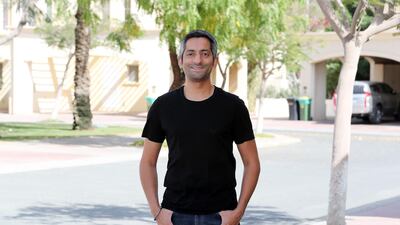
Entrepreneur Pali Banwait is the cofounder of business-to-business online wholesale marketplace WeMena, a Dubai tech start-up supplying personal protective equipment (PPE), sanitiser and cleaning products among 50,000-plus lines to companies and retailers. The Briton moved to the UAE in early 2018, briefly working with property crowdfunding firm SmartCrowd before helping establish WeMena last August, taking it live in January. Mr Banwait, 39, who also manages a property portfolio in the UK, lives in The Springs, Dubai, with his wife and three-year-old son.
How did your upbringing shape your attitude towards money?
I grew up in a fairly tough London neighbourhood. My attitude is very much linked to my childhood because at the time my father wasn’t around and my mother was, and still is, a carer for the elderly. I went to work as soon as I left school at 16, to be financially independent; I didn’t want to be a burden on the household. I wouldn’t change it for the world. It was the making of me.
What was that first job?
I worked full-time with DHL – admin, booking flights, photo-copying – and was paid £230 (Dh1,048) a month. That setting fast-tracked my learning about professional work environments. The internet was emerging and I got into that space. I ended up being webmaster for several intranets by the time I left. It established my skill set, being a web designer/web project manager at a young age. One thing about tech companies/start-ups is this mindset that you have to be a Stanford or Harvard graduate … that’s so far from the truth.
How did you become an entrepreneur?
I’ve been fortunate to have the right mentors. Everyone tells me I had the ability to think outside the box and a lot of line managers encouraged me to explore opportunities. I wanted freedom of expression, to make my own decisions. Eventually, I had enough experience through working for different companies. I started, with my co-founder – still with me today – building e-commerce solutions for small businesses.
What led you to the UAE?
We sold one of our companies in spring 2017, an online ticketing marketplace, around the time my son was born. I wanted a break from entrepreneurial life, time with family. I’d been visiting the UAE since 2000 to see friends and my younger sister in Abu Dhabi. We thought we’d try something new and had no expectations. The first year we just enjoyed the lifestyle. I had things in England I could manage remotely while learning more about this region, looking at opportunities. Essentially there hasn’t been any digitisation of B2B trading in this region. We felt this was something well needed.
What has been your best investment?
One of the best things me and my wife did together was invest in property, apartments in the UK, just after the 2008 financial crisis. That ended up becoming very fruitful. We’ve always thought: ’build our assets up first, then enjoy our lifestyle’. I’m lucky we’re on the same page most of the time. That’s allowed us to take more risk, like coming to Dubai, getting into more opportunities. Another one of my best investments was to buy Facebook shares in 2012 when they were at around $18-$20 (Dh66 – Dh73). I bought because Facebook had nearly one billion users then and even if they monetised just a tiny proportion of that user base Facebook was going to do well. They peaked at over $220 and today it's about $190, but I sold them a long time ago.
Has the Covid-19 pandemic affected your business?
I’ve learnt you should be cost-conscious in good times as well as in bad. We don’t pay office rent; our investors give us free space in Media City. From a business cultural standpoint, nothing’s really changed because we were lean before. With that core value there’s no shock to the system.
But has it altered trade?
There's no activity in one part of the business at the moment – electronics, fast-moving consumer goods and office supplies as most offices are closed, so consumption is not like it was.
But we're selling goods in lots of different categories. That's allowed us to pivot into product lines in demand right now and maintain stability in the business. But we had to build new supply relationships super quick.
On the PPE side, we’re really conscious of making sure our pricing is fair; we’re not concerned about adding a margin at this stage. One of the businesses we sold PPE to is doing a hospital fit out. Also we’re supplying to food plants. We’re doing something quite important for the sector, helping some businesses stay open.
We’re not really that profit conscious at this point in our journey. Our goal is to build a long-term, enduring company.
Are you affected personally?
With the properties, I’m just waiting for a month when no rent comes in because people living there lose their jobs. We’ve always kept a good buffer, but we’re analysing our risks.
With WeMena being a young company, we don’t pay huge salaries in the first place. And eating out less, not going out – you’re saving money straight away. We don’t have a lavish lifestyle. My son goes to school and we’re negotiating the fees.
What is your usual spending and saving outlook?
I’m 50/50. As I’ve got older I've started spending more freely. When I was younger I'd think, ‘I need to get to this milestone’. Ticking off the milestones, I’ve started feeling more relaxed. I’ll probably find a way of using my savings towards a business because I’m quite fidgety, always thinking of a project. It becomes more interesting than seeing money in an account. We do save though and I’m keeping money aside in case I need it for the business.
Have you been wise with your money?
It’s important to build an asset profile from a young age, like committing to that studio apartment to rent out in the future. Income fluctuates, so you need a backup plan. That can be saving a heap of cash or assets to fall back on.
You need a portfolio, but also to think about how much are you investing in yourself. If you’re in business, you turn that into an asset. I’ve also lost money in the past, through personal investments and business ventures. Some worked out, some didn’t. You learn about mistakes and how you’re not going to make them again.

What has been your most cherished purchase?
Buying our family home in Ealing Broadway, by the Central Line in West London. It felt like a coming together of everything I’d been working for. Starting out, it was something I had in mind, so getting to that point was really important.
Does money make you happy?
Of course. Money is an enabler and gives you options. It leads to a level of happiness creation. I spent more money on our honeymoon in the Maldives than the wedding. We’ve done driving holidays through Canada and America. Last year I went trekking in Nepal.
But money’s not the end goal for me professionally, it’s about building things. I like that feeling, confirmation that people like what we’re building. That’s the driver.
Are you planning for the future?
Things change when you have kids. We’re thinking about the life we want our son to have, to make sure we put him through decent education.
I don’t see myself ever completely switching off and retiring. I always want to be involved in things; advising businesses, or some coaching. And I’ve always had a dream of having a nice place on a vineyard one day.

