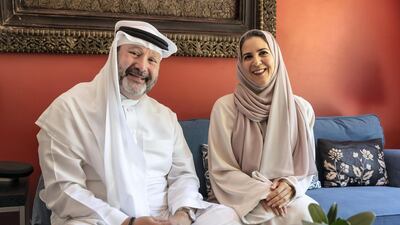
Giving children gifts during religious festivals is a tradition followed by families across the globe. For Muslims, those presents often take the form of eidiyah, spending money distributed to children on celebrations such as Eid Al Fitr and Eid Al Adha.
The social tradition dates to the early Middle Ages, when the Fatimid caliphs distributed money, sweets or clothes to young and old citizens on the first day of Eid. By the end of the Ottoman period, however, eidiyah had largely evolved to refer to small amounts of cash given to children by their parents and older relatives within a family.
There are parents who use the tradition of eidiyah as a way to teach children about money management and saving for the future.
The custom is by no means universal, though. Some families don’t give eidiyah at all, others frame it as a reward for successfully completing a month’s fasting in Ramadan – particularly at Eid Al Fitr – and in other communities, parents may even give decorated envelopes full of cash to their adult children. Here in the UAE, residents traditionally give eidiyah to children in their families and within the neighbourhood.
While the tradition has taken a more commercial turn in recent times, with presents such as smartphones and video game consoles becoming common, some parents look to teach their children the value of money by giving financial investments instead.
“Ramadan traditions have been increasingly changing with the advent of globalisation,” says Sammy Badran, assistant professor of Political Science at the American University of Sharjah’s Department of International Studies, who researches social trends as part of his job.
The American draws a parallel between local Eid traditions and Christmas. “What was once a modest monetary gift from parents to their children has arguably become more commercialised. We see clever marketing framing these gifts as embodying Ramadan’s emphasis on generosity. Yet, on the other hand, there are parents who use the tradition of eidiyah as a way to teach children about money management and saving for the future,” he adds.
It is this aspect of financial management that National Bonds, the UAE sharia savings and investment company, focuses on with its annual eidiyah campaign. The initiative gives 500 minor bondholders Dh50 each via special electronic draws on the first day of Eid Al Fitr.
“In addition to encouraging minors to adopt a culture of savings and look upon the practice as a rewarding habit, the initiative also seeks to raise awareness among parents on the value of regular savings, especially when it comes to preparing for the rising costs of educating their children,” says Mohammed Qasim Al Ali, chief executive of National Bonds.
Gift vouchers are a particularly apposite gift at the present moment, he says. “Vouchers are not just monetary gifts, they’re protectors of a future … whether it's for a newlywed in your life, a child dreaming of a university education, or someone in need.”
Here, four UAE residents explain what eidiyah means to them and how they decide how much to give:
“Set a budget, don’t go overboard”
Dubai resident Aliya Khan, a Pakistani marketing professional who grew up in the UK and Saudi Arabia, remembers how her grandfather would greet all the children on Eid morning with a gift of fresh, new banknotes.
“My siblings and I loved the newness and crispness of those notes, and we’d sit with our cousins to count what we had received,” she says.
Her husband, Yasser Al Toubah, a Palestinian banker who is one of eight children, received both money and sweets from his extended family – while his older sisters were given gold jewellery.
The couple live in Dubai with their son, Rakaan, 13. They give him both cash and a gift every Eid, and also distribute cash to children of extended family members and to domestic helpers.
The Al Toubahs set a budget in advance and stick to it. The family also celebrate Christmas, Ms Khan says, so it’s important that gifts at each festival have a similar value. “Among the family, eidiyah of Dh100-Dh200 is standard, depending on how close you are. As parents, though, we like to stay within a realistic budget for each festival. Dh1,000 is not eidiyah, Dh500 or so is fine,” she says.
Cash allows Rakaan to buy whatever he feels like. “Children like to make those spending decisions themselves. If they want to save it, that’s great. Rakaan has saved up and then used the money for a specific goal – and he understands that the satisfaction of doing so is greater than if we were to buy it for him,” says Ms Khan.
She expects to continue giving eidiyah as long as she can.
“We gave cryptocurrencies one year”
University lecturer and entrepreneur Somia Anwar and her husband Ali Khwaja have created their own Eid traditions since moving to the UAE as well as sticking to familiar customs such as family dinners and get-togethers. Ms Anwar, 39, from Pakistan, has been living in Sharjah for the past 20 years and still receives eidiyah – or eidi as it’s known in Pakistan – from her parents and in-laws.
“Ali started a tradition for giving gifts to everyone – kids and adults. Over the years, the gifts have varied considerably. They might be a foosball table, a TV set, a PlayStation console, kitchen appliances – and even Bitcoin,” the Sharjah resident says.
As a child growing up in Karachi, eidi was always just a token amount of cash, she says. “But nowadays kids are more aware and start suggesting Eid gifts a month in advance,” she says, putting in requests for items such as iPhones, iPads, Nintendo Switch and PlayStation consoles and games. “All very costly.”
One year, Mr Khwaja, a cryptocurrency enthusiast, introduced the family to Bitcoin by giving each person a printout of their personal cryptowallet. “The adults immediately set up their cryptowallets online,” says Ms Khan. “The kids enjoyed it for one year. They would open their wallet occasionally and review how the price would go up and down but it lost excitement because they couldn't buy much with it.”
The couple’s children, Zoha, 14 and Abdullah, 12, are now more likely to receive gadgets.
"It's a lesson in financial responsibilities and obligations"
Dr Rana Batterjee, owner of candy store Sugarfied & Co, and vice-president of Momair Trading, an F&B company, believes eidiyah can serve to educate children about personal finance.
“Eidiyah is a good way to teach children how to save money and feel responsibility for it,” says the Saudi-American, 52. “I'd explain to my children what it meant to have money and what it meant to save and spend. I'd ask them how much of the eidiyah they wanted to keep and the rest I would save for them.
"As they grew older, I opened a bank account for them to track their money independently. As they became more responsible and mature, I explained to them the importance of zakat (charity), which is one of the five pillars of Islam.”
In addition to jewellery gifts as a child, Dr Batterjee remembers being given a small white envelope with her name neatly written on the outside, and how she’d run to her mother to open the envelope and count the eidiyah.
Ms Batterjee and her husband Mazen Omair, from Saudi Arabia, have continued this tradition with their now grown-up children – usually giving cash. “We’ve always encouraged them to save it for something special,” she says. “Eidiyah is about the thought and act of giving, not the money. I think I will continue until one day they have their own children, then I will give the eidiyah to them as well.”
"Online transfers are a way to send eidiyah in coronavirus times"
With families split across the world during the pandemic, many residents send eidiyah using online money transfer channels, says Farheen Matheranwala, from India, who lives in Sharjah. The crisis has changed the way people are celebrating, and the 37-year-old expects to connect with friends and family via apps such as Zoom.
“Meeting people may get difficult but technology will help to overcome this. A safe way to send eidiyah nowadays is using [online] banking,” she says. Although she plans to celebrate Eid Al Fitr at home in the UAE with her husband and two sons, Mohammed, 10, and Hussain, 4, she has recommended online transfer option to friends.
Ms Matheranwala sees eidiyah as a small token of blessing and says she was taught early on to save the cash for something she needed, such as books or school accessories. It’s an attitude she tries to teach children, steering them away from demands for toys, video games and electronic gadgets.
“We don’t give them expensive gifts, but highlight the traditional values behind the festival instead," she says. "We also encourage my older son to give eidiyah to his brother.”
The specs
Engine: 3.0-litre six-cylinder MHEV
Power: 360bhp
Torque: 500Nm
Transmission: eight-speed automatic
Price: from Dh282,870
On sale: now
Ten tax points to be aware of in 2026
1. Domestic VAT refund amendments: request your refund within five years
If a business does not apply for the refund on time, they lose their credit.
2. E-invoicing in the UAE
Businesses should continue preparing for the implementation of e-invoicing in the UAE, with 2026 a preparation and transition period ahead of phased mandatory adoption.
3. More tax audits
Tax authorities are increasingly using data already available across multiple filings to identify audit risks.
4. More beneficial VAT and excise tax penalty regime
Tax disputes are expected to become more frequent and more structured, with clearer administrative objection and appeal processes. The UAE has adopted a new penalty regime for VAT and excise disputes, which now mirrors the penalty regime for corporate tax.
5. Greater emphasis on statutory audit
There is a greater need for the accuracy of financial statements. The International Financial Reporting Standards standards need to be strictly adhered to and, as a result, the quality of the audits will need to increase.
6. Further transfer pricing enforcement
Transfer pricing enforcement, which refers to the practice of establishing prices for internal transactions between related entities, is expected to broaden in scope. The UAE will shortly open the possibility to negotiate advance pricing agreements, or essentially rulings for transfer pricing purposes.
7. Limited time periods for audits
Recent amendments also introduce a default five-year limitation period for tax audits and assessments, subject to specific statutory exceptions. While the standard audit and assessment period is five years, this may be extended to up to 15 years in cases involving fraud or tax evasion.
8. Pillar 2 implementation
Many multinational groups will begin to feel the practical effect of the Domestic Minimum Top-Up Tax (DMTT), the UAE's implementation of the OECD’s global minimum tax under Pillar 2. While the rules apply for financial years starting on or after January 1, 2025, it is 2026 that marks the transition to an operational phase.
9. Reduced compliance obligations for imported goods and services
Businesses that apply the reverse-charge mechanism for VAT purposes in the UAE may benefit from reduced compliance obligations.
10. Substance and CbC reporting focus
Tax authorities are expected to continue strengthening the enforcement of economic substance and Country-by-Country (CbC) reporting frameworks. In the UAE, these regimes are increasingly being used as risk-assessment tools, providing tax authorities with a comprehensive view of multinational groups’ global footprints and enabling them to assess whether profits are aligned with real economic activity.
Contributed by Thomas Vanhee and Hend Rashwan, Aurifer
US PGA Championship in numbers
1 Joost Luiten produced a memorable hole in one at the par-three fourth in the first round.
2 To date, the only two players to win the PGA Championship after winning the week before are Rory McIlroy (2014 WGC-Bridgestone Invitational) and Tiger Woods (2007, WGC-Bridgestone Invitational). Hideki Matsuyama or Chris Stroud could have made it three.
3 Number of seasons without a major for McIlroy, who finished in a tie for 22nd.
4 Louis Oosthuizen has now finished second in all four of the game's major championships.
5 In the fifth hole of the final round, McIlroy holed his longest putt of the week - from 16ft 8in - for birdie.
6 For the sixth successive year, play was disrupted by bad weather with a delay of one hour and 43 minutes on Friday.
7 Seven under par (64) was the best round of the week, shot by Matsuyama and Francesco Molinari on Day 2.
8 Number of shots taken by Jason Day on the 18th hole in round three after a risky recovery shot backfired.
9 Jon Rahm's age in months the last time Phil Mickelson missed the cut in the US PGA, in 1995.
10 Jimmy Walker's opening round as defending champion was a 10-over-par 81.
11 The par-four 11th coincidentally ranked as the 11th hardest hole overall with a scoring average of 4.192.
12 Paul Casey was a combined 12 under par for his first round in this year's majors.
13 The average world ranking of the last 13 PGA winners before this week was 25. Kevin Kisner began the week ranked 25th.
14 The world ranking of Justin Thomas before his victory.
15 Of the top 15 players after 54 holes, only Oosthuizen had previously won a major.
16 The par-four 16th marks the start of Quail Hollow's so-called "Green Mile" of finishing holes, some of the toughest in golf.
17 The first round scoring average of the last 17 major champions was 67.2. Kisner and Thorbjorn Olesen shot 67 on day one at Quail Hollow.
18 For the first time in 18 majors, the eventual winner was over par after round one (Thomas shot 73).
Ponti
Sharlene Teo, Pan Macmillan
How to get there
Emirates (www.emirates.com) flies directly to Hanoi, Vietnam, with fares starting from around Dh2,725 return, while Etihad (www.etihad.com) fares cost about Dh2,213 return with a stop. Chuong is 25 kilometres south of Hanoi.
Avatar: Fire and Ash
Director: James Cameron
Starring: Sam Worthington, Sigourney Weaver, Zoe Saldana
Rating: 4.5/5
GAC GS8 Specs
Engine: 2.0-litre 4cyl turbo
Power: 248hp at 5,200rpm
Torque: 400Nm at 1,750-4,000rpm
Transmission: 8-speed auto
Fuel consumption: 9.1L/100km
On sale: Now
Price: From Dh149,900
Groom and Two Brides
Director: Elie Semaan
Starring: Abdullah Boushehri, Laila Abdallah, Lulwa Almulla
Rating: 3/5
The National Archives, Abu Dhabi
Founded over 50 years ago, the National Archives collects valuable historical material relating to the UAE, and is the oldest and richest archive relating to the Arabian Gulf.
Much of the material can be viewed on line at the Arabian Gulf Digital Archive - https://www.agda.ae/en
Mercer, the investment consulting arm of US services company Marsh & McLennan, expects its wealth division to at least double its assets under management (AUM) in the Middle East as wealth in the region continues to grow despite economic headwinds, a company official said.
Mercer Wealth, which globally has $160 billion in AUM, plans to boost its AUM in the region to $2-$3bn in the next 2-3 years from the present $1bn, said Yasir AbuShaban, a Dubai-based principal with Mercer Wealth.
“Within the next two to three years, we are looking at reaching $2 to $3 billion as a conservative estimate and we do see an opportunity to do so,” said Mr AbuShaban.
Mercer does not directly make investments, but allocates clients’ money they have discretion to, to professional asset managers. They also provide advice to clients.
“We have buying power. We can negotiate on their (client’s) behalf with asset managers to provide them lower fees than they otherwise would have to get on their own,” he added.
Mercer Wealth’s clients include sovereign wealth funds, family offices, and insurance companies among others.
From its office in Dubai, Mercer also looks after Africa, India and Turkey, where they also see opportunity for growth.
Wealth creation in Middle East and Africa (MEA) grew 8.5 per cent to $8.1 trillion last year from $7.5tn in 2015, higher than last year’s global average of 6 per cent and the second-highest growth in a region after Asia-Pacific which grew 9.9 per cent, according to consultancy Boston Consulting Group (BCG). In the region, where wealth grew just 1.9 per cent in 2015 compared with 2014, a pickup in oil prices has helped in wealth generation.
BCG is forecasting MEA wealth will rise to $12tn by 2021, growing at an annual average of 8 per cent.
Drivers of wealth generation in the region will be split evenly between new wealth creation and growth of performance of existing assets, according to BCG.
Another general trend in the region is clients’ looking for a comprehensive approach to investing, according to Mr AbuShaban.
“Institutional investors or some of the families are seeing a slowdown in the available capital they have to invest and in that sense they are looking at optimizing the way they manage their portfolios and making sure they are not investing haphazardly and different parts of their investment are working together,” said Mr AbuShaban.
Some clients also have a higher appetite for risk, given the low interest-rate environment that does not provide enough yield for some institutional investors. These clients are keen to invest in illiquid assets, such as private equity and infrastructure.
“What we have seen is a desire for higher returns in what has been a low-return environment specifically in various fixed income or bonds,” he said.
“In this environment, we have seen a de facto increase in the risk that clients are taking in things like illiquid investments, private equity investments, infrastructure and private debt, those kind of investments were higher illiquidity results in incrementally higher returns.”
The Abu Dhabi Investment Authority, one of the largest sovereign wealth funds, said in its 2016 report that has gradually increased its exposure in direct private equity and private credit transactions, mainly in Asian markets and especially in China and India. The authority’s private equity department focused on structured equities owing to “their defensive characteristics.”

