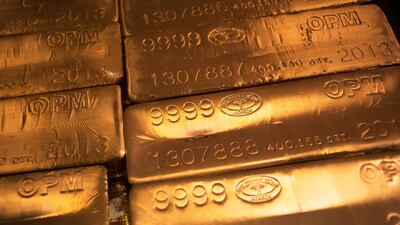
Not all segments of the gold market have gained during the first quarter, with demand for consumer-focused sectors such as jewellery and gold bars weakening sharply. Reuters

Gold’s powerful price surge makes $1,800 a real possibility


  • English
  • Arabic

Gold extended a rally to hit the highest level in more than seven years on concern that the coronavirus pandemic will have a devastating effect on the global economy, hammering corporate earnings while supercharging demand for havens.

Bullion has soared as the outbreak tipped economies into recession and spurred central banks to launch huge stimulus. Since getting caught up in a wave of forced selling last month as equities sank, gold has staged a powerful recovery. That means futures are now nearing $1,800 an ounce after trading in the $1,400s less than four weeks ago. Spreads over spot prices remain wide.

“What’s happening here is that the Fed is expanding its balance sheet and every other central bank in the world is doing the same,” said Hans Goetti, founder and chief executive of HG Research.

“What you’re looking at is massive currency debasement in the long term. That’s the major reason why gold is higher, and I would think that over the next few weeks or months, we’re probably going to retest the high that we saw in 2011.”

Gold futures traded on the Comex in New York are up 16 per cent this year, less than 10 per cent below the record set in 2011. Banks including UBS Group have boosted price targets for the metal, making the case that easier monetary policy, other stimulus, and lower real interest rates will support gains. As earnings season kicks off in earnest this week, investors will be looking to get a better sense of how bad the hit to profits has been and how this quarter will shape up.

Futures climbed as much as 1.3 per cent to $1,785 an ounce on the Comex, the highest since October 2012, and was little changed at 1:24pm UAE time. Spot gold was more than $40 cheaper at $1,720.34, with the huge spread a feature of trading in recent weeks amid physical market disruptions.

“Risk sentiment is turning towards the cautious side, and investors are fleeing into the perceived safe-haven in view of the virus situation and massive money-printing activities,” Margaret Yang, an analyst at CMC Markets Singapore, said in a research note.

Worldwide holdings in bullion-backed exchange-traded funds have ballooned to a record on rising demand, with investors seeking additional portfolio protection. On Monday, volumes in SPDR Gold Shares, the largest such fund, surged above 1,000 tonnes to the highest since mid-2013.

Gold’s latest upswing has come even as the pace of coronavirus infections has slowed in some of the hardest-hit economies, with the focus shifting towards how movement restrictions can be eased. President Donald Trump said he has “total” authority to order states to relax social distancing and reopen their economies.

As the outbreak has unfolded, a series of high-profile figures offered endorsements of gold’s qualities. Among them, billionaire investor Ray Dalio said this month that bullion, along with some stocks, was attractive as central banks print money.

In other precious metals, silver, platinum and palladium all advanced.

Mercer, the investment consulting arm of US services company Marsh & McLennan, expects its wealth division to at least double its assets under management (AUM) in the Middle East as wealth in the region continues to grow despite economic headwinds, a company official said.

Mercer Wealth, which globally has $160 billion in AUM, plans to boost its AUM in the region to $2-$3bn in the next 2-3 years from the present $1bn, said Yasir AbuShaban, a Dubai-based principal with Mercer Wealth.

Within the next two to three years, we are looking at reaching $2 to $3 billion as a conservative estimate and we do see an opportunity to do so,” said Mr AbuShaban.

Mercer does not directly make investments, but allocates clients’ money they have discretion to, to professional asset managers. They also provide advice to clients.

“We have buying power. We can negotiate on their (client’s) behalf with asset managers to provide them lower fees than they otherwise would have to get on their own,” he added.

Mercer Wealth’s clients include sovereign wealth funds, family offices, and insurance companies among others.

From its office in Dubai, Mercer also looks after Africa, India and Turkey, where they also see opportunity for growth.

Wealth creation in Middle East and Africa (MEA) grew 8.5 per cent to $8.1 trillion last year from $7.5tn in 2015, higher than last year’s global average of 6 per cent and the second-highest growth in a region after Asia-Pacific which grew 9.9 per cent, according to consultancy Boston Consulting Group (BCG). In the region, where wealth grew just 1.9 per cent in 2015 compared with 2014, a pickup in oil prices has helped in wealth generation.

BCG is forecasting MEA wealth will rise to $12tn by 2021, growing at an annual average of 8 per cent.

Drivers of wealth generation in the region will be split evenly between new wealth creation and growth of performance of existing assets, according to BCG.

Another general trend in the region is clients’ looking for a comprehensive approach to investing, according to Mr AbuShaban.

“Institutional investors or some of the families are seeing a slowdown in the available capital they have to invest and in that sense they are looking at optimizing the way they manage their portfolios and making sure they are not investing haphazardly and different parts of their investment are working together,” said Mr AbuShaban.

Some clients also have a higher appetite for risk, given the low interest-rate environment that does not provide enough yield for some institutional investors. These clients are keen to invest in illiquid assets, such as private equity and infrastructure.

“What we have seen is a desire for higher returns in what has been a low-return environment specifically in various fixed income or bonds,” he said.

“In this environment, we have seen a de facto increase in the risk that clients are taking in things like illiquid investments, private equity investments, infrastructure and private debt, those kind of investments were higher illiquidity results in incrementally higher returns.”

The Abu Dhabi Investment Authority, one of the largest sovereign wealth funds, said in its 2016 report that has gradually increased its exposure in direct private equity and private credit transactions, mainly in Asian markets and especially in China and India. The authority’s private equity department focused on structured equities owing to “their defensive characteristics.”
