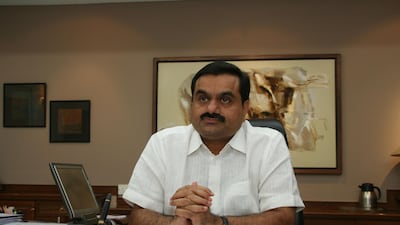
Gautam Adani
Billionaire Gautam Adani is likely to see three more companies from his coal mining-to-data centres conglomerate join the MSCI India Index after shares in each one of them more than doubled this year, according to analysts.
The group’s flagship Adani Enterprises, gas supplier Adani Total Gas and power distributor Adani Transmission may get included in MSCI's country benchmark after the index provider’s semi-annual review of its gauges in May, according to broker Edelweiss Financial Services and independent research provider Smartkarma. Adani Green Energy and Adani Ports & Special Economic Zone are already there.
The potential inclusions are seen further boosting wealth for Mr Adani, who has added $20.2 billion to his net worth this year, the second-biggest increase among the world’s billionaires.
The tycoon – who started out as a commodities trader in the late 1980s – has diversified from mines, ports and power plants into airports, data centres and defence. The rally in stocks shows investors have rewarded his strategy of interlocking his group’s interests with the Indian government’s infrastructure programme.
There is “very high probability of these Adani names to come in the index primarily due to the surge in their market capitalisation”, Brian Freitas, a New Zealand-based analyst at Smartkarma, said. “Exchange-traded funds and other passive funds will have to buy, adding to Adani’s fortune.”
Passive funds may have to buy shares worth about $830 million in total in the three companies after their inclusion, according to calculations by Mr Freitas. Still, these stocks “trade much much higher than their global peers and longer-term returns may not be worth the risks involved”, he wrote in a note on April 14.
A lack of analyst coverage for many of the Adani group’s companies hasn’t deterred MSCI from adding their stocks as the index provider’s focus is more on other factors such as market value. Adani Green, which was added to the MSCI India gauge at the end of November, still has no analysts covering it, according to data compiled by Bloomberg.
Mr Freitas also sees the possibility of Adani Green being included in the NSE Nifty 50 Index, the National Stock Exchange of India’s benchmark gauge, once the bourse allows derivative contracts on the stock.
MSCI is set to declare the results of its latest review on May 11 and changes will be effective from close of trading on May 28, the index provider said in February.

Michael Dell
Michael Dell’s fortune surpassed $50bn for the first time after his Dell Technologies said last week it will spin off its stake in VMware.
Dell shares surged to a record high on April 15, valuing its founder’s net worth at $50.7bn, according to the Bloomberg Billionaires Index. He’s now the world’s 26th-richest person after adding $10.6bn to his wealth this year.
Mr Dell’s stake in his eponymous Texas-based company makes up the bulk of his fortune. The 56-year-old listed Dell in 1988, but took it private in 2013 with investment firm Silver Lake Management as sales of personal computers sagged. At the end of that year, Mr Dell was worth about $15bn and was 59th on the Bloomberg ranking.
Dell acquired VMware’s parent, EMC, in 2016 for $67bn, helping the company branch out from its origins as a personal computer maker, but saddling it with debt. Two years later, he relisted Dell in the US and his fortune has soared. This year alone, the stock has jumped 35 per cent.
Mr Dell’s personal fortune is managed by MSD Capital, an investment firm led by Gregg Lemkau and John Phelan. Founded in 1998, MSD is regarded as one of the most sophisticated family offices, with the expertise and capital to buy companies and manage internal hedge funds.

Kjeld Kirk Kristiansen
The billionaire owners of Lego are set to shift more of their wealth into ventures that figure out how to reduce surplus plastic in environmentally friendly ways.
Kirkbi, which oversees about $20bn in assets on behalf of the family behind toymaker Lego, is looking for at least one new plastic project to invest in this year. That’s after first testing the market in 2020 with its purchase of a stake in Quantafuel, a Norwegian company that transforms old plastic into energy.
In an interview, chief investment officer Thomas Schleicher singled out plastic waste as a key focus area for the fund. But it’s also looking at ideas such as “new technology for producing alternatives to plastic”, he said.
Kirkbi is chaired by Kjeld Kirk Kristiansen, the grandson of Lego’s founder and one of Denmark’s richest men with a fortune of $7.3bn, according to the Bloomberg Billionaires Index. In recent years, he has handed more control of Kirkbi to his three children, Agnete Kirk Thinggaard, Sofie Kirk Kristiansen and Thomas Kirk Kristiansen, who have a personal fortune of about $7.1bn each.
The Lego family fund is underscoring its commitment to fighting plastic waste with the creation of a new portfolio for such investments, called Circular Plastic.
Mr Schleicher says there’s no connection between Kirkbi’s investments in the area and Lego’s own use of plastic in its production. The company, which makes almost 100,000 tonnes of plastic bricks each year, is trying to develop a product using renewable, plant-based materials, such as sugar cane.
Kirkbi’s investment in Quantafuel has already paid off, with the value of its stake almost doubling since its June investment of roughly $26m. Mr Schleicher said Kirkbi is open to supporting Quantafuel should it need to raise new capital.
Meanwhile, profit on overall investments at the fund dropped 62 per cent last year. That’s despite record results at Lego, which generates the bulk of Kirkbi’s returns. But some of its other big investments lost money.
The fund is now keen to buy up a lot more clean assets, amid signs the sector also generates healthy returns. Mr Schleicher says Kirkbi also wants to invest more in solar and wind power, adding to the $1.3bn it’s already dedicated to the area. But prices have soared as more investors pile in.
Kirkbi is therefore looking into entering potential investments earlier on in the value chain, as it did with Adapture Renewables, which both develops, constructs and owns solar cell parks.

Zhang Yiming
Just last year, the world’s most valuable start-up, ByteDance, was being squeezed from all sides.
The Trump administration wanted the Chinese firm, which owns the TikTok video-sharing platform, to get rid of assets, while India blacklisted some of its social-media apps.
For all the obstacles, ByteDance kept growing. Now its founder, 38-year-old Zhang Yiming, is among the world’s richest people.
Shares of the company trade in the private market at a valuation of more than $250bn, people familiar with the dealings have said. At that level, Mr Zhang, who owns about a quarter of ByteDance, could be worth more than $60bn, placing him alongside Tencent Holdings' Pony Ma, bottled-water king Zhong Shanshan and members of the Walton and Koch families in the US, according to the Bloomberg Billionaires Index.
ByteDance, famous for its short-video apps and news aggregator Toutiao, more than doubled revenue last year after expanding beyond its core advertising business into areas such as e-commerce and online gaming. It’s now weighing options for an initial public offering of some businesses.
“Zhang is someone who’s known for thinking long term and not easily dissuaded by short-term setbacks,” said Ma Rui, partner at venture-capital firm Synaptic Ventures. “He is set on building an enduring, global business.”
During its last fundraising round, ByteDance reached a $180bn valuation, a source said. That’s up from $20bn about three years ago, according to CB Insights. But in the private market, some investors recently were asking for the equivalent of a $350bn valuation to part with their shares, sources said.
The company's value for private-equity investors is approaching $400bn, the South China Morning Post reported. That would mean an even bigger fortune for Mr Zhang.
Born in the southern Chinese city of Longyan, Mr Zhang, the only son of civil servants, studied programming at Tianjin’s Nankai University, where he built a following on the school’s online forum by fixing classmates’ computers. He joined Microsoft for a brief stint after graduating, later calling the job so boring he often “worked half of the day and read books in the other half”, according to an interview with Chinese media. He went on to develop several ventures, including a real estate search portal.
His breakthrough came in 2012, when working in a four-bedroom apartment in Beijing he created ByteDance’s first hit – a joke-sharing app later shut down by censors. It then turned to news aggregation before winning over more than 1 billion global users with its short-video platforms TikTok and Chinese twin app, Douyin.
In the process, it attracted big-name investors such as SoftBank Group, Sequoia Capital and proprietary-trading firm Susquehanna International Group, making it a rarity among Chinese internet start-ups that usually get absorbed into the wider eco-systems of Tencent and Alibaba Group Holding.

