

Investors have enjoyed a strong start to the year, with US and UK stock markets rebounding more than 5 per cent so far, and Europe bouncing more than 10 per cent.
The recovery, which began in mid-October, comes as some relief after a tough 2022, but there is now a severe risk that investors are getting carried away.
Many have based their bullishness on the assumption that inflation will continue to fall, allowing the US Federal Reserve and other central bankers to change tack and start slashing interest rates rather than increasing them.
Watch: US Federal Reserve chief warns of 'pain' in reducing inflation
Cheaper money will turbocharge the economic recovery, stock markets will fly and everyone will feel richer as a result. That's the theory, anyway.
As ever, reality could be a lot tougher. Before you start dreaming of the next enriching stock market bull run, a word of caution.
Many investors are in danger of jumping the gun, having learnt that the early stages of a bull run are typically the most profitable of all.
We aren’t there yet. The world’s problems have not magically disappeared, and this year could still be a lot stickier than we think.
US stocks have now leapt to unsustainable highs and could come crashing back down when investors realise the Fed pivot may not arrive at all in 2023, according to Michael Wilson, chief US equity strategist at Morgan Stanley.
He reckons US markets have entered the “death zone”, a mountaineering term describing high altitudes where oxygen is in short supply and climbers struggle to breathe.
He says this is a perfect analogy for today’s markets and warns that the S&P 500 could drop 26 per cent from current levels, taking it from about 4,000 points today to below 3,000.
Mr Wilson is a renowned Wall Street bear but he is far from alone, with Bank of America chief economist Michael Hartnett warning that the Fed’s mission to defeat inflation is “very much unaccomplished”.
Mr Hartnett predicts a drop of 7 per cent on the S&P 500 by early March, with a “hard landing” later this year as continued interest rate increases push the US into recession.
Two recent pieces of US data have struck fear into traders not just on Wall Street, but everywhere else in the world.
The first is US consumer price inflation, which rose 0.5 per cent in January, up from December’s 0.1 per cent.
Annual CPI was 6.4 per cent, which is well down on last June’s 9.1 per cent peak but still higher than expected. Inflation is not beaten yet.
January data delivered another shock as US employers created a thumping 517,000 jobs, almost triple the 185,000 forecast, while unemployment plunged to its lowest level since 1969, at 3.4 per cent.
In any sane world, these figures would be seen as good economic news. But not these days, when investors everywhere yearn for the familiar comforts of low inflation and borrowing costs, and each positive piece of real world news delays its arrival.
As ever, where the US leads, the rest of the world follows. Just a few days ago, Europe was looking forward to a better 2023, as inflation has been on a downhill curve from 10.6 per cent in October to 8.5 per cent in January, and growth prospects were upgraded.
US inflationary fears have wrecked that rosy scenario, with Chris Beauchamp, chief market analyst at online trading platform IG, noting that Europe has been hit harder by recent Fed hawkishness than the US itself.
As was London's FTSE 100.
It was one of the best-performing major stock market indexes last year, but its high exposure to commodity stocks such as Anglo American, Glencore and Rio Tinto is working against it right now.
market analyst at City Index and Forex.com.
“Expectations of ‘higher for longer’ in US interest rates mean that commodity prices have continued to tumble and this has seen the FTSE 100 reverse some of its recent stratospheric performance,” Mr Beauchamp says.
US inflation is the figure everyone is watching “as investors continually try to front-run the Fed and other central banks”, says Fawad Razaqzada, market analyst at City Index and Forex.com.
“Recent hawkish comments from several Fed officials have raised the possibility of a higher terminal US interest rate.”
Markets expect at least two more 0.25 per cent increases in March and May, and possibly another in June, he adds.
The Fed funds rate currently ranges from 4.5 per cent to 4.75 per cent, but unless inflation is tamed, it could soon be heading towards 6 per cent as “the door remains open for a 0.5 per cent move in the future”, Mr Razaqzada says.
A higher Fed funds rate is also driving up the value of the US dollar, which is bad news for emerging markets, as many have borrowed heavily in the greenback and this makes their debts more costly to service.
This has also hit precious metals, with the gold price falling 5.55 per cent in the past 30 days and silver down 10.83 per cent.
UAE and India gold trade pact takes effect — in pictures
-

The Gold Souk in Deira on the banks of the Dubai Creek. An agreement between the UAE and India is expected to boost trade in gold, benefitting jewellers and shoppers. All photos: Antonie Robertson / The National -

Chandu Siroya, managing director of Siroya Jewellers, says the UAE India trade pact is a win-win for both countries. -

Import duties have been removed for jewellery exported to the UAE from India. -

India has agreed to a one per cent concession on duty on gold imports from the UAE for up to 120 tonnes of gold in the first year, rising to 200 tonnes in five years. -
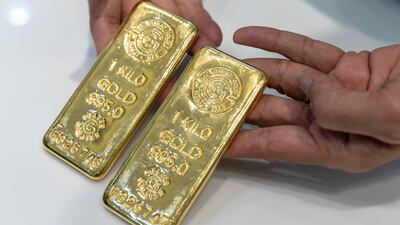
The UAE accounts for 80 per cent of India’s plain gold jewellery exports and 20 per cent of studded jewellery exports. -

Some of the jewellery from India, Italy and Turkey on display at Siroya Jewellers in Dubai. -

A jeweller examines a necklace at Siroya Jewellers in Dubai. -

Dubai is set to become a major gateway for Indian jewellery to the world, because of the economic agreement. -
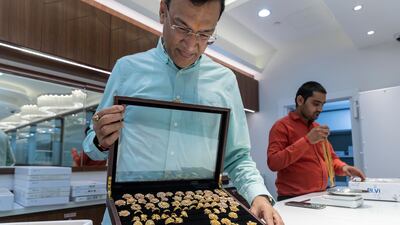
The family-owned Siroya Jewellers is one of Dubai’s biggest wholesalers, supplying jewellery to more than 30 countries. -

Gem and jewellery exports to the UAE declined to US$1.18 billion in 2020-2021 during the Covid-19 pandemic. -

With the duty waiver, India's Gem and Jewellery Export Promotion Council has said exports of gold from India to the UAE are expected to grow to US$10 billion in 2023.


Both are “buck-denominated”, Mr Razaqzada says, making them more expensive for buyers in other currencies, hitting demand from key buyers India and China.
While global investors fixate on US interest rates, the war in Ukraine rumbles on, with the risk that it could intensify or draw in China. Tensions over Taiwan could worsen, too.
Yet it all keeps coming back to the Fed, which faces a long struggle to get its funds rate down to its target of 2 per cent.
Larry Ball a macroeconomist at Johns Hopkins University, believes that would require an unemployment rate of 6.5 per cent for at least two years, the equivalent of 10.8 million workers.
That would plunge the US into a recession and drag the rest of the world into the heart of Mr Wilson’s “death zone”.
So is the rally now played out? The true answer is that nobody knows; stock markets are too complex for anyone to second guess.
But the air is getting thinner and investors should proceed with caution and keep checking their oxygen tanks.

