A New York Stock Exchange trader. It has been a difficult year for investors as equities remain in bear market territory. AP

Five difficult lessons investors have learnt this year


  • English
  • Arabic

Investors have learnt some hard lessons this year, after the 13-year-long bull market collapsed into confusion and volatility.

Those who piled into high-risk sectors such as US Big Tech, cryptocurrencies and meme stocks would have learnt the oldest lesson of all, which is that share prices can go down as well as up (and the faster they rise, the harder they fall).

Here are five more lessons that many investors have learnt the hard way — and how to apply them to your portfolio.

Lesson 1: the US Federal Reserve will not always bail out markets

For the past couple of decades, every time the stock market has looked in danger of a serious correction, the US Federal Reserve has raced to the rescue with yet another dollop of monetary easing.

This was originally known as the “Greenspan Put”, after former Fed chairman Alan Greenspan, which gave investors the idea that the central bank would always backstop asset prices.

Central bankers duly raced to the rescue during the financial crisis, slashing interest rates to almost zero in March 2009, and again during the Covid pandemic, flooding the market with stimulus in March 2020.

Now the backstop has gone.

Lavishing investors with fiscal and monetary stimulus worked when inflation was low, but will only fuel today’s inflationary bonfire.

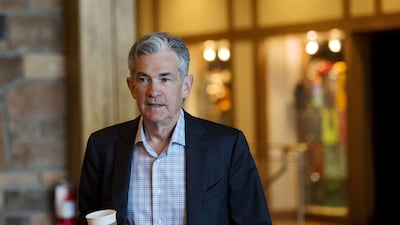
So instead of bailing markets out, Fed chairman Jerome Powell has another priority, according to Joshua Mahony, senior market analyst at online trading platform IG.

_________________

Watch: Federal Reserve's Jerome Powell warns of 'pain' in reducing inflation

“Mr Powell is hammering home the point that monetary policy will now address inflation rather than employment or growth concerns.”

He made it clear at last month’s Jackson Hole Economic Symposium that markets must brace themselves for more interest rate hikes, Mr Mahony says. “We remain a long way from the position where rates can be brought under control once again.”

The Fed will also step up the unwinding of its $9 trillion balance sheet, Vijay Valecha, chief investment officer at Century Financial, says. “With higher interest rates putting pressure on equity valuations while an earnings downgrade cycle is under way, more market turmoil may lie ahead.”

The summer stock market rally is gone and forgotten. “Instead of saving the economy, the Fed might trigger a recession,” Mr Valecha adds.

This lesson is going to be a harsh one.

Lesson 2: you do not play games with inflation

It is now 40 years since inflation was at today’s levels and investors are seeing first-hand the damage it inflicts.

Inflation wipes out the real value of savings and squeezes incomes as everyday living costs, such as food and fuel, soar out of control.

The Fed is willing to engineer a recession and stock market crash to defeat it, but its powers are limited, Russ Mould, AJ Bell investment director, says.

“The Fed has spent more than a decade trying to fuel inflation with the blunt instruments of interest rates and quantitative easing [QE] and is now using the same tools to choke it off.”

_____________

Jackson Hole Economic Symposium — in pictures

  • Federal Reserve chairman Jerome Powell's remarks are to be livestreamed from the annual Jackson Hole Economic Policy Symposium. Reuters
    Federal Reserve chairman Jerome Powell's remarks are to be livestreamed from the annual Jackson Hole Economic Policy Symposium. Reuters
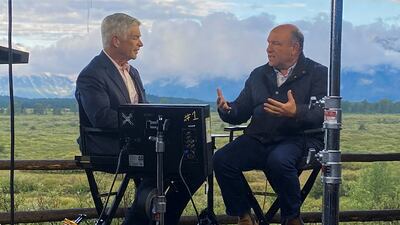
  • Philadelphia Federal Reserve Bank President Patrick Harker, left, speaks with CNBC's Steve Liesman in an interview ahead of the annual Federal Reserve Bank of Kansas City's Economic Policy Symposium, at Jackson Hole, Wyoming. Reuters
    Philadelphia Federal Reserve Bank President Patrick Harker, left, speaks with CNBC's Steve Liesman in an interview ahead of the annual Federal Reserve Bank of Kansas City's Economic Policy Symposium, at Jackson Hole, Wyoming. Reuters
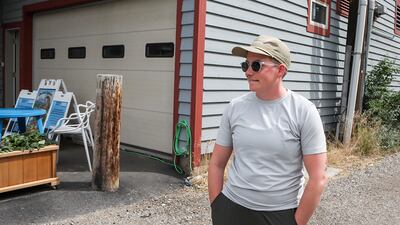
  • Ash Hermanowski, food access and operations manager of the Jackson Cupboard in Jackson Hole, hands out meals from a garage after the nonprofit's location flooded. AP
    Ash Hermanowski, food access and operations manager of the Jackson Cupboard in Jackson Hole, hands out meals from a garage after the nonprofit's location flooded. AP
  • High inflation, soaring home prices and financial inequality are all too visible in the idyllic mountain setting where the economic conference takes place. AP
    High inflation, soaring home prices and financial inequality are all too visible in the idyllic mountain setting where the economic conference takes place. AP
  • Esther George, president and chief executive officer of the Federal Reserve Bank of Kansas City, gives an interview at the Jackson Hole Economic Symposium Bloomberg
    Esther George, president and chief executive officer of the Federal Reserve Bank of Kansas City, gives an interview at the Jackson Hole Economic Symposium Bloomberg
  • Pierre-Olivier Gourinchas, professor of economics at the University of California-Berkeley, at the 2019 summit. Reuters
    Pierre-Olivier Gourinchas, professor of economics at the University of California-Berkeley, at the 2019 summit. Reuters
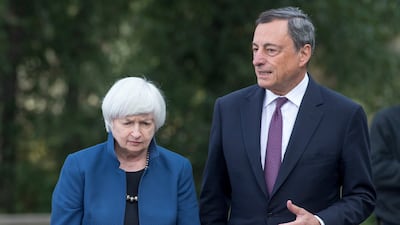
  • Janet Yellen, at the time chairwoman of board of governors of the Federal Reserve System and Mario Draghi, at the time president of the European Central Bank, at Jackson Hole in 2017. Bloomberg
    Janet Yellen, at the time chairwoman of board of governors of the Federal Reserve System and Mario Draghi, at the time president of the European Central Bank, at Jackson Hole in 2017. Bloomberg
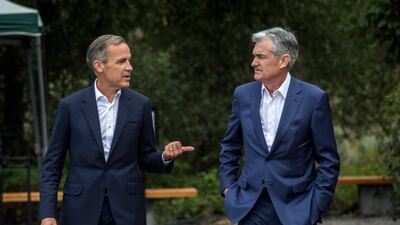
  • Mark Carney, left, at the time governor of the Bank of England, and Federal Reserve chairman Jerome Powell, at the 2019 Jackson Hole gathering. AP
    Mark Carney, left, at the time governor of the Bank of England, and Federal Reserve chairman Jerome Powell, at the 2019 Jackson Hole gathering. AP
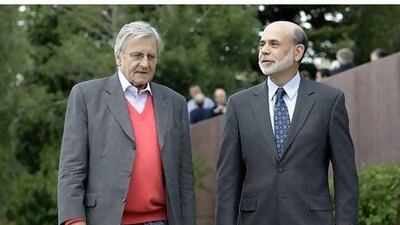
  • Former US Federal Reserve chairman Ben Bernanke, right, and Jean-Claude Trichet, former president of the European Central Bank, at a previous summit. AP
    Former US Federal Reserve chairman Ben Bernanke, right, and Jean-Claude Trichet, former president of the European Central Bank, at a previous summit. AP
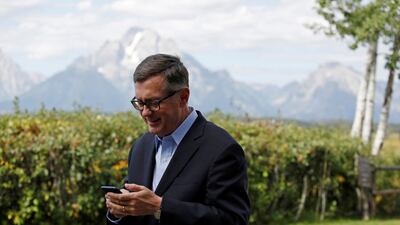
  • Former Federal Reserve vice chairman Richard Clarida at the 2019 Jackson Hole symposium. Reuters
    Former Federal Reserve vice chairman Richard Clarida at the 2019 Jackson Hole symposium. Reuters
  • With upscale ski resorts, campsites and ranches Jackson Hole is popular with outdoor enthusiasts. Bloomberg
    With upscale ski resorts, campsites and ranches Jackson Hole is popular with outdoor enthusiasts. Bloomberg

In 1974, inflation drove the Fed funds rate to 13 per cent. It hit 19 per cent in 1980, after the fall of the Shah of Iran in 1979 triggered a second oil-price shock.

Those interest rates are unthinkable today, with the Fed funds rate in a target range of 2.25 per cent to 2.5 per cent, but the historical echoes are making investors jittery, Mr Mould says.

Bear market falls of more than 20 per cent in the S&P 500, Russell 2000 and Nasdaq Composite may only be the start. “Even those pullbacks only take the indices back to where they were in spring 2021.”

The Fed is set to keep hammering away at inflation, regardless of the pain it inflicts, Mr Mould says. It has no choice.

Lesson 3: Germany doesn't always get it right

Germany is admired for its innovative, export-led economy, but this year even Europe's economic powerhouse has come unstuck.

The country faces political and economic disaster after getting hooked on Russian natural gas, leaving it at the mercy of President Vladimir Putin. It is now in a race against time to secure supplies of liquefied natural gas before winter arrives, after Mr Putin cut all deliveries through Nord Stream 1.

Germany now faces some of the highest gas prices in the world, Mr Mahony says. “Worryingly, consumers appear to be cutting back on spending with a view to braving a difficult winter, which is expected to drive the country into a deep recession.”

Germany's MSCI Index is down 29.6 per cent in the year to July 29, almost three times the fall of 9.61 per cent on the MSCI World Index.

Markets expect Germany’s struggles to continue, says Fawad Razaqzada, market analyst at City Index and Forex.com. “Reduced Russian energy shipments through the Nord Stream 1 pipeline have increased the risk of rationing in the coming months.”

At least Germany is waking up to its mistakes. The Government set a target of achieving gas storage of 85 per cent by October but now says it could hit that total early this month. "If it succeeds, rationing might be averted after all,” Mr Razaqzada says.

Germany has made mistakes before, but it has always bounced back. That’s another lesson history has taught us.

Lesson 4: bonds and shares can fall at the same time

Shares and bonds are supposed to complement each other within a portfolio, because when shares rise, bonds fall, and vice versa.

They are known as “non-correlating assets” and combining them in the classic 60/40 equity/bond portfolio is said to offer investors the best of both worlds.

Until this year, that is, when both asset classes fell at the same time.

It is a misconception that bond and share prices are uncorrelated, Symon Stickney, chief executive of digital asset manager Collidr, says.

“This led investors to believe that if shares fell, then the bond element of their portfolio would offer a partial hedge against that fall.”

As they fall in tandem, investors have no place to hide, he adds.

Inflation is bad for shares but spells “disaster” for bonds, as their fixed rate of income suddenly looks a lot less attractive, David Henry, investment manager at Quilter Cheviot, says. “Particularly when the starting income is basically non-existent, as was the case this time last year.”

Fund managers are “decrying the death of the classic 60/40 equity/bond portfolio” but Mr Henry cautions: “If we look at the historical numbers, maybe the grim reaper should hold on to his horses.”

Since 1986, there were just nine quarters when both bonds and stocks fell in tandem, but they bounced back strongly every time.

Which reminds us of another long-standing lesson, investing is cyclical. “Don’t get too excited on the way up, or too despondent on the way down,” Mr Henry adds.

Lesson 5: Bitcoin is not digital gold

Cryptocurrency enthusiasts have made a lot of big claims, but one of the most outlandish is that Bitcoin is now “digital gold”.

This year has put paid to that, with the price falling by more than two thirds to below $20,000.

Rather than a store of value, Bitcoin has been a destroyer. Instead of mimicking gold, it has been following moves in the US stock market, Mr Valecha says. “Bitcoin’s summer recovery of around 30 per cent was broadly in line with gains on US tech stocks.”

Bitcoin may recover, but only if stock markets do.

So what of real gold? It's also supposed to be a safe haven in a crisis, yet the price has fallen 8 per cent this year.

Gold is priced in dollars and it has been hit hard by greenback strength, which makes it more expensive to buyers in other currencies, suppressing demand.

Even if markets fall further, gold may not benefit, Mr Valecha says. “The US dollar may continue to gain, as US interest rates rise.”

Which brings us to our final lesson. The ultimate safe haven asset is the world’s reserve currency, the US dollar.

________________

Watch: What is Bitcoin and how did it start?

Key findings of Jenkins report
  • Founder of the Muslim Brotherhood, Hassan al Banna, "accepted the political utility of violence"
  • Views of key Muslim Brotherhood ideologue, Sayyid Qutb, have “consistently been understood” as permitting “the use of extreme violence in the pursuit of the perfect Islamic society” and “never been institutionally disowned” by the movement.
  • Muslim Brotherhood at all levels has repeatedly defended Hamas attacks against Israel, including the use of suicide bombers and the killing of civilians.
  • Laying out the report in the House of Commons, David Cameron told MPs: "The main findings of the review support the conclusion that membership of, association with, or influence by the Muslim Brotherhood should be considered as a possible indicator of extremism."
'HIJRAH%3A%20IN%20THE%20FOOTSTEPS%20OF%20THE%20PROPHET'
%3Cp%3E%3Cstrong%3EEdited%20by%3A%3C%2Fstrong%3E%20Idries%20Trevathan%3Cbr%3E%3Cstrong%3EPages%3A%3C%2Fstrong%3E%20240%3Cbr%3E%3Cstrong%3EPublisher%3A%3C%2Fstrong%3E%20Hirmer%20Publishers%3Cbr%3E%3Cstrong%3EAvailable%3A%3C%2Fstrong%3E%20Now%3C%2Fp%3E%0A
SPECS
%3Cp%3E%3Cstrong%3EEngine%3A%3C%2Fstrong%3E%201.5-litre%204-cylinder%3Cbr%3E%3Cstrong%3EPower%3A%3C%2Fstrong%3E%20101hp%3Cbr%3E%3Cstrong%3ETorque%3A%3C%2Fstrong%3E%20135Nm%3Cbr%3E%3Cstrong%3ETransmission%3C%2Fstrong%3E%3A%20Six-speed%20auto%3Cbr%3E%3Cstrong%3EPrice%3A%3C%2Fstrong%3E%20From%20Dh79%2C900%3Cbr%3E%3Cstrong%3EOn%20sale%3A%3C%2Fstrong%3E%20Now%3C%2Fp%3E%0A
LA LIGA FIXTURES

Thursday (All UAE kick-off times)

Sevilla v Real Betis (midnight)

Friday

Granada v Real Betis (9.30pm)

Valencia v Levante (midnight)

Saturday

Espanyol v Alaves (4pm)

Celta Vigo v Villarreal (7pm)

Leganes v Real Valladolid (9.30pm)

Mallorca v Barcelona (midnight)

Sunday

Atletic Bilbao v Atletico Madrid (4pm)

Real Madrid v Eibar (9.30pm)

Real Sociedad v Osasuna (midnight)

Benefits of first-time home buyers' scheme
  • Priority access to new homes from participating developers
  • Discounts on sales price of off-plan units
  • Flexible payment plans from developers
  • Mortgages with better interest rates, faster approval times and reduced fees
  • DLD registration fee can be paid through banks or credit cards at zero interest rates
While you're here
Sri Lanka squad

Dinesh Chandimal, Dimuth Karunaratne, Kaushal Silva, Kusal Mendis, Angelo Mathews, Lahiru Thirimanne, Niroshan Dickwella, Sadeera Samarawickrama, Rangana Herath, Suranga Lakmal, Nuwan Pradeep, Lakshan Sandakan, Vishwa Fernando, Lahiru Kumara, Jeffrey Vandersay, Milinda Siriwardana, Roshen Silva, Akila Dananjaya, Charith Asalanka, Shaminda Eranga and Dhammika Prasad.

Zodi%20%26%20Tehu%3A%20Princes%20Of%20The%20Desert
%3Cp%3E%3Cstrong%3EDirector%3A%20%3C%2Fstrong%3EEric%20Barbier%26nbsp%3B%3C%2Fp%3E%0A%3Cp%3E%3Cstrong%3EStarring%3A%20%3C%2Fstrong%3EYoussef%20Hajdi%2C%20Nadia%20Benzakour%2C%20Yasser%20Drief%3C%2Fp%3E%0A%3Cp%3E%3Cstrong%3ERating%3A%3C%2Fstrong%3E%204%2F5%3C%2Fp%3E%0A
TECH%20SPECS%3A%20APPLE%20WATCH%20SERIES%209
%3Cp%3E%3Cstrong%3EDisplay%3A%3C%2Fstrong%3E%2041mm%20%E2%80%93%20352%20x%20430%3B%2045mm%20%E2%80%93%20396%20x%20484%3B%20always-on%20Retina%20LTPO%20OLED%2C%202000%20nits%20max%3B%20Ion-X%20glass%20(aluminium%20cases)%2C%20sapphire%20crystal%20(stainless%20steel%20cases)%3C%2Fp%3E%0A%3Cp%3E%3Cstrong%3EProcessor%3A%3C%2Fstrong%3E%20Apple%20S9%2064-bit%2C%20W3%20wireless%2C%202nd-gen%20Ultra%20Wideband%3C%2Fp%3E%0A%3Cp%3E%3Cstrong%3ECapacity%3A%3C%2Fstrong%3E%2064GB%3C%2Fp%3E%0A%3Cp%3E%3Cstrong%3EMemory%3A%3C%2Fstrong%3E%201GB%3C%2Fp%3E%0A%3Cp%3E%3Cstrong%3EPlatform%3A%3C%2Fstrong%3E%20watchOS%2010%3C%2Fp%3E%0A%3Cp%3E%3Cstrong%3EHealth%20metrics%3A%3C%2Fstrong%3E%20Blood%20oxygen%20sensor%2C%20electrical%20heart%20sensor%20and%20ECG%2C%203rd-gen%20optical%20heart%20sensor%2C%20high%20and%20low%20heart%20rate%20notifications%2C%20irregular%20rhythm%20notifications%2C%20sleep%20stages%2C%20temperature%20sensing%3C%2Fp%3E%0A%3Cp%3E%3Cstrong%3EEmergency%20services%3A%3C%2Fstrong%3E%20Emergency%20SOS%2C%20international%20emergency%20calling%2C%20crash%20detection%2C%20fall%20detection%3C%2Fp%3E%0A%3Cp%3E%3Cstrong%3EConnectivity%3A%3C%2Fstrong%3E%20GPS%2FGPS%20%2B%20cellular%3B%20Wi-Fi%2C%20LTE%2C%20Bluetooth%205.3%2C%20NFC%20(Apple%20Pay)%3C%2Fp%3E%0A%3Cp%3E%3Cstrong%3EDurability%3A%3C%2Fstrong%3E%20IP6X%2C%20water%20resistant%20up%20to%2050m%2C%20dust%20resistant%3C%2Fp%3E%0A%3Cp%3E%3Cstrong%3EBattery%3A%3C%2Fstrong%3E%20308mAh%20Li-ion%2C%20up%20to%2018h%20regular%2F36h%20low%20power%3B%20wireless%20charging%3C%2Fp%3E%0A%3Cp%3E%3Cstrong%3ECards%3A%3C%2Fstrong%3E%20eSIM%3C%2Fp%3E%0A%3Cp%3E%3Cstrong%3EFinishes%3A%3C%2Fstrong%3E%20Aluminium%20%E2%80%93%20midnight%2C%20pink%2C%20Product%20Red%2C%20silver%2C%20starlight%3B%20stainless%20steel%20%E2%80%93%20gold%2C%20graphite%2C%20silver%3C%2Fp%3E%0A%3Cp%3E%3Cstrong%3EIn%20the%20box%3A%3C%2Fstrong%3E%20Watch%20Series%209%2C%20woven%20magnetic-to-USB-C%20charging%20cable%2C%20band%2Floop%3C%2Fp%3E%0A%3Cp%3E%3Cstrong%3EPrice%3A%3C%2Fstrong%3E%20Starts%20at%20Dh1%2C599%20(41mm)%20%2F%20Dh1%2C719%20(45mm)%3C%2Fp%3E%0A
What is blockchain?

Blockchain is a form of distributed ledger technology, a digital system in which data is recorded across multiple places at the same time. Unlike traditional databases, DLTs have no central administrator or centralised data storage. They are transparent because the data is visible and, because they are automatically replicated and impossible to be tampered with, they are secure.

The main difference between blockchain and other forms of DLT is the way data is stored as ‘blocks’ – new transactions are added to the existing ‘chain’ of past transactions, hence the name ‘blockchain’. It is impossible to delete or modify information on the chain due to the replication of blocks across various locations.

Blockchain is mostly associated with cryptocurrency Bitcoin. Due to the inability to tamper with transactions, advocates say this makes the currency more secure and safer than traditional systems. It is maintained by a network of people referred to as ‘miners’, who receive rewards for solving complex mathematical equations that enable transactions to go through.

However, one of the major problems that has come to light has been the presence of illicit material buried in the Bitcoin blockchain, linking it to the dark web.

Other blockchain platforms can offer things like smart contracts, which are automatically implemented when specific conditions from all interested parties are reached, cutting the time involved and the risk of mistakes. Another use could be storing medical records, as patients can be confident their information cannot be changed. The technology can also be used in supply chains, voting and has the potential to used for storing property records.

Company Profile 

Founder: Omar Onsi

Launched: 2018

Employees: 35

Financing stage: Seed round ($12 million)

Investors: B&Y, Phoenician Funds, M1 Group, Shorooq Partners

COMPANY PROFILE
Name: ARDH Collective
Based: Dubai
Founders: Alhaan Ahmed, Alyina Ahmed and Maximo Tettamanzi
Sector: Sustainability
Total funding: Self funded
Number of employees: 4

The Two Popes

Director: Fernando Meirelles

Stars: Anthony Hopkins, Jonathan Pryce 

Four out of five stars

World record transfers

1. Kylian Mbappe - to Real Madrid in 2017/18 - €180 million (Dh770.4m - if a deal goes through)
2. Paul Pogba - to Manchester United in 2016/17 - €105m
3. Gareth Bale - to Real Madrid in 2013/14 - €101m
4. Cristiano Ronaldo - to Real Madrid in 2009/10 - €94m
5. Gonzalo Higuain - to Juventus in 2016/17 - €90m
6. Neymar - to Barcelona in 2013/14 - €88.2m
7. Romelu Lukaku - to Manchester United in 2017/18 - €84.7m
8. Luis Suarez - to Barcelona in 2014/15 - €81.72m
9. Angel di Maria - to Manchester United in 2014/15 - €75m
10. James Rodriguez - to Real Madrid in 2014/15 - €75m

The%C2%A0specs%20
%3Cp%3E%0D%3Cstrong%3EEngine%3A%20%3C%2Fstrong%3E6-cylinder%2C%204.8-litre%20%0D%3Cbr%3E%3Cstrong%3ETransmission%3A%20%3C%2Fstrong%3E5-speed%20automatic%20and%20manual%0D%3Cbr%3E%3Cstrong%3EPower%3A%20%3C%2Fstrong%3E280%20brake%20horsepower%20%0D%3Cbr%3E%3Cstrong%3ETorque%3A%20%3C%2Fstrong%3E451Nm%20%0D%3Cbr%3E%3Cstrong%3EPrice%3A%20%3C%2Fstrong%3Efrom%20Dh153%2C00%0D%3Cbr%3E%3Cstrong%3EOn%20sale%3A%20%3C%2Fstrong%3Enow%3C%2Fp%3E%0A

Hotel Silence
Auður Ava Ólafsdóttir
Pushkin Press

'Unrivaled: Why America Will Remain the World’s Sole Superpower'
Michael Beckley, Cornell Press

Mercer, the investment consulting arm of US services company Marsh & McLennan, expects its wealth division to at least double its assets under management (AUM) in the Middle East as wealth in the region continues to grow despite economic headwinds, a company official said.

Mercer Wealth, which globally has $160 billion in AUM, plans to boost its AUM in the region to $2-$3bn in the next 2-3 years from the present $1bn, said Yasir AbuShaban, a Dubai-based principal with Mercer Wealth.

Within the next two to three years, we are looking at reaching $2 to $3 billion as a conservative estimate and we do see an opportunity to do so,” said Mr AbuShaban.

Mercer does not directly make investments, but allocates clients’ money they have discretion to, to professional asset managers. They also provide advice to clients.

“We have buying power. We can negotiate on their (client’s) behalf with asset managers to provide them lower fees than they otherwise would have to get on their own,” he added.

Mercer Wealth’s clients include sovereign wealth funds, family offices, and insurance companies among others.

From its office in Dubai, Mercer also looks after Africa, India and Turkey, where they also see opportunity for growth.

Wealth creation in Middle East and Africa (MEA) grew 8.5 per cent to $8.1 trillion last year from $7.5tn in 2015, higher than last year’s global average of 6 per cent and the second-highest growth in a region after Asia-Pacific which grew 9.9 per cent, according to consultancy Boston Consulting Group (BCG). In the region, where wealth grew just 1.9 per cent in 2015 compared with 2014, a pickup in oil prices has helped in wealth generation.

BCG is forecasting MEA wealth will rise to $12tn by 2021, growing at an annual average of 8 per cent.

Drivers of wealth generation in the region will be split evenly between new wealth creation and growth of performance of existing assets, according to BCG.

Another general trend in the region is clients’ looking for a comprehensive approach to investing, according to Mr AbuShaban.

“Institutional investors or some of the families are seeing a slowdown in the available capital they have to invest and in that sense they are looking at optimizing the way they manage their portfolios and making sure they are not investing haphazardly and different parts of their investment are working together,” said Mr AbuShaban.

Some clients also have a higher appetite for risk, given the low interest-rate environment that does not provide enough yield for some institutional investors. These clients are keen to invest in illiquid assets, such as private equity and infrastructure.

“What we have seen is a desire for higher returns in what has been a low-return environment specifically in various fixed income or bonds,” he said.

“In this environment, we have seen a de facto increase in the risk that clients are taking in things like illiquid investments, private equity investments, infrastructure and private debt, those kind of investments were higher illiquidity results in incrementally higher returns.”

The Abu Dhabi Investment Authority, one of the largest sovereign wealth funds, said in its 2016 report that has gradually increased its exposure in direct private equity and private credit transactions, mainly in Asian markets and especially in China and India. The authority’s private equity department focused on structured equities owing to “their defensive characteristics.”

Cinco in numbers

Dh3.7 million

The estimated cost of Victoria Swarovski’s gem-encrusted Michael Cinco wedding gown

46

The number, in kilograms, that Swarovski’s wedding gown weighed.

1,000

The hours it took to create Cinco’s vermillion petal gown, as seen in his atelier [note, is the one he’s playing with in the corner of a room]

50

How many looks Cinco has created in a new collection to celebrate Ballet Philippines’ 50th birthday

3,000

The hours needed to create the butterfly gown worn by Aishwarya Rai to the 2018 Cannes Film Festival.

1.1 million

The number of followers that Michael Cinco’s Instagram account has garnered.

Ukraine%20exports
%3Cp%3EPresident%20Volodymyr%20Zelenskyy%20has%20overseen%20grain%20being%20loaded%20for%20export%20onto%20a%20Turkish%20ship%20following%20a%20deal%20with%20Russia%20brokered%20by%20the%20UN%20and%20Turkey.%3Cbr%3E%22The%20first%20vessel%2C%20the%20first%20ship%20is%20being%20loaded%20since%20the%20beginning%20of%20the%20war.%20This%20is%20a%20Turkish%20vessel%2C%22%20Zelensky%20said%2C%20adding%20exports%20could%20start%20in%20%22the%20coming%20days%22%20under%20the%20plan%20aimed%20at%20getting%20millions%20of%20tonnes%20of%20Ukrainian%20grain%20stranded%20by%20Russia's%20naval%20blockade%20to%20world%20markets.%3Cbr%3E%22Our%20side%20is%20fully%20prepared%2C%22%20he%20said.%20%22We%20sent%20all%20the%20signals%20to%20our%20partners%20--%20the%20UN%20and%20Turkey%2C%20and%20our%20military%20guarantees%20the%20security%20situation.%22%3C%2Fp%3E%0A
Kill%20
%3Cp%3E%3Cstrong%3EDirector%3A%3C%2Fstrong%3E%20Nikhil%20Nagesh%20Bhat%3C%2Fp%3E%0A%3Cp%3E%3Cstrong%3EStarring%3C%2Fstrong%3E%3A%20Lakshya%2C%20Tanya%20Maniktala%2C%20Ashish%20Vidyarthi%2C%20Harsh%20Chhaya%2C%20Raghav%20Juyal%3C%2Fp%3E%0A%3Cp%3E%3Cstrong%3ERating%3A%3C%2Fstrong%3E%204.5%2F5%3Cbr%3E%3C%2Fp%3E%0A
Updated: March 13, 2024, 12:13 PM