

To understand why Mark Zuckerberg thinks the metaverse is the next frontier, consider the case of Sam Peurifoy. The 27-year-old, who holds a doctorate in chemistry from Columbia University in New York, left his job at Goldman Sachs at the height of the Covid-19 pandemic and is now seeking his fortune in cryptocurrency by playing video games.
He has recruited dozens of people from Mexico to the Philippines to a “Guild” that plays under the command of “Captain” Peurifoy. In exchange, he contributes to the funds needed to enter Axie Infinity, a game where players collect Smooth Love Potion – a digital token that can potentially be converted into real money.
The metaverse of Mr Zuckerberg’s dreams is the sort of place where everyone’s plugged into a virtual reality, able to teleport, make things happen merely by thinking about them and effectively step beyond the limitations of the physical world into a brave, new digital one. The billionaire concedes this is still “a long way off”.
But what Mr Peurifoy and his Guild are now doing on Axie offers an early glimpse into this future. It’s not quite Ready Player One – Steven Spielberg’s dystopian sci-fi adventure based on Ernest Cline’s book – or even Snow Crash, the 1992 Neal Stephenson novel that coined the term “metaverse”.
Rather, It’s an online arena where “decentralised finance,” or DeFi, reigns – fusing together cryptocurrencies, blockchain technology, non-fungible tokens and video gaming.
However, his world is filled with dangers and is far from altruistic. Investors and bankers have profound disagreements about how cryptocurrencies will shake out in the end, but what they do know is that prices have been extremely volatile.
With technical outages and sudden price shifts, there’s no guarantee these tokens can be converted into cash. In the cryptocurrency world, it’s also seen as a rite of passage to be scammed at one point or another. That may be fine for wealthy investors who can stomach the risk, but could leave market participants vulnerable.
Axie – which is at the forefront of this “GameFi” trend – has already generated more than $2.5 billion in trading volume. Several other rivals offering games that lure players with the promise of cryptocurrency are also gaining popularity. Venture capitalists and hedge funds are trying to cash in on this new online gold rush.
The ability to earn by playing a game has transformed the lives of some players, many in the Philippines where it exploded in popularity as the pandemic locked many out of work, and dollars – as well as digital tokens – go far. At least when their prices are up.
-

Axie Infinity, the game in which players earn cryptocurrency. Photo: Sky Mavis -
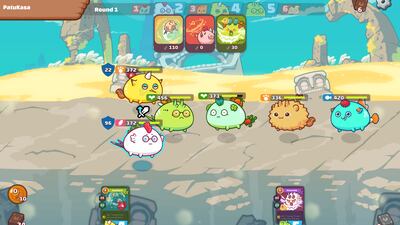
Axie Infinity, the game in which players earn cryptocurrency. Photo: Sky Mavis -
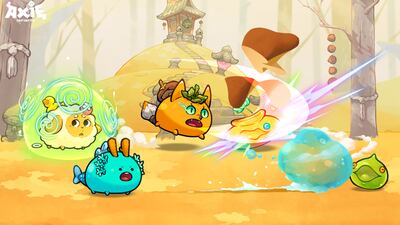
Axie Infinity, the game in which players earn cryptocurrency. Photo: Sky Mavis -
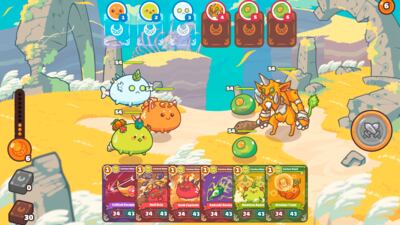
Axie Infinity, the game in which players earn cryptocurrency. Photo: Sky Mavis


It’s impossible to say exactly how many people are playing to earn. But all the signs are pointing up. One marker: the relationship between games and digital wallets, those accounts people use to receive and store cryptocurrency.
As of last March, about 51,000 daily active wallets were connected to gaming-related contracts in the blockchain ecosystem, according to DappRadar, a firm that tracks data on DeFi. Three months later, that figure had risen sharply to 359,284 – a 599 per cent increase.
Games like Axie show why tech titans are gravitating towards the concept: the metaverse and its possibilities have the potential to upend not only how we work, earn and spend, but also the fundamental ways in which we live, plan and run our lives. In essence, they promise to transform the way capitalism functions.
“Axie embodies a new generation of games, where game creators are not operating from a place of fear but rather as an open, free market economy,” says Arianna Simpson, general partner at venture capital firm Andreessen Horowitz that invested in Sky Mavis, the Vietnamese studio that developed Axie. “What this means for the future of games and really the web as we know it, is as big as your imagination will allow.”
What Ms Simpson is hinting at goes beyond the mere fact that Axie players can earn cryptocurrencies. Axie shows how a key pillar of the metaverse – the NFT – works and why anyone might want to get their hands on one.
NFTs are digital certificates that help prove that you own things in the online realm.
In Axie’s corner of the metaverse, players must buy NFTs before they can play. They must buy a minimum of three Axies, at roughly $300 apiece, paid for in Ethereum. In other words, it takes nearly $1,000 to start playing, with no guarantee of success.
The result: Axie has become the single most valuable collection of NFTs anywhere yet.
Numbers like those have perked rich ears. Last May, Mark Cuban and Alexis Ohanian, co-founder of Reddit, invested in Sky Mavis.
Justin Sun, chief executive of BitTorrent and founder of Tron Foundation, launched a $300m fund focusing on play-to-earn and GameFi. Andreessen Horowitz, valuing Sky Mavis at $3bn, recently led a Series B funding round of $150m.
What’s notable with NFTs in GameFi is that they aren’t just digital files to look at. They do stuff, interact with other NFTs and can appreciate over time.
“Players can actually own the game items and they can see that they are scarce,” says Axie co-founder Aleksander Larsen. “It’s much more real than when you see someone wearing a Louis Vuitton bag on the street. The thing that blockchain brings is trust. That then extends to digital assets.”
co-founder, Axie
For years, players like Mr Peurifoy have paid the overlords of a $175bn industry – Sony, Nintendo, Tencent, Microsoft – homage to play in digital fiefs. They’ve watched the fruits of their labour vanish into nothing once the game is over. They want something more, something closer to capitalism, with private ownership of the means of production, wage labour and voluntary exchange.
In this new world order, Mr Peurifoy is a bit like a banker. He’s created his digital Guild built around his online persona, literally called Das Kapitalist. Members of this Guild meet on Twitch, a sort of YouTube for video games with live streams and chat functionality.
Because Axie NFTs are so expensive, Mr Peurifoy funds “scholarships” for willing players. He owns the NFTs, but his Guild members play them, earning more cryptocurrency. Mr Peurifoy then splits the winnings with his players.
Carlos Almaraz, 24, discovered Axie this summer and dropped out of medical school in hopes of getting rich in GameFi.
Mr Almaraz, who goes by the handle Steel Valkyries, is already moving up in the Axie economy. He’s gone from blue-collar “scholar” to more white-collar “moderator”.
He pulled in $700 (real dollars) in September – more than his parents earn combined. They still haven’t totally gotten over his decision to drop out of medical school but, he says, they can’t argue with the money.
On the Das Kapitalist live stream on a recent Thursday night, the Captain is rallying the crew. One member of the Guild, known as Fordex, is about to become a father.
“Dude, that’s so cool!” Mr Peurifoy says. “That’s the first baby in the community!”
Later, at 9pm on a recent Sunday, the Captain is back. He mentions that the founder of another cryptocurrency game recently tweeted that Axie sounds a bit like a Ponzi scheme.
No one seems to care. “I’m out-earning my dad,” another Guild member says. “He thought I was stealing or doing some fraud.”
The conversation turns to parental expectations, dead-end jobs, the banality of real-world life – a twentysomething, metaverse-view in which the hopes of a generation have led to this, a Twitch livestream about a play-for-pay game.
Axie is just one realm in the growing crypto-verse. There’s also CryptoBlades, a virtual Middle Earth where players earn Skill tokens by slaying monsters. And there’s Zed Run, in which players own, race and breed digital thoroughbreds. Illuvium promises a “journey across a vast and varied landscape on your quest to hunt and capture deity-like creatures”.
As Axie has lured players, Axie Infinity Shards – another token in the game – have taken off. AXS has soared from $3.22 in June to about $136 now.

Such upside isn’t lost on gamers, particularly those in developing countries. Chatrooms are full of stories about how Axie helped someone get by during the pandemic or even earn enough money to buy a home.
In the Philippines, Red Bantilo turned to Axie after losing his job as a fitness trainer. His wife quit her job as a nurse because she didn’t feel safe and is now playing Axie, too.
Mr Bantilo, 34, has parlayed a small, initial investment into a stash of 130,000 Axie tokens. He’s been able to buy health insurance and is hoping to make enough to renovate his home in Bulacan, just north of Manila. He’s also sponsoring 28 scholars.
Cryptocurrency evangelists will tell you that blessings will rain down upon the faithful. Shreyansh Singh, head of NFTs and gaming at Polygon, says major game studios are watching. He predicts the transition to play-to-earn will be slow and difficult, but says the switch appears “inevitable”.
“They can’t abandon what they know and jump on to an entirely new ship,” Mr Singh says of the game lords.
Countless hurdles loom. Game developers are trying to build out “know your customer” capabilities akin to the ones banks use to ferret out illicit money, according to Thomas Olsen, a partner at Bain & Co.
partner, Bain & Co
Cryptocurrency has no shortage of bad actors, but then, the entire financial world is moving towards blockchain-style technology.
“Ten or 20 or 30 years in the future, all assets are going to be tokenised,” Mr Olsen says. “All equities, all bonds are going to be on a digital asset platform that is being built by the crypto experiment today.”
Nick Kneuper is part of the experiment right now. His company is putting out a game called Crypto Raiders. He has a team of about 10 people and 1,800 players. They initially sold NFT characters for $45 a pop. Within three months, those NFTs were fetching $680.
Mr Kneuper, 31, is aptly named the “head of growth”. But can runaway growth lead to problems for virtual worlds, the way it can for the real one?
“The real challenge,” says Mr Kneuper, “is creating a balanced game”. Too many players earning too much digital money could effectively crash a game’s economy.
What happens if millions want to play Axie tomorrow – or if, for whatever reason, the Smooth Love Potion that gamers have been chasing for hours, days, weeks and months abruptly collapsed?
In that scenario, the gamers’ virtual world problems start to get real fast. Future metaverse economies will have to be managed just like our real one, Mr Kneuper says.
His prediction: “People with economics degrees are going to be hired by NFT games.”
Bloomberg

