


The UAE Sustainable Finance Working Group, comprised of local regulators and exchanges chaired by the Abu Dhabi Global Market, issued a high-level statement on sustainable finance, detailing their commitment to achieving the UAE’s sustainability objectives and the recently announced net-zero 2050 programme.
The statement, issued on the sidelines of the Glasgow Cop26 summit, outlines three key deliverables: a targeted study aimed at encouraging consistent environmental social and governance corporate disclosure standards across the UAE, examining how to strengthen good corporate governance by UAE companies, and, crucially, developing a UAE taxonomy of sustainable activities, which constitutes a major milestone defining the path for economic transition to sustainable development.
The group includes the Ministry of Economy, the Ministry of Finance, the Office of the UAE’s Special Envoy for Climate Change, the Ministry of Climate Change and Environment, the Central Bank of the UAE, the Securities and Commodities Authority, the Dubai Financial Services Authority, the Abu Dhabi Securities Exchange, the Dubai Financial Market and Nasdaq Dubai.
"Addressing the impact of climate change has never been more critical, and the financial regulators must work together to establish standards and norms that support the development of a sustainable economy with long term value returns," Ahmed Jasim Al Zaabi, chairman of ADGM, said.
"As key UAE regulators, we at ADGM are responsible for setting out robust frameworks that promote greater adoption of sustainable financing, to support the nation’s ambitious net-zero objective."
Investors in the UAE are increasingly seeing the benefits of integrating sustainable investing into their portfolio, with a recent study by Swiss investment bank UBS showing that 93 per cent believe it is a crucial part of their financial strategy.
-

Activists dressed as Pokemon character Pikachu protest near the Cop26 summit venue in Glasgow against Japan's use of coal. AP Photo -
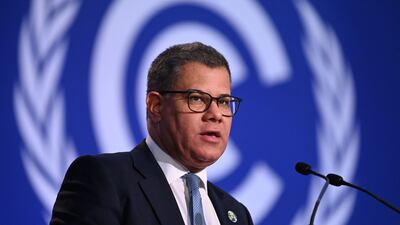
Alok Sharma, the Cop26 president, addresses a session. AFP -

A delegate wears a virtual-reality headset at the media centre. Reuters -

Sunrise over the SEC on the banks of the River Clyde, where the Cop26 summit is being held. Getty Images -

Kwasi Kwarteng, the British Secretary of State for Business, Energy and Industrial Strategy, speaks to delegates. Getty Images -

Delegates arrive in bright sunshine on Energy Day at Cop26. Getty Images -
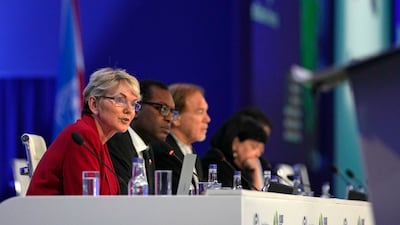
Jennifer Granholm, US Secretary of Energy, listens at the conference. AP Photo -

Extinction Rebellion activists demonstrate in Glasgow. Reuters


A Standard Chartered survey revealed that 74 per cent of UAE investors want to leave a positive legacy through sustainable investing compared with the global average of 65 per cent.
Globally, the total value of sustainable and responsible investments stood at $35.3 trillion as of 2020, an increase of 15 per cent over the previous two years alone, according to the 2021 Global Sustainable Investment Review.
The UAE's statement sets a clear roadmap for the participating authorities to contribute to the nation's sustainable and climate change objectives, outlined in global frameworks such as the Paris Agreement, the United Nations Sustainable Development Goals and the UAE's own net zero objective.
"Amongst the many areas on which MOCCAE focuses in its commitment to responding to climate change, sustainable finance remains one of the crucial pillars supporting the development of a successful, green, and resilient economy," said Mariam Al Mheiri, Minister of Climate Change and Environment, and Minister of State for Food Security.
chairman of ADGM
"The significant investment in clean and renewable energy sources that will be required to implement the UAE Net Zero by 2050 Strategic Initiative over the course of the next three decades only underscores the critical importance of sustainable finance."
The statement added that the implementation of the deliverables will be achieved through both legislative and non-legislative means and in co-ordination with authorities on the monitoring and technical support required to incorporate sustainability into regulatory frameworks.
"Mitigating the impact of climate change on key economic sectors is a prerequisite for building resilient and sustainable economies. We are committed to devising sustainable finance policies to contribute to the UAE’s net-zero goal and support sustainable economic and social development, which represent a key pillar for the next 50 years," said Younis Haji Al Khoori, undersecretary of the Ministry of Finance.

