

A lot of people still do not get the point of Bitcoin. They say it does nothing that could not be done before. That it has no intrinsic value. That it is dirty, both in terms of emissions and the way it is used by criminals.
The charge sheet against Bitcoin is a long one. The cryptocurrency is volatile and its price movements are impossible to predict or explain, even in hindsight. The market is dominated by a handful of investors known as the whales, who can shift the price at will, or in the case of Tesla founder Elon Musk, with a single tweet.
Yet even its harshest critics have to accept that with a market cap of $1 trillion, Bitcoin has made its point.
It has survived scorn and derision from the great and the good – from Warren Buffett to economist Nouriel Roubini, who reckons “the Flintstones had a better monetary system”.
Now, it has even withstood a regulatory clampdown from China, which shut down Bitcoin miners or drove them abroad.
Matjaz Skorjanc, founder of cryptocurrency platform NiceHash, suggests that Bitcoin has actually benefited from this. “It is even stronger now that governments see it as a threat, since that proves that it works.”
chief executive, Polybius and OSOM Finance
On July 20, the price dipped below $30,000. At the time of writing, it has almost doubled to $60,000. Some reckon the price could soon hit $100,000 or $120,000, but have you left it too late?
It is never too late to get into Bitcoin, just like it is never too late to get into gold, says Anton Altement, chief executive of Polybius and OSOM Finance. “Both assets are perceived as a reliable store of value and it’s likely to stay that way for the foreseeable future.”
The price is being driven by two underlying megatrends, he says. The first is monetary easing as low interest rates and money printing boost the appeal of Bitcoin, whose supply cannot increase.
The second is its growing adoption by big financial institutions, Mr Altement says. “As crypto assets mature and their purpose becomes clearer, institutional investors are keener to embrace them.”
In a further boost, the International Swaps and Derivatives Association is integrating cryptocurrencies into its transactional framework, he says.
Marcus de Maria, chief executive of Investment Mastery, also says this is only the start. “Less than 4 per cent of the world’s population holds Bitcoin, which means it has a lot of room to grow.”
Only 21 million Bitcoins will ever be created – fewer than the number of millionaires in the world, he says. “It is now viewed more as a store of value, like gold, but far superior – many are calling it ‘liquid gold’ because it can be sent in minutes across the globe.”
-
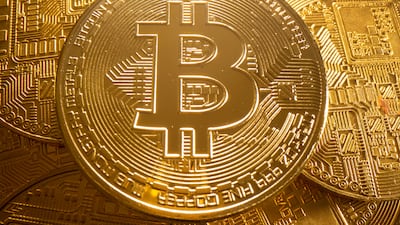
Bitcoin slid about 8 per cent to $40,237 in early Asian trading on September 21, 2021, dropping to its lowest level since the beginning of August. Reuters -

Vitalik Buterin, the co-founder of Ethereum, became the world's youngest crypto billionaire after Ether breached the $3,000 level in May this year. Bloomberg -
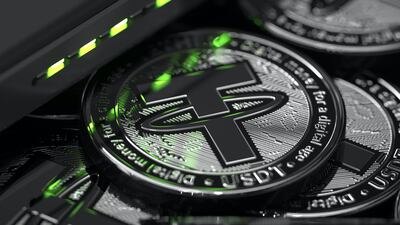
Tether, also known as USTD, is considered a stablecoin as it was designed to always be worth $1. Unsplash -
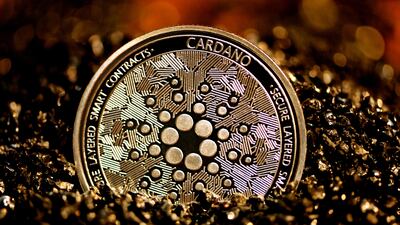
Cardano is growing in popularity with cryptocurrency investors after reaching a market cap of $77 billion in May this year. Unsplash -
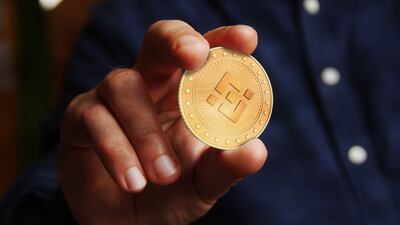
Binance Coin is one of the biggest cryptocurrencies in the world. Alamy -
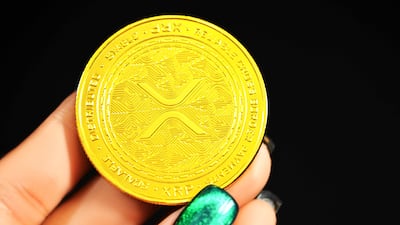
US technology company Ripple created the XRP cryptocurrency in 2012. Today, it is trading at about $0.94, according to Coinbase. Unsplash -

Solana, a programmable blockchain cryptocurrency, hit a record $80.12 in August. Bloomberg -

The USD Coin is a stablecoin with about $27 billion worth of coins in global circulation. Unsplash -
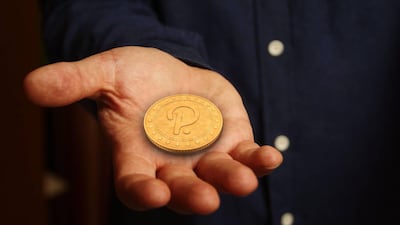
The Polkadot cryptocurrency is built on a multi-blockchain network and has a market cap of about $28.8 billion. Alamy -
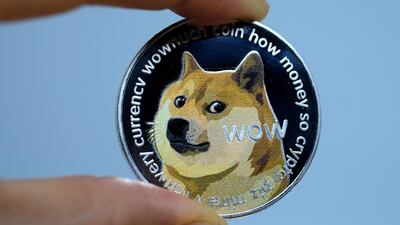
Originally designed as a meme joke in 2013, Dogecoin today trades for about $0.21 and has a market capitalisation of about $27.6 billion. Getty Images


One question remains, Mr de Maria says. “Bitcoin is like money 2.0 since it is cheaper, faster and more accessible. So, why didn’t people buy when it dipped?”
His answer is that investors let emotions get the better of them. “Instead of being happy when it falls, they get fearful. The danger is that too many buy high and sell low, instead of the other way around.”
Mr de Maria fears private investors could make the opposite mistake if Bitcoin now flies to $100,000. “At that point, the sky is the limit and that’s when the real fear of missing out, or Fomo, will kick in.”
The market is bubbling with anticipation of a new all-time high for Bitcoin, but calling price movements is "a fool’s errand”, says Simon Peters, cryptoasset analyst at multi-asset investment platform eToro.
Despite all the frenzy around Bitcoin, the most common strategy is to buy and hold, or as Bitcoin traders call it, HODL.
This is squeezing supply and driving up the price. “More than 2.37 million Bitcoin migrated from shorter term to longer term holders in the past seven months, according to Glassnode. In that period, just 166,000 has been mined,” Mr Peters says.
He expects to see price resistance towards the $60,000 level and potentially a pull-back.
founder, Tally
Crypto investors must focus on the long-term use cases of the tokens, Mr Peters says. “Focusing on short-term price movements is a highly risky approach.”
Cameron Parry, founder of challenger banking platform Tally, says Bitcoin’s highly concentrated ownership makes extreme volatility inevitable.
“An estimated 2 per cent of Bitcoin wallets own between 70 per cent and 95 per cent of all coins. This puts the currency at the mercy of ‘whales’, who can have a huge impact on price,” he says.
No viable currency can be so susceptible to the actions of a mere handful of players, Mr Parry says.
While the US Securities and Exchange Commission may have triggered the recent jump by saying it has no intention to ban Bitcoin, “reports that a mysterious investor, or group of investors, has placed a $1.6 billion order also helped”, says Ross Thompson, finance and accountancy lecturer at Arden University in the UK.
Cryptocurrency thrives on this kind of speculation, which will drive impressive spikes or huge drops, Mr Thompson says. “There is likely to be another drop sooner than later, giving people an opportunity to invest.”
It may also be worth keeping an eye on other cryptocurrencies that are rising, such as Shiba Inu, he says.
Do not look for rhyme or reason in any of this, Mr Thompson says. “The rising Bitcoin price suggests speculators are betting on good times ahead. Just what that is, remains hard to fathom.”
El Salvador adopting Bitcoin as legal tender was another step towards mainstream adoption, says Rene Pomassl, chief executive of Salamantex.
The big question now is how cryptocurrencies will fit into the broader financial ecosystem. “We don’t expect them to replace conventional payment methods but sit alongside them,” he says.
Central bankers are fighting back by launching their own digital currencies, but Mr Pomassl says this could further boost crypto assets. “It could encourage retail and institutional investors to see cryptocurrencies as a viable payment option.
“Ultimately, the enabler to mass adoption will be crypto’s integration into existing payment infrastructures,” he says.
Central bankers have not given in yet, according to Susannah Streeter, senior investment and markets analyst at Hargreaves Lansdown.

“Sir Jon Cunliffe, the deputy governor of the Bank of England, believes speculation has reached such a level that a crypto time-bomb is now ticking, which could blow up in the face of the financial sector,” she says.
Unregulated cryptocurrency assets have grown from just under $800 billion to $2.3 trillion this year alone, a rise of 200 per cent, with contagion a danger if it deflates, Ms Streeter says.
The UK’s Financial Conduct Authority is extremely worried about the collision between social media and the cryptocurrency world, she says.
“Kim Kardashian’s single post about a token earlier this year was the biggest financial promotion in history. Regulators fear financially vulnerable younger investors being targeted by influencers in crypto wild west could undermine the stability of the financial system.”
Central bankers responded by pushing stable coins, pegged to fiat currencies such as the dollar, but these only make up about 5 per cent of cryptocurrency assets.
senior investment and markets analyst, Hargreaves Lansdown
The influential Basel Committee on Banking Supervision is considering making financial institutions who dabble in cryptocurrencies put aside enough capital to cover 100 per cent of potential losses, Ms Streeter says.
“This could make cryptocurrency dealing and investment very expensive and limit the number of new institutional entrants.”
She acknowledges that regulators may be reluctant to tighten too much, because they could get left behind in the fast-moving world of decentralised finance, as others welcome cryptocurrencies with open arms.
Many will regret failing to snap up Bitcoin during this summer’s lows, but there will be plenty of other buying opportunities so don’t despair, Chris Muller, director of audience growth at DoughRoller.net, says.
“Even once all the Bitcoin is mined, which will take a while, each can be broken down into one hundred million ‘satoshis’, plus there are many other digital coins out there.”
Mr Muller suggests investing a regular monthly amount in a spread of cryptocurrencies. “You’ll ride the ups and the downs, but if crypto succeeds, you’ll be glad you put away all those small portions.”
Do not be too hard on yourself if you have missed out altogether.
“At least, you’re in the good company of Warren Buffett,” Mr Muller says.

