

The space race is back on, but this time it is commercial companies battling it out rather than Cold War rivals the US and the Soviet Union, while investors are placing their bets on the winners in the hope of generating rocket-fuelled returns.
The so-called SpaceTech sector remains the final frontier for investors but with big names such as Jeff Bezos’ Blue Origin, Richard Branson’s Virgin Galactic and Elon Musk’s SpaceX commercialising space travel and commandeering attention, it is impossible to ignore.
Around $6.4 billion was invested in SpaceTech in the first half of 2021 – the equivalent to 85 per cent of investment for the whole of 2020, according to new research from Seraphim.
The pace of growth is accelerating – of this, $3.7bn was in the second quarter, up from $2.7bn in the first.
The space industrial revolution is “demonstrably in full swing” as 34 rockets launched 573 satellites during the second quarter, Seraphim says.
This is the most exciting new frontier of them all but, as ever with a hot new sector, investors must beware the hype or risk of getting sucked into an investment black hole.
Private equity funds and venture capitalists are pouring money into space travel, satellite communications, telecoms, Earth imaging and aerospace.
Before 2021, just six space companies had gone public, raising a combined $800 million. So far this year, 12 space-related businesses have announced special purpose acquisition company (SPAC) mergers, representing more than $7bn of investment, Seraphim says.
Private investors can now get a share of the action, with two notable space investment fund launches this year.
Star fund manager Cathie Wood, chief investment officer and chief executive of ARK Investment Management, launched the ARK Space Exploration and Innovation ETF in March, targeting the SpaceTech space.
Ms Wood is famed for investing in “disruptive innovation” and sees the two biggest opportunities in satellite mobile connectivity, which could give 3.5 billion people mobile access for the first time, and hypersonic flights that could carry passengers from New York to Japan or Australia in two hours.
The ARK Space Exploration and Innovation ETF's top holdings include global navigation satellite specialist Trimble and autonomous drone firm Kratos Defence, as well as defence giants Lockheed Martin and Boeing.
However, some of the ETF's holdings may surprise – for example, it holds farm machinery manufacturer John Deere, which is using satellite technology to improve precision agriculture and guide autonomous vehicles.
Ms Wood held a small position in Virgin Galactic at launch and has since offloaded her entire holding amid widespread scepticism about the commercial potential of space tourism.
head of investment analysis at AJ Bell
The Seraphim Space Investment Trust IPO, a London-listed investment trust launched last month, gives private investors exposure to a portfolio of early and growth stage SpaceTech firms.
It raised £180m ($247.6m) in an oversubscribed IPO, beating its target of £150m, another sign of growing interest in the sector.
The trust will target sector leaders in areas such as climate, communications, mobility and cyber security, whose first mover advantages give them the potential to dominate globally, chief executive Mark Boggett says.
The $366bn space industry is experiencing a “revolution”, led by SpaceX, he adds.
“Privately financed companies are advancing radical changes and creating a new data and connectivity ecosystem that is about to transform the world.”
Space is no longer just the preserve for billionaires, with 100,000 satellites set to be launched over the next decade, a giant leap from 3,700 today, Mr Boggett says. “Low-cost access to space is a reality with innovations such as reusable rockets and miniaturised satellites, while the cost of building and launching a satellite has fallen by a factor of more than a hundred.”
Demand for space-related technologies will increase dramatically in the era of driverless cars, robotics, smart cities and the Internet of Things. “Space will effectively become a digital platform in the sky."
Seraphim invests in 15 seed assets, including AST SpaceMobile, which is building a space-based cellular broadband network, ChAl, which forecasts commodity prices using data such as satellite imagery, and Earth observation company Satellite Vu.
It plans to invest a further £100m in another four ventures: satellite data specialist Spire Global, quantum encryption firm Arqit, Earth imaging operator Iceye and space logistics firm D-orbit.
Seraphim's success highlights the sheer demand for space-related investments, Samuel Leach, director of Samuel & Co Trading, says. "I believe these IPOs will become more common, as demand far outweighs supply. Seraphim gives investors unparalleled early access to SpaceTech companies with huge potential that could shape an economic revolution.”
Space is open for business but it is also a step into the unknown, Mr Leach says. "As with any transformative sector, it can be tricky identifying which investments will pay off and which could fizzle out.”
Meanwhile, the “lunacy” of space tourism, with billionaires vying to fly into space, has detracted from the sustainability benefits of SpaceTech, Malcom McPartlin, co-manager of the Aegon Global Sustainable Equity Fund, says
Yet a raft of positive developments lie behind this display of “egoism” that could help drive efforts to make the world a greener place, Mr McPartlin says.
-
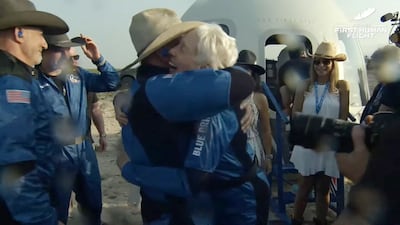
Billionaire businessman Jeff Bezos embraces veteran aviator Wally Funk after Blue Origin’s reusable New Shepard craft capsule returned from space on Tuesday, July 20, 2021. -

Jeff Bezos, Funk and and gap-year student Oliver Daemen, 18, disembark after Blue Origin’s reusable New Shepard capsule returned from space. -
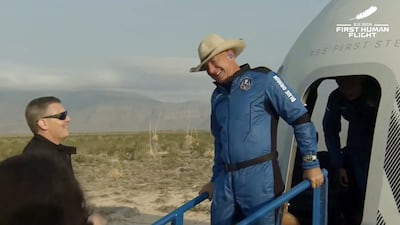
Jeff Bezos disembarks after the flight. -

New Shepard touches down on Earth. -

New Shepard approaches the ground. -
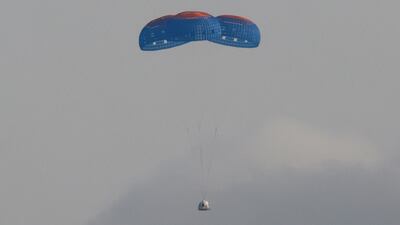
The capsule carrying Jeff Bezos and three crew members returns to Texas by parachute. -
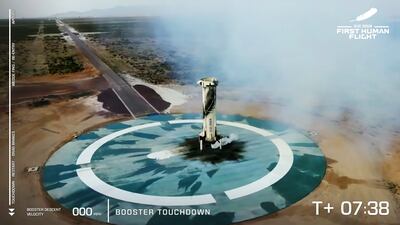
The booster rocket returns to the launch pad. -
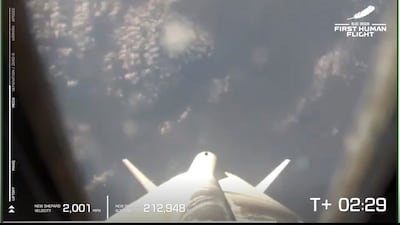
The rocket lifts off. -
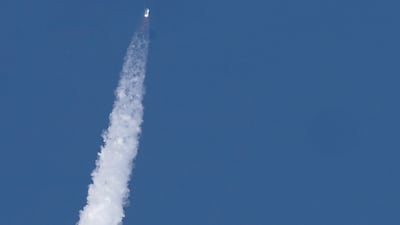
The launch viewed from far. -
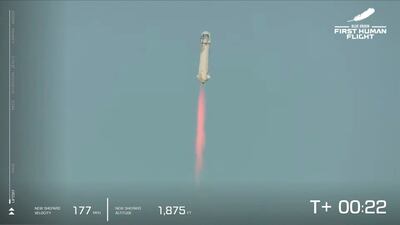
The rocket is launched on the world’s first unpiloted suborbital flight. -
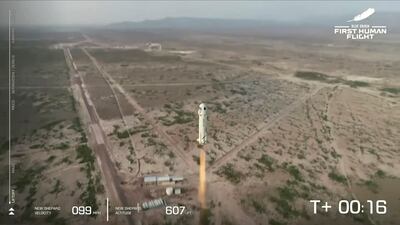
It took off from Blue Origin’s launch site, near Van Horn in western Texas, US. -
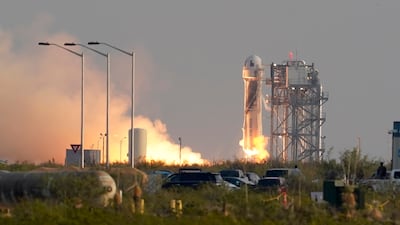
Blue Origin’s New Shepard rocket is launched from its spaceport. -
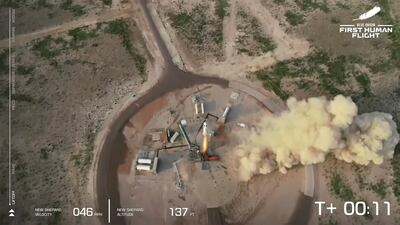
The rocket lift-off. -
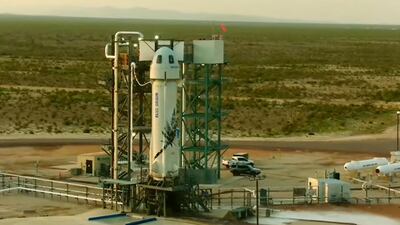
The launch pad. Blue Origin’s first crewed mission was an 11-minute flight from Texas and back. Reaching an altitude of 106 kilometres, it coincided with the 52nd anniversary of the first Moon landing. -
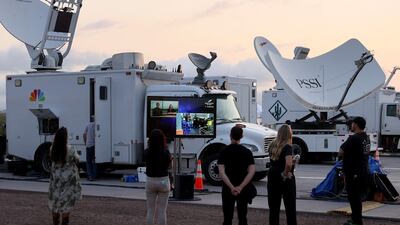
People watch on a television screen as the rocket sits on the launch pad. -

The crew members prepare for the flight. -
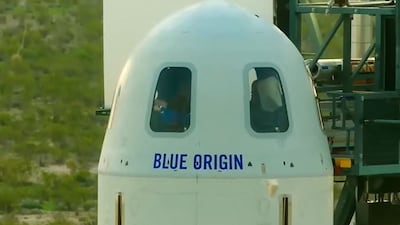
The crew members prepare for the flight. -
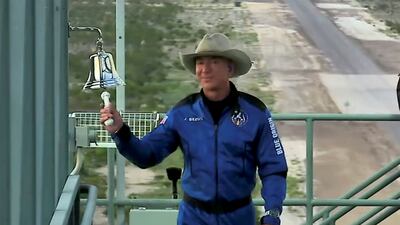
Jeff Bezos, the founder of Amazon.com, rings a bell before boarding the flight. -
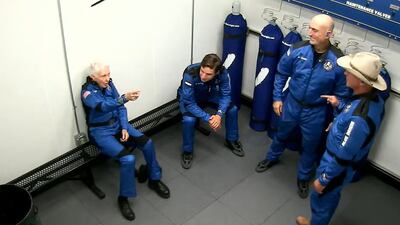
This still image taken from video by Blue Origin shows Funk, Daemen and the Bezos brothers before they leave for the flight. -

A monitor in a zone reserved for the media shows Wally Funk being interviewed. -
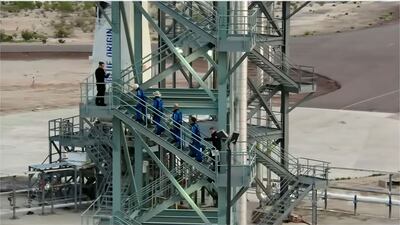
This still image taken from video by Blue Origin shows Funk, Jeff and Mark Bezos, and Daemen as they ascend the crew tower for the flight. -
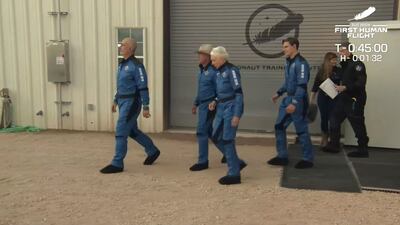
This still image taken from video by Blue Origin shows, from left, Mark Bezos, Jeff Bezos, Wally Funk and Oliver Daemen as they travel to the launch pad. -

Jeff Bezos, his brother Mark Bezos, a private equity executive, Wally Funk and Oliver Daemen pose in an undated photograph.


He hails the concept of reusable rockets, pioneered by SpaceX, and the continued miniaturisation of technology. “We expect to see this paradigm shift in the cost of SpaceTech to lead to a wave of disruptive products and services.”
Sustainability benefits include delivering satellite-based connectivity to billions. “This would make a massive difference to education, trade and economic prosperity in the developing world.”
It could also provide a more powerful global view of climate data and environmental science, creating more effective climate action and better environmental, social and governance reporting.
“The next time we see a billionaire fly past in their latest space toy, we can take comfort that we have achieved something more worthwhile with space,” McPartlin adds.
There are two types of space companies, Rémy Astié, founder and chief executive of investment platform Vauban, says. First, there are software companies, which mostly use existing satellite data for commercial purposes, so do not require much infrastructure and should be treated like any other software developer.
What he calls “real” space companies are risker because they demand huge sums of capital, yet the market is small and demand is limited at present. "The ability to scale and become profitable is still not there,” he argues.
chief executive of Seraphim Space Investment Trust IPO
Mr Astié urges caution amid the frenzy. “As with any market in its infancy, the risks are high and the potential for financial reward might still be many years off.”
The danger here is obvious. Every time a new theme comes into favour, it also has the danger of crashing just as fast.
Some investors have spotted a different opportunity here. Short-sellers have now placed $2.7bn in bets against Cathie Wood's flagship ARK Innovation ETF, according to S3 Partners.
Tuttle Capital Management has even gone as far as filing for an inverse ARK ETF that will replicate the opposite of its performance.
Last year, ARK Innovation returned a stellar 152.52 per cent, yet its trajectory has slowed in 2021 as value stocks came back into favour and growth fell out. The ETF is only up 5.05 per cent year to date, against 21.24 per cent on the S&P 500.
Space tourism profitability may be light years away, but more down-to-earth applications such as collecting data and providing greater internet connectivity can provide revenues here and now, Laith Khalaf, head of investment analysis at online investment platform AJ Bell, says.
Both ARK Innovation and ARK Space Exploration and Innovation are high risk by design. “While that can clearly lead to big gains if disruptive innovations take root, it can mean commensurate losses if they don’t,” he says.
Mr Khalaf describes space exploration “as a niche theme within the risky technology sector”.
"Investors are boldly going where few have gone before and should only chance a small part of their portfolio.”

