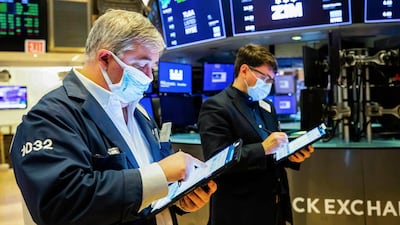
World stocks held near a record high as strong US economic data, robust corporate earnings and the Federal Reserve's commitment to continue supporting the economy fuelled investors' appetite for risk.
Asian stocks had less luck, with MSCI's ex-Japan index losing 0.6 per cent, following a softer-than-expected survey on China's manufacturing.
"China's economic recovery in January-March was strong but there are some doubts over whether you can take it at face value," said Wang Shenshen, senior strategist at Mizuho Securities.
Chinese tech giant shares listed in Hong Kong also buckled as Beijing summoned 13 internet platforms to order them to strengthen compliance with regulations, weighing on the Hang Seng index.
Mainland Chinese shares lost 0.25 per cent while Japan's Nikkei shed 0.7 per cent on position adjustments ahead of a long weekend. Both markets will be closed through Wednesday.
European stocks are expected to dip slightly, with euro Stoxx futures down 0.1 per cent and Britain's FTSE futures trading 0.2 per cent lower.
MSCI's broadest gauge of world stocks covering 50 markets, ACWI, however, was little changed and stood close to a record peak touched the previous day and up 5.1 per cent on the month.
On Wall Street, the S&P 500 also closed at an all-time high while the Nasdaq Composite hit a intraday record before paring some gains.
For both ACWI and S&P500, analysts are now expecting the earnings in the next 12 months to recover to above their pre-pandemic levels.
With just over a half of S&P500 companies reporting earnings, about 87 per cent beat market expectations, according to Refinitiv, the highest level in recent years.
Amazon was the latest to report stellar results late on Thursday, lifting its shares by 2.4 per cent in after-hours trade.
Data on Thursday showed US economic growth accelerated in the first quarter, fuelled by massive government aid to households and businesses.
New York City aims to "fully reopen" on July 1 after more than a year of closures and capacity restrictions, Mayor Bill de Blasio said, buttressing hopes for recovery in the battered service sector, an important source of employment.
That came against the backdrop of the Federal Reserve's reassurance on Wednesday that it is not time yet to begin discussing any change in its easy monetary policy.
The 10-year US Treasury yield rose to 1.690 per cent, its highest in more than two weeks, and last stood at 1.640 per cent.
"For now we are likely to see strong economic data from the US and that means we need to be wary of further rise in US bond yields, and the dollar/yen," said Toshiya Nakamura, chief manager of forex trading at Mitsubishi Trust Bank.
In the currency market, the yen was listless at 108.79 per dollar, having hit a two-week low of 109.22 as higher US bond yields helped the dollar.
The positive risk mood saw the euro extending its bull run to a two-month high of $1.2150 in the previous session and it last stood at $1.2115. With 3.3 per cent gains so far this month, it is on course for its biggest monthly rise in 9 months.
The Canadian dollar extended its gains to a three-year high of C$1.22715 per US unit, boosted by the Bank of Canada's tapering of its bond-buying programme and higher commodities including oil and lumber.
Oil prices took a breather after hitting six-week highs on strong US economic data.
Brent slipped 0.8 per cent to $68 per barrel, after having hit a high of $68.95 on Thursday while US West Texas Intermediate (WTI) eased 0.9 per cent to $64.41 per barrel.
"Strong US data is supporting the market. But on the other hand, given that oil producers have capacities to boost outputs further, there will be resistances around $65 for WTI and $70 for Brent," said Tatsufumi Okoshi, senior commodity strategist at Nomura Securities.

The National's picks
4.35pm: Tilal Al Khalediah
5.10pm: Continous
5.45pm: Raging Torrent
6.20pm: West Acre
7pm: Flood Zone
7.40pm: Straight No Chaser
8.15pm: Romantic Warrior
8.50pm: Calandogan
9.30pm: Forever Young
Labour dispute
The insured employee may still file an ILOE claim even if a labour dispute is ongoing post termination, but the insurer may suspend or reject payment, until the courts resolve the dispute, especially if the reason for termination is contested. The outcome of the labour court proceedings can directly affect eligibility.
- Abdullah Ishnaneh, Partner, BSA Law
INFO
Everton 0
Arsenal 0
Man of the Match: Djibril Sidibe (Everton)
Men's football draw
Group A: UAE, Spain, South Africa, Jamaica
Group B: Bangladesh, Serbia, Korea
Group C: Bharat, Denmark, Kenya, USA
Group D: Oman, Austria, Rwanda
Who's who in Yemen conflict
Houthis: Iran-backed rebels who occupy Sanaa and run unrecognised government
Yemeni government: Exiled government in Aden led by eight-member Presidential Leadership Council
Southern Transitional Council: Faction in Yemeni government that seeks autonomy for the south
Habrish 'rebels': Tribal-backed forces feuding with STC over control of oil in government territory
Mercer, the investment consulting arm of US services company Marsh & McLennan, expects its wealth division to at least double its assets under management (AUM) in the Middle East as wealth in the region continues to grow despite economic headwinds, a company official said.
Mercer Wealth, which globally has $160 billion in AUM, plans to boost its AUM in the region to $2-$3bn in the next 2-3 years from the present $1bn, said Yasir AbuShaban, a Dubai-based principal with Mercer Wealth.
“Within the next two to three years, we are looking at reaching $2 to $3 billion as a conservative estimate and we do see an opportunity to do so,” said Mr AbuShaban.
Mercer does not directly make investments, but allocates clients’ money they have discretion to, to professional asset managers. They also provide advice to clients.
“We have buying power. We can negotiate on their (client’s) behalf with asset managers to provide them lower fees than they otherwise would have to get on their own,” he added.
Mercer Wealth’s clients include sovereign wealth funds, family offices, and insurance companies among others.
From its office in Dubai, Mercer also looks after Africa, India and Turkey, where they also see opportunity for growth.
Wealth creation in Middle East and Africa (MEA) grew 8.5 per cent to $8.1 trillion last year from $7.5tn in 2015, higher than last year’s global average of 6 per cent and the second-highest growth in a region after Asia-Pacific which grew 9.9 per cent, according to consultancy Boston Consulting Group (BCG). In the region, where wealth grew just 1.9 per cent in 2015 compared with 2014, a pickup in oil prices has helped in wealth generation.
BCG is forecasting MEA wealth will rise to $12tn by 2021, growing at an annual average of 8 per cent.
Drivers of wealth generation in the region will be split evenly between new wealth creation and growth of performance of existing assets, according to BCG.
Another general trend in the region is clients’ looking for a comprehensive approach to investing, according to Mr AbuShaban.
“Institutional investors or some of the families are seeing a slowdown in the available capital they have to invest and in that sense they are looking at optimizing the way they manage their portfolios and making sure they are not investing haphazardly and different parts of their investment are working together,” said Mr AbuShaban.
Some clients also have a higher appetite for risk, given the low interest-rate environment that does not provide enough yield for some institutional investors. These clients are keen to invest in illiquid assets, such as private equity and infrastructure.
“What we have seen is a desire for higher returns in what has been a low-return environment specifically in various fixed income or bonds,” he said.
“In this environment, we have seen a de facto increase in the risk that clients are taking in things like illiquid investments, private equity investments, infrastructure and private debt, those kind of investments were higher illiquidity results in incrementally higher returns.”
The Abu Dhabi Investment Authority, one of the largest sovereign wealth funds, said in its 2016 report that has gradually increased its exposure in direct private equity and private credit transactions, mainly in Asian markets and especially in China and India. The authority’s private equity department focused on structured equities owing to “their defensive characteristics.”
Fifa%20World%20Cup%20Qatar%202022%20
%3Cp%3E%3Cstrong%3EFirst%20match%3A%20%3C%2Fstrong%3ENovember%2020%0D%3Cbr%3E%3Cstrong%3EFinal%2016%20round%3A%20%3C%2Fstrong%3EDecember%203%20to%206%0D%3Cbr%3E%3Cstrong%3EQuarter-finals%3A%20%3C%2Fstrong%3EDecember%209%20and%2010%0D%3Cbr%3E%3Cstrong%3ESemi-finals%3A%20%3C%2Fstrong%3EDecember%2013%20and%2014%0D%3Cbr%3E%3Cstrong%3EFinal%3A%20%3C%2Fstrong%3EDecember%2018%3C%2Fp%3E%0A
