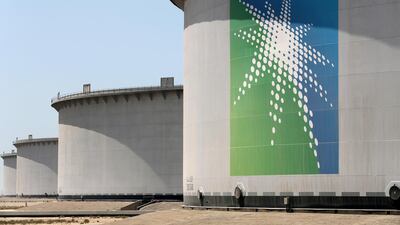
Oil tanks at Saudi Aramco's Ras Tanura oil refinery in Saudi Arabia. Reuters

Saudi Aramco makes return to bond markets


Michael Fahy
  • English
  • Arabic

Saudi Aramco is set to return to global bond markets 19 months after its debut bond issue.

The world's largest oil exporter will begin issuing senior, unsecured bonds denominated in US dollars, but said the amount issued and the bond values are "subject to market conditions".

The company is planning to issue three, five, 10, 30 and/or 50-year notes, it said in a statement to the Tadawul exchange, where its shares trade. Aramco has hired Citi, Goldman Sachs, HSBC, JP Morgan, Morgan Stanley and NCB Capital to work on the issue, which is being undertaken under its Global Medium Term Note Programme. The bonds will be traded on the London Stock Exchange.

Saudi Aramco first tapped bond markets for $12 billion in April 2019 and used proceeds to help fund its $69.1bn purchase of a 70 per cent stake in petrochemicals company Saudi Basic Industries Company from the kingdom's Public Investment Fund.

The state oil company later floated a 1.75 per cent stake on Tadawul in the world's biggest public offering in December last year raising $29.4bn.

Saudi Aramco currently has $501bn in total assets with total liabilities of about $204bn, according to its latest bond prospectus. The company operates "within a conservative financial framework", generating $33.5bn of free cash flow during the first nine months of the year, it said in the prospectus.

Earlier this month, the company reported a 44.6 per cent annual fall in third quarter net profit to 44.21bn riyals ($11.79bn), citing lower crude oil prices and volumes.

Debt issuance by borrowers in the Middle East and North Africa hit a record high of $92.4bn for the first nine months of the year, up 8 per cent on the same period last year, according to Refinitiv's latest MENA Investment Banking Review.

Sovereign and corporate borrowers have looked to take advantage of record low interest rates as central banks inject monetary stimulus to mitigate the economic impact of Covid-19.

French business

France has organised a delegation of leading businesses to travel to Syria. The group was led by French shipping giant CMA CGM, which struck a 30-year contract in May with the Syrian government to develop and run Latakia port. Also present were water and waste management company Suez, defence multinational Thales, and Ellipse Group, which is currently looking into rehabilitating Syrian hospitals.

Kandahar%20
%3Cp%3E%3Cstrong%3EDirector%3A%3C%2Fstrong%3E%20Ric%20Roman%20Waugh%3C%2Fp%3E%0A%3Cp%3E%3Cstrong%3EStars%3A%C2%A0%3C%2Fstrong%3EGerard%20Butler%2C%20Navid%20Negahban%2C%20Ali%20Fazal%3C%2Fp%3E%0A%3Cp%3E%3Cstrong%3ERating%3A%3C%2Fstrong%3E%202.5%2F5%3C%2Fp%3E%0A
Closing the loophole on sugary drinks

As The National reported last year, non-fizzy sugared drinks were not covered when the original tax was introduced in 2017. Sports drinks sold in supermarkets were found to contain, on average, 20 grams of sugar per 500ml bottle.

The non-fizzy drink AriZona Iced Tea contains 65 grams of sugar – about 16 teaspoons – per 680ml can. The average can costs about Dh6, which would rise to Dh9.

Drinks such as Starbucks Bottled Mocha Frappuccino contain 31g of sugar in 270ml, while Nescafe Mocha in a can contains 15.6g of sugar in a 240ml can.

Flavoured water, long-life fruit juice concentrates, pre-packaged sweetened coffee drinks fall under the ‘sweetened drink’ category
 

Not taxed:

Freshly squeezed fruit juices, ground coffee beans, tea leaves and pre-prepared flavoured milkshakes do not come under the ‘sweetened drink’ band.

Who's who in Yemen conflict

Houthis: Iran-backed rebels who occupy Sanaa and run unrecognised government

Yemeni government: Exiled government in Aden led by eight-member Presidential Leadership Council

Southern Transitional Council: Faction in Yemeni government that seeks autonomy for the south

Habrish 'rebels': Tribal-backed forces feuding with STC over control of oil in government territory

'The worst thing you can eat'

Trans fat is typically found in fried and baked goods, but you may be consuming more than you think.

Powdered coffee creamer, microwave popcorn and virtually anything processed with a crust is likely to contain it, as this guide from Mayo Clinic outlines: 

Baked goods - Most cakes, cookies, pie crusts and crackers contain shortening, which is usually made from partially hydrogenated vegetable oil. Ready-made frosting is another source of trans fat.

Snacks - Potato, corn and tortilla chips often contain trans fat. And while popcorn can be a healthy snack, many types of packaged or microwave popcorn use trans fat to help cook or flavour the popcorn.

Fried food - Foods that require deep frying — french fries, doughnuts and fried chicken — can contain trans fat from the oil used in the cooking process.

Refrigerator dough - Products such as canned biscuits and cinnamon rolls often contain trans fat, as do frozen pizza crusts.

Creamer and margarine - Nondairy coffee creamer and stick margarines also may contain partially hydrogenated vegetable oils.

John%20Wick%3A%20Chapter%204
%3Cp%3E%3Cstrong%3EDirector%3A%3C%2Fstrong%3E%20Chad%20Stahelski%3C%2Fp%3E%0A%3Cp%3E%3Cstrong%3EStars%3A%3C%2Fstrong%3E%20Keanu%20Reeves%2C%20Laurence%20Fishburne%2C%20George%20Georgiou%3C%2Fp%3E%0A%3Cp%3E%3Cstrong%3ERating%3A%20%3C%2Fstrong%3E4%2F5%3C%2Fp%3E%0A
The specs

Engine: 2.0-litre 4cyl turbo

Power: 261hp at 5,500rpm

Torque: 405Nm at 1,750-3,500rpm

Transmission: 9-speed auto

Fuel consumption: 6.9L/100km

On sale: Now

Price: From Dh117,059

Islamophobia definition

A widely accepted definition was made by the All Party Parliamentary Group on British Muslims in 2019: “Islamophobia is rooted in racism and is a type of racism that targets expressions of Muslimness or perceived Muslimness.” It further defines it as “inciting hatred or violence against Muslims”.