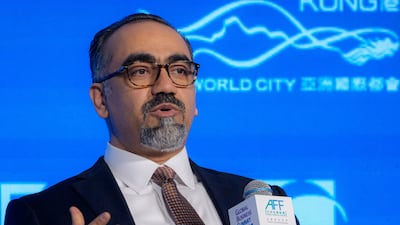

The UAE’s Capital Market Authority is no longer simply a “watchdog” of financial markets but an enabler of economic activity, working alongside regulators in Abu Dhabi and Dubai’s financial free zones to support the country’s broader economic development goals, its chief executive has said.
Over the past 18 months, the CMA has undergone a complete overhaul that has helped reposition the UAE, the Arab world’s second-largest economy, as an international financial jurisdiction, Waleed Al Awadhi said at the Meira 2026 conference in Dubai on Thursday.
“We are not a watchdog any more. We are a market engineer,” Mr Al Awadhi said. “We support the industry, and we thought it's very important for a good regulator to be part of the economic growth of a country.”

Mr Al Awadhi, who took charge of the CMA in February 2025, said the reform of the authority, which oversees capital markets activity outside the financial free zones in the Emirates, was the logical step forward, given the “size and the ambition” of the UAE to be a top international financial services jurisdiction.
“The first thing that we did, we rewrote our laws and regulations completely,” he said.
Harmonisation
The CMA has instituted its reform in a way that complements the key financial free zones in the UAE to elevate it and enable it to compete with the likes of London, New York, Hong Kong and Singapore, he said.
Both Dubai and Abu Dhabi are home to onshore financial hubs. The Dubai Financial Services Authority regulates the Dubai International Financial Centre, while the Financial Services Regulatory Authority is the regulator of Abu Dhabi’s ADGM.

“The three of us, me, the DFSA and FSRA, we sat together 18 months ago, and we decided to have harmonisation between the three jurisdictions, and this harmonisation, we realised, will lead to strengthening of the economy,” Mr Al Awadhi said.
The UAE is pushing to diversify its economy away from oil, and developing the country’s capital markets and its financial sector are among the central planks of the country’s transformation agenda. The regulators, over the years, have also amended their regimes to make the country more attractive to foreign investors as well as the global banking and financial industry.
In January, the UAE issued two federal decree laws to strengthen its capital markets regulations as part of the country's efforts to modernise its financial legislation and regulatory framework.
The decree laws enhanced the independence of the CMA as well as capital markets rules, aligning them more closely with international regulatory frameworks.
In April, the CMA also rolled out a new framework to regulate virtual asset activities, in a move to keep pace with rapid market growth.
The efforts by regulators and the government have paid dividends, and several trillion-dollar asset managers, global banking giants, wealth managers, large family offices, investors and insurers now call ADGM and DIFC home.

Mr Al Awadhi said the UAE, the Arab world’s second-largest economy, is blessed as multiple jurisdictions within the country offer a suite of products across “the entire investment spectrum that we have globally”.
The jurisdictions of the mainland and free zones are the same in terms of the rule books and the policies that apply for conducting business or transactions. The only difference is in the legal system being followed in terms of common law jurisdiction versus the civil law jurisdiction.
“What we decided to do together as regulators, [was that] we will adhere to the highest standards of regulations, policy compliance as standard setters globally,” he said.
“I think, in so many respects, the variety [of jurisdictions] is actually the UAE capital market's strength as long as you're talking to each other.”
Thrice-tested
In terms of the strength of the country's capital market and its financial system, the UAE has passed the resilience test three times in recent decades, starting with the global financial crisis, then the Covid-19 pandemic and now the continuing geopolitical crisis.
Investors' confidence has grown in the country’s resilience with each crisis, which is evident from the continued economic activity and flow of funds to the financial markets, he said.
“That's why when we speak to big organisations, they tell us this is a long-term capital investment because we know how your country operates during conflicts, how your country operates during a pandemic, how your country operates during financial crises,” Mr Al Awadhi said.
“We passed all these complex tests, and we became much stronger than we were before.”

