

Investors and lawyers in Israel are weighing up their next steps as they fret over parliament passing a bill that will weaken the power of judges.
The shekel fell after the bill was easily passed in the Knesset, with opposition politicians boycotting the vote. The currency has weakened by 0.9 per cent to 3.69 per dollar this week, the worst performance among a basket of major units tracked by Bloomberg.
Israeli stocks dropped 2.2 per cent on Monday. They’re still up 4.4 per cent this year, but that’s far less than US equities or the MSCI World Index.
On Monday, despite widespread anger and thousands taking to the streets in protest, Prime Minister Benjamin Netanyahu’s right-wing coalition scrapped a law allowing judges to void ministerial decisions they consider “unreasonable”.
-

Mass protests continue across Israel against the government's justice system reform plan. EPA -

Anti-government protesters march towards the Israeli Knesset in Jerusalem. EPA -

Protesters blocked roads across Israel, hours after parliament adopted a key clause of the government's judicial overhaul package, which opponents say threatens democracy. AFP -

A demonstrator in a dinosaur suit marches at Ben Gurion Airport near Lod. AFP -

Israelis wave flags during a protest against plans by Prime Minister Benjamin Netanyahu's government to overhaul the judicial system. AP -

Israelis have taken to the streets en masse to protest against the government’s plans to weaken the power of judges. Bloomberg -

Mass protests continue across the country against the government's justice system reform plan. EPA -
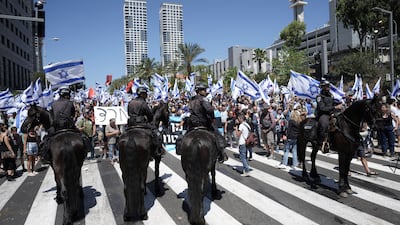
Mounted police in Tel Aviv, Israel, control protesters demonstrating against plans to overhaul the judicial system. AP -

Police and protesters clash on the 'Day of Disruption' opposing the judicial overhaul, in Tel Aviv. Reuters -

Israeli demonstrators wave flags as they block Highway 443 between Jerusalem and Tel Aviv, near Modiin. AFP -
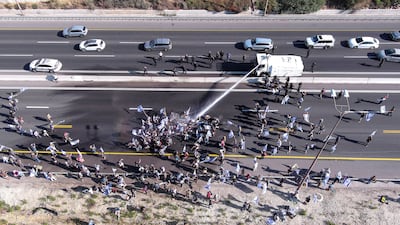
Israeli police use a water cannon against demonstrators at the Ein Hemed junction towards Jerusalem. Reuters -

Protesters set off a flare near Jerusalem as they oppose a bill to curb the Israeli Supreme Court's power to void government decisions. Reuters -

A confrontation in Tel Aviv, Israel, during protests against the move by Prime Minister Benjamin Netanyahu's coalition. Reuters -

Members of the Israeli security forces remove demonstrators blocking a highway to Jerusalem. Reuters -
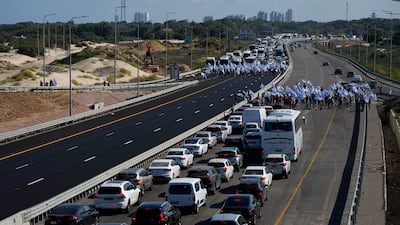
Israeli protesters block the Tel Aviv to Haifa highway near Beit Yanai, Israel. AP -

Demonstrators block a road with tents at the entrance to Herzliya, north of Tel Aviv, Israel. Reuters -

Israeli anti-government protesters block the entrance to Jerusalem, where some demonstrators entered the Knesset building. EPA


While the government and its supporters say the move will help prevent judicial abuse, opponents fear for the economy and Israel’s status as a magnet for technology investments. The White House was also critical.
There were further protests on Tuesday morning. Some doctors went on strike, with little sign of demonstrations, which have rocked the country since Mr Netanyahu unveiled plans to overhaul the judiciary early this year, abating.
“We’re entering a twilight zone,” said Elah Alkalay, head of corporate responsibility at Tel Aviv’s IBI Investment House.
“The rules of the game should be fixed and clear. Now they will be at the mercy of politicians.”
IBI was one of 150 major companies that went on strike on Monday to express their opposition to the bill.
Mr Alkalay, along with numerous other business people, say they are afraid of more populist moves by the coalition.
The government says the reasonableness law is just the first step. It wants to increase the ability of politicians to select judges and make it harder for the Supreme Court to overturn legislation.
Mr Netanyahu tried to placate opponents late on Monday, saying he was prepared to “discuss everything” and wait until November before trying to pass more legislation.
“Anyone who believes in a free market should be anxious now for Israel’s economy,” said Ranen Cohen-Orgad, co-chief executive of Leader Capital Markets, which joined in the strike.
“Gatekeepers draw their strength from regulatory certainty.”
Yaniv Pagot, who heads trading at the Tel Aviv Stock Exchange, said he’s worried about Israel’s credit rating, which could stop the recent positive trend in the local bond market. Moody’s Investors Service rates the government’s debt A1, the fifth-highest level.
“The next few days will be a test,” he said.
Not every investor is pessimistic. Michael Fertik, founder of Heroic Ventures and a Silicon Valley-based entrepreneur, said he considers much of the reaction to be pure hysteria.
“This is actually the best time to invest in Israeli start-ups,” he said.
“There are two important things: the first is that Israel still has more great entrepreneurs than ever. The second is that when everyone is afraid, it’s the best time to invest.”
Protests and occasional strikes are expected to continue in the coming weeks. There is concern among the professional classes that Mr Netanyahu is trying to appease the far-right parties he brought into his coalition when he took power in late 2022. Some protesters also say the law changes will help him fight charges of bribery and fraud, something which Mr Netanyahu denies as well as the charges themselves.
Thousands of military reservists have threatened they’ll no longer volunteer for duty, with some saying they now question the country’s values., at a time of growing tensions with Iran and its proxies.
The new law voiding reasonableness has already been sent to the Supreme Court for appeal. It will take some time before judges announce whether they accept it. Many scholars, including law Prof Yuval Shany at Jerusalem’s Hebrew University, assume they will.
Prof Shany expects, though, the judges to weigh in on how the law should function, perhaps suggesting limits. They probably won’t issue an injunction in the meantime, the scholars say, meaning it will likely go into effect immediately.
“This could take months and the government will be free to conduct itself without the oversight that reasonableness has afforded until now,” said Yohanan Plesner, president of the non-profit Israel Democracy Institute, which has opposed the law.
Critics of the coalition fear its members may try to fire top legal advisers, including the attorney general, Gali Baharav-Miara. Some of her decisions, including ordering Mr Netanyahu to recuse himself from parliamentary debates over the judiciary while he faces corruption charges, have angered the prime minister and his allies.
Such “gatekeeper” officials were afforded protection by the reasonableness law, according to Mr Plenser.


