


Dubai Electricity and Water Authority increased the number of shares offered in its initial public offering to 8.5 billion ordinary shares, from 3.25 billion, resulting in a free float of 17 per cent of its share capital, the result of "strong investor demand" and may raise as much as $5.7 billion from the listing.
Dewa stands to raise between Dh19.1 billion ($5.2bn) and Dh21bn ($5.7bn), based on its decision to set the offer price range between Dh2.25 and Dh2.48 per ordinary share on March 24.
The decision to raise the size of the IPO was "based on strong investor demand and oversubscription across all tranches", the company said on Wednesday.
The utility is expected to list on the Dubai Financial Market on or around April 12, 2022.
The increase of the IPO size was approved by the UAE Securities and Commodities Authority (SCA) and the government of Dubai will continue to own 83 per cent of Dewa's share capital, the statement said.
Dewa also received approval from the SCA to increase the size of the tranche reserved for qualified investors (which includes the new strategic investors) to 16.4 per cent, or 8.175 billion shares, from 5.9 per cent of the capital. New strategic investors, who will receive approximately 7 per cent, will face a lock-up period of between 180 and 365 days.
The balance of the deal size, including for cornerstone investors, is up to 10 per cent from 6.5 per cent. Emirates Investment Authority, Abu Dhabi’s holding company ADQ, UAE Strategic Investment Fund, Multiply Group, Alpha Dhabi Partners and Investment Holdings have already been confirmed as cornerstone investors in the IPO, with total commitments of up to Dh4.7bn, Dewa previously said.
__________________________
Some of the biggest listings in UAE since 2021 - in pictures
-
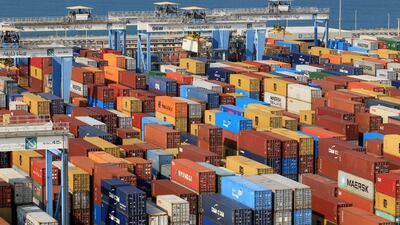
Abu Dhabi Ports - $1.1 billion IPO in February 2022: AD Ports Group raised $1.1bn from its share sale to help expand its operations globally and boost growth. ADQ, one of the region’s largest holding companies, remains a majority shareholder in AD Ports Group with a 75.44 per cent stake in the listed entity. Reuters -

Dewa became the first public entity to list on the Dubai Financial Market, raising Dh22.41bn in an oversubscribed share sale. The IPO of the Dubai utility in April was the largest in Europe and the Middle East since Saudi Aramco’s debut in 2019. It has a market value of about $39bn and is the largest on the exchange. AFP -
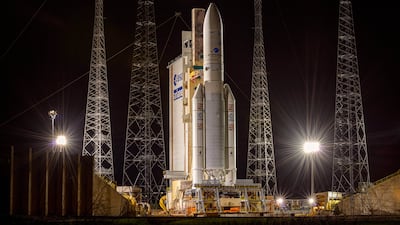
Yahsat – $730.6 million in July 2021: a unit of Mubadala Investment Company, it raised about $731m from its initial public offering last July. It sold 975.9 million shares, or 40 per cent of equity, through the IPO, which was several times oversubscribed, with significant demand from both qualified institutional and retail investors in the UAE. Photo: Mubadala Investment Company -
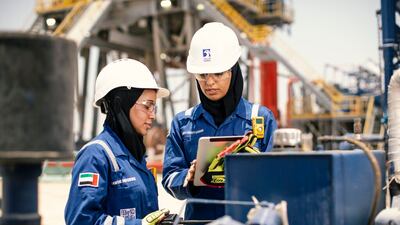
Adnoc Drilling - $1.1 billion IPO in October 2021: Adnoc Drilling’s share sale, oversubscribed more than 31 times, was the largest listing on the ADX, raising more than $1.1 billion. Adnoc maintains its majority 84 per cent stake in the company while US energy services company Baker Hughes, which entered into a strategic partnership with Adnoc Drilling in October 2018, has a 5 per cent stake, and US contract oil and gas driller Helmerich & Payne holds 1 per cent. Photo: Adnoc -
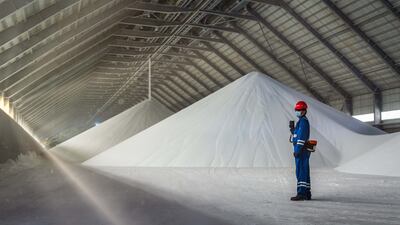
Fertiglobe- $795 million in October 2021: a joint venture between Adnoc and Netherlands-listed OCI, raised about $795m in its initial IPO last year, amid strong demand from international, regional and local investors. The company — which is also the Mena region’s largest producer of nitrogen fertilisers by production capacity — sold more than 1.145 billion shares, representing 13.8 per cent of its share capital. Photo: Fertiglobe


__________________________
The size of the retail and employee tranches will remain the same at Dh731 million to Dh806m.
"The new offering size was determined by the government of Dubai as the selling shareholder ... that reflects the government of Dubai’s long-term confidence in Dewa’s growth trajectory. The decision also reflected Dewa's prioritisation of supporting aftermarket trading performance post-listing," the statement said.
The subscription period for the IPO is unchanged and will close on April 2, 2022 for UAE retail investors and on April 5 for qualified domestic and international institutional investors.
Dewa, the first government entity to list on the DFM, operates as a vertically integrated multi-utility, with business activities including electricity generation, transmission and distribution, water desalination and district cooling.
As of December 31, it had total electricity generation capacity of 13,417 megawatts and a water capacity of 526 million imperial gallons per day through eight majority-owned and operated plants.
The company reported revenue of Dh23.8bn and assets of Dh169.5bn in 2021. It has projects valued at about Dh86bn that are planned to be commissioned in the next five years, to meet the increasing demand for electricity and water in the emirate, it said last year.
The number of people living in the commercial, tourism and financial heart of the Middle East is expected to grow to 5.8 million by 2040, from 3.5 million now. Energy demand rose 11 per cent last year, nearly triple the company's estimates, Saeed Al Tayer, managing director and chief executive of Dewa, said earlier this month.
After the IPO, Dewa intends to pay dividends twice each financial year – in April and October. A minimum dividend of Dh6.2bn per annum is expected to be paid over the next five years.
-
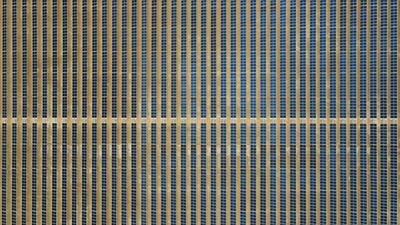
An aerial view of Mohammed bin Rashid Solar Park in Dubai in January 2022. Solar is essential to the UAE's new energy mix. All photos by Pawan Singh / The National -
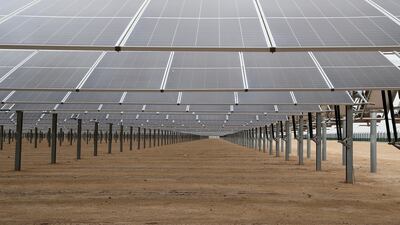
The fifth phase of a clean energy project at the Mohammed bin Rashid Solar Park will further help reduce carbon emissions. -

An aerial view of the Solar Park in the Dubai desert. -
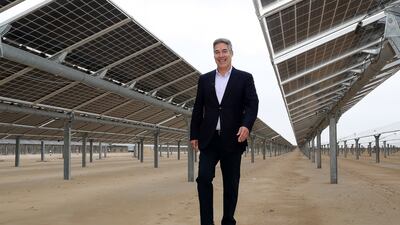
Marco Garcia, chief commercial officer of Nextracker, a US company which has provided photovoltaic technology used in the project. -
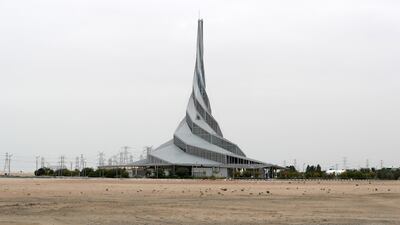
The Innovation Centre at the MBR Solar Park in Dubai, where machine learning is being utilised to track direct sunlight to maximise efficient energy capture, storage and transmission. -

The solar powered panels follow the path of the sun to help the emirate reach its clean energy transition goals. -
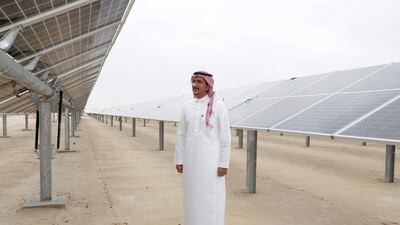
Omar Al Hassan, chief executive of Shuaa Energy 3, the company operating the scheme, says the vast project will ultimately create clean energy to power more than 250,000 houses in Dubai. -
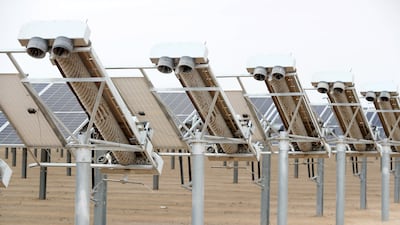
Robotic cleaning systems are installed on the solar panels. -
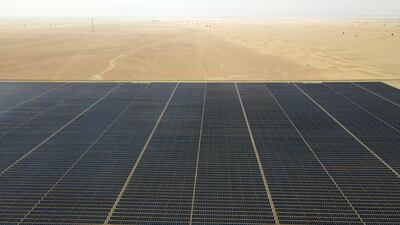
More than 2.5 million photovoltaic modules have been fitted during phase 5 of the project.


Earlier this week, Moody's Investor Services affirmed Dewa's Baa2 long-term issuer ratings afte the IPO announcement, confirming that its outlook on all ratings is stable.
The stable outlook reflects Dewa's “low business risk profile and considers the significant credit linkages between Dewa and the government of Dubai”, it said.
Dewa will remain one of the few utilities in the region that does not rely on government subsidies to be profitable, it said.
Dubai announced plans in November to list 10 state-owned companies to increase the size of its financial market to Dh3 trillion, as well as set up a Dh2bn market maker fund to encourage the listing of more private companies from sectors such as energy, logistics and retail.
The next entity expected to be listed on the DFM is the Salik toll system, officials said last year.
Emirates NBD is Dewa's financial adviser on the deal, while US-based Moelis & Company is the independent financial adviser.
Citigroup, Emirates NBD Capital and HSBC are joint global co-ordinators. Credit Suisse, EFG-Hermes, First Abu Dhabi Bank and Goldman Sachs are joint bookrunners.
Emirates NBD is the lead receiving bank. Abu Dhabi Commercial Bank, Abu Dhabi Islamic Bank, Ajman Bank, Al Maryah Community Bank, Dubai Islamic Bank, Emirates Islamic Bank, First Abu Dhabi Bank, Mashreq Bank and Sharjah Islamic Bank have been appointed as receiving banks.

