


Electric vehicle maker Tesla reported its largest quarterly net profit at September close, driven by a record delivery of vehicles despite a global semiconductor shortage and supply chain disruptions.
The company’s net profit jumped about 389 per cent to $1.6 billion, almost $1.3bn more than the income earned in the same period a year ago. This is the ninth straight profitable quarter and the second consecutive three-month period with more than $1bn profit for the world’s biggest EV maker.
Revenue during the quarter increased 57 per cent to nearly $13.8bn, exceeding analysts’ expectation of $13.6bn. This was the fourth time in a row the company reported $10bn or more in sales. It was 15 per cent more on a quarterly basis.
“This level of profitability was achieved while our ASP [average selling price] decreased by 6 per cent year-on-year in the third quarter due to a continued mix shift towards lower-priced vehicles,” Tesla said.
-
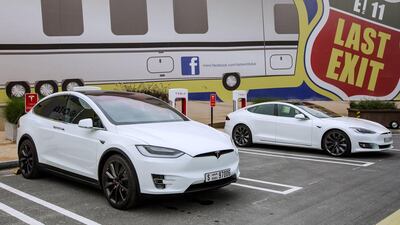
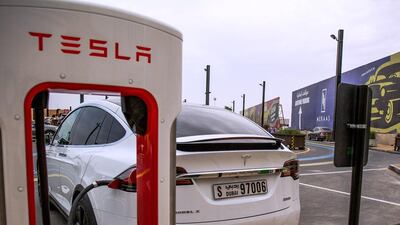
The Tesla Model X. All photos: Victor Besa / The National -
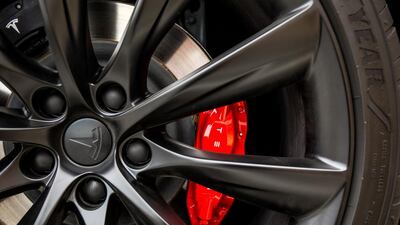
The regenerative braking, which can be set to standard or low, has the triple effect that when you ease off the accelerator, it slows the car automatically while extending the range (which can be up to 500 kilometres in total) and brake life. -
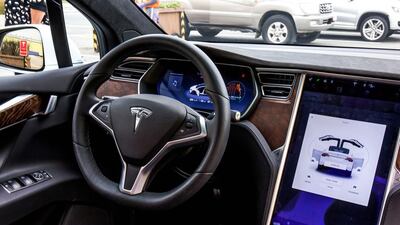
The all-wheel-drive X has other suitably boastful feathers in its cap, including its panoramic windscreen, which curves up into its roof to create something of an observatory to the outside world, also opening up the vistas for rear-seat passengers. It is, Tesla says, the biggest windscreen of its type in production. -
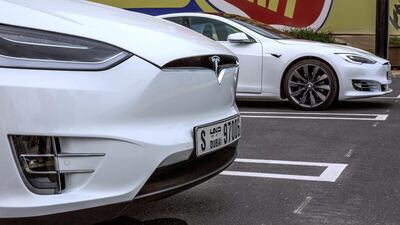
The battery’s positioning, beneath the X’s floor, gives 50:50 weight distribution that Tesla claims makes it incredibly stable and almost immune to rollovers. Should the worst happen, though, crash tests have shown that the X will be one of the safest vehicles in its category, with collision avoidance and automatic emergency braking. -
With the X’s added elements from its more-futuristic, full-aluminium design (dramatic falcon-wing doors and all) through to its capacity to carry seven full-sized adults, it’s arguably an even more capable car than the S. -

Access to the rear seating is painless thanks to those unfurling falcon-wing doors, which can be automatically operated via the car’s Tesla-shaped key fob.


“Our operating margin reached an all-time high as we continue to reduce cost at a higher rate than declines in ASP,” it added.
The company reported a record operating income of $2bn in the July-September period, about 148 per cent more than the prior year period. It surged mainly due to vehicle volume growth and cost reduction.
“Positive impacts were partially offset by growth in operating expenses, lower regulatory credit revenue, additional supply chain costs and Bitcoin-related impairment of $51m and other items,” Tesla said.
The company increased its capital expenditure in the third quarter by about 81 per cent yearly to $1.8bn, while its quarter-end cash and cash equivalents decreased to $16.1bn in the three-month period.
This was driven mainly by a “net debt and finance lease repayments of $1.5bn, partially offset by free cash flow of $1.3bn,” the company said.

The company’s total debt excluding vehicle and energy product financing has fallen to $2.1bn as of September 30.
Tesla delivered a record 241,300 vehicles in the third quarter of this year, topping analysts’ expectations of 220,900 vehicles. This was about 20 per cent, or 40,450 vehicles, more than the cars sold in the second quarter of this year.
In the third quarter, it sold 232,025 units of Model 3s and Model Ys, although it delivered only 9,275 units of its more expensive Model S saloons and Model X SUVs, which are priced from $75,000.
The company said it witnessed Covid-induced challenges related to supply chain, transportation and manufacturing. However, despite challenges, it managed to run its production lines “as close to full capacity as conditions allow[ed]”.
While “sequential growth” remained the company’s goal, the magnitude of growth will be determined largely by outside factors, it said.
“We plan to grow our manufacturing capacity as quickly as possible … over a multi-year horizon, we expect to achieve 50 per cent average annual growth in vehicle deliveries.”
The rate of growth will depend on the company’s equipment capacity, operational efficiency and the stability of the supply chain, said Tesla, and it added that it has sufficient liquidity to fund its product road map and long-term capacity expansion plans.
The Nasdaq-listed company's stock price rose about 0.2 per cent to $865.8 a share on Wednesday but dropped slightly to $862.5 in after-hour trading.
Tesla currently produces its vehicles in Fremont, California and Shanghai, China, but announced earlier this month that it would move to leave the Golden State for Texas.
The company, which joined the S&P 500 index in December, is building the Model Y at its new giga-factories in Germany (Berlin) and the US (Austin), and aims to start deliveries from each location this year.
The company is also currently accepting orders for its Cybertruck, with production scheduled to begin in 2022.
Despite challenges, Tesla’s Fremont factory produced 430,000 cars in the last four quarters, more cars than in any other year, and the company said there is “room for continued improvement”.
“EV demand continues to go through a structural shift … our supply chain, engineering and production teams have been dealing with global challenges with ingenuity, agility and flexibility that is unparalleled in the automotive industry,” Tesla said.


