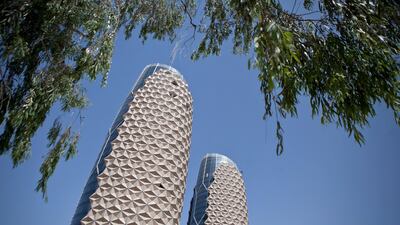
The UAE ranked 14th for the highest national concentration of sustainable buildings in the world and was the only country from the region in the top 30, according to a new survey.
The country is home to 869 green-rated buildings, while Saudi Arabia ranked 54th with 38 green-rated buildings, consultancy Knight Frank said in the second edition of its (Y)our Space report, which surveyed almost 400 businesses worldwide on their workplace strategies and real estate needs.
Kuwait and Oman have 12 green-accredited buildings each and rank 69th and 70th, respectively.
"The climate crisis has spawned a global green reawakening and businesses in the Middle East are alive to the climate challenge," Faisal Durrani, head of Middle East research at Knight Frank, said.
The UAE is encouraging the construction of greener buildings and working to retrofit older buildings to make them less energy-intensive as part of its push into energy sustainability. The UAE has committed to the Paris Agreement on climate change to reduce its greenhouse gas emissions by 23.5 per cent by 2030.
Global companies that have set a 2030 net zero carbon target may struggle to achieve their objectives if there is no major shift towards sustainable buildings, the Knight Frank report found
Three-quarters of Middle East businesses surveyed, which represent 7,800 staff, say their real estate choices in the future will be influenced by their net zero targets, the consultancy said. However, the vast majority of companies say that less than 25 per cent of their global portfolios are green or sustainable.
“The message to landlords is loud and clear: green credentials of buildings will become a key battleground in [the] post-Covid economy, particularly as office footprints are likely to be revised downward as more businesses adopt hybrid working methods, factoring for greater remote working," Mr Durrani said.
Being "greener" will be a major differentiator as businesses adapt their occupational strategies to encourage more employees to return to the office, he added.
Landlords in the region will have to weigh the costs and benefits of "greenifying" their buildings to cater to changing business demands.
"As investors and businesses are increasingly factoring the green credentials of a building in their decision making, it’s clear that the saleability and lettability of non-green-rated buildings will be negatively impacted over the medium to long-term," Mr Durrani said.
Global businesses want to be more sustainable, with 40 per cent of companies setting a net zero carbon target, the report showed. Of those, 77 per cent are aiming to achieve this goal by 2030.
However, despite the real estate sector accounting for as much as 40 per cent of global carbon emissions, and with growing pressure from the environmental, social and governance (ESG) agendas of investors, more than 87 per cent of companies said that less than half of their current global real estate portfolios are either green or sustainable, the report said.
"This suggests a real disconnect between real estate and wider corporate thinking on sustainability," Knight Frank said.
Almost 60 per cent of global respondents said that there is only a partial recognition from their wider business that occupying and utilising real estate differently will impact their ability to achieve net zero carbon and wider sustainability targets.
A further 15 per cent said that there is no recognition of this at all, the report showed.
“Developers and landlords in the Middle East have made great strides in delivering world-leading green buildings, incorporating stunning technologies," Mr Durrani said, citing the condensation harvesting system on the Burj Khalifa as an example.
"But such technologies need to be adopted more widely if landlords are to compete on a level playing field for increasingly green conscious businesses," he added.

How to get there
Emirates (www.emirates.com) flies directly to Hanoi, Vietnam, with fares starting from around Dh2,725 return, while Etihad (www.etihad.com) fares cost about Dh2,213 return with a stop. Chuong is 25 kilometres south of Hanoi.
More from Neighbourhood Watch
Ten tax points to be aware of in 2026
1. Domestic VAT refund amendments: request your refund within five years
If a business does not apply for the refund on time, they lose their credit.
2. E-invoicing in the UAE
Businesses should continue preparing for the implementation of e-invoicing in the UAE, with 2026 a preparation and transition period ahead of phased mandatory adoption.
3. More tax audits
Tax authorities are increasingly using data already available across multiple filings to identify audit risks.
4. More beneficial VAT and excise tax penalty regime
Tax disputes are expected to become more frequent and more structured, with clearer administrative objection and appeal processes. The UAE has adopted a new penalty regime for VAT and excise disputes, which now mirrors the penalty regime for corporate tax.
5. Greater emphasis on statutory audit
There is a greater need for the accuracy of financial statements. The International Financial Reporting Standards standards need to be strictly adhered to and, as a result, the quality of the audits will need to increase.
6. Further transfer pricing enforcement
Transfer pricing enforcement, which refers to the practice of establishing prices for internal transactions between related entities, is expected to broaden in scope. The UAE will shortly open the possibility to negotiate advance pricing agreements, or essentially rulings for transfer pricing purposes.
7. Limited time periods for audits
Recent amendments also introduce a default five-year limitation period for tax audits and assessments, subject to specific statutory exceptions. While the standard audit and assessment period is five years, this may be extended to up to 15 years in cases involving fraud or tax evasion.
8. Pillar 2 implementation
Many multinational groups will begin to feel the practical effect of the Domestic Minimum Top-Up Tax (DMTT), the UAE's implementation of the OECD’s global minimum tax under Pillar 2. While the rules apply for financial years starting on or after January 1, 2025, it is 2026 that marks the transition to an operational phase.
9. Reduced compliance obligations for imported goods and services
Businesses that apply the reverse-charge mechanism for VAT purposes in the UAE may benefit from reduced compliance obligations.
10. Substance and CbC reporting focus
Tax authorities are expected to continue strengthening the enforcement of economic substance and Country-by-Country (CbC) reporting frameworks. In the UAE, these regimes are increasingly being used as risk-assessment tools, providing tax authorities with a comprehensive view of multinational groups’ global footprints and enabling them to assess whether profits are aligned with real economic activity.
Contributed by Thomas Vanhee and Hend Rashwan, Aurifer
Company%20profile
%3Cp%3EName%3A%20Tabby%3Cbr%3EFounded%3A%20August%202019%3B%20platform%20went%20live%20in%20February%202020%3Cbr%3EFounder%2FCEO%3A%20Hosam%20Arab%2C%20co-founder%3A%20Daniil%20Barkalov%3Cbr%3EBased%3A%20Dubai%2C%20UAE%3Cbr%3ESector%3A%20Payments%3Cbr%3ESize%3A%2040-50%20employees%3Cbr%3EStage%3A%20Series%20A%3Cbr%3EInvestors%3A%20Arbor%20Ventures%2C%20Mubadala%20Capital%2C%20Wamda%20Capital%2C%20STV%2C%20Raed%20Ventures%2C%20Global%20Founders%20Capital%2C%20JIMCO%2C%20Global%20Ventures%2C%20Venture%20Souq%2C%20Outliers%20VC%2C%20MSA%20Capital%2C%20HOF%20and%20AB%20Accelerator.%3Cbr%3E%3C%2Fp%3E%0A
The biog
Year of birth: 1988
Place of birth: Baghdad
Education: PhD student and co-researcher at Greifswald University, Germany
Hobbies: Ping Pong, swimming, reading
The Penguin
Starring: Colin Farrell, Cristin Milioti, Rhenzy Feliz
Creator: Lauren LeFranc
Rating: 4/5
Company Fact Box
Company name/date started: Abwaab Technologies / September 2019
Founders: Hamdi Tabbaa, co-founder and CEO. Hussein Alsarabi, co-founder and CTO
Based: Amman, Jordan
Sector: Education Technology
Size (employees/revenue): Total team size: 65. Full-time employees: 25. Revenue undisclosed
Stage: early-stage startup
Investors: Adam Tech Ventures, Endure Capital, Equitrust, the World Bank-backed Innovative Startups SMEs Fund, a London investment fund, a number of former and current executives from Uber and Netflix, among others.
The Sky Is Pink
Director: Shonali Bose
Cast: Priyanka Chopra Jonas, Farhan Akhtar, Zaira Wasim, Rohit Saraf
Three stars
