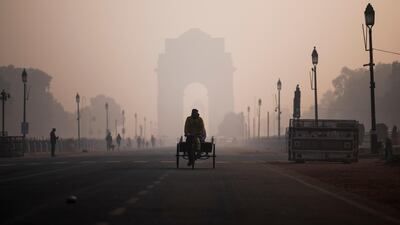
A man rides a rickshaw along a street near India Gate in heavy smoggy conditions in New Delhi on December 6, 2019. (Photo by Jewel SAMAD / AFP)

Rising tensions add doubts over future of India's ambitious solar targets


Jennifer Gnana
  • English
  • Arabic

India's power developers are bracing for a projected increase in solar panel costs as South Asia’s largest economy plans to levy additional taxes on Chinese panels – its biggest driver of solar-powered growth.

New Delhi is planning to impose 20 per cent tariffs on solar cells, modules and inverters imported from China starting on August 1. The move comes in the wake of a widespread backlash against Chinese investments following clashes between the two Asian countries along their shared Himalayan border. India, cancelled key contracts with Chinese developers and banned 59 apps, including the popular ByteDance-owned Tiktok, which enjoys huge popularity in the country.

India’s plan to target the solar parts manufacturing sector is particularly significant as China provides 80 per cent of its imports.

Both countries have underpinned the growth of their booming economies on renewable transition. Plagued by smoggy skies and very high pollution levels in metropolises such as Delhi, Shanghai and Beijing, India and China devoted significant political capital to realise their renewable energy targets.

China plans to drive 16 per cent of its power from renewables by 2030, while India has more ambitious targets of reaching 57 per cent renewable capacity by 2027.

India’s commitments are over and above its pledge to the Paris Agreement signed in 2016, which stipulates a target of 40 per cent renewable electricity generation by 2030.

For now, renewables account for just over a fifth of India’s power generation. However, New Delhi plans to add 175 gigawatts of renewable energy capacity by 2022. Of that, 100GW will come from solar, 60GW from wind, 10GW from biomass and 5GW from hydroelectricity.

With clean energy goals looming on the horizon and much of the capacity to come from solar, tariffs on the country’s biggest source of solar equipment could prove to be a set back.

But tariffs on Chinese panels are not new. In 2018, the Indian government imposed a 25 per cent tariff on solar cells and modules imported from China and Malaysia. The main motive then was to kickstart domestic manufacturing capacity, which has been unable to keep up with the country’s aggressive solar power generation targets.

The safeguard duty, as the levy is known, was subsequently lowered to 20 per cent in 2019 and to 15 per cent earlier this year. The government is considering a possible extension of the duty beyond its expiry on July 29, 2020.

However, despite the incentive, Indian domestic capacity has been unable to keep up with stiff Chinese competition.

"Indian modules are 33 per cent more expensive than imported Chinese modules,” said Kanika Chawla, director, centre for energy finance at the New Delhi-based Council on Energy, Environment and Water (CEEW).

Poor utilisation of available domestic manufacturing capacity is one reason, she added.

"If we were able, without adding any infrastructure, just to use the domestic manufacturing capacity at scale, we would already bring down this price difference to about 21 per cent," Ms Chawla said. "So we go from about being a third less competitive to being a fifth less competitive.”

While new tariffs could put Indian producers on an equal footing with their Chinese competitors, there would be a significant mismatch over the pace at which additional manufacturing can be brought on stream and the country’s plans to add more solar power.

"As it currently stands, India’s domestic manufacturing capacity will not be able to support the country’s ambitious solar growth,” said Xiaojing Sun senior analyst, solar systems and technologies at Wood Mackenzie.

The country’s manufacturing capacity for solar modules and cells will reach 10GW and 6GW, respectively by the end of the year, according to the consultancy. India’s demand for solar power is set to reach 9GW in 2020 and will be above 12GW annually between 2021 and 2025.

"Unless the manufacturing capacity continues to expand in the next few years to beyond [the] 15GW level, domestic Indian manufacturers alone won’t be able to make up for the lost imports,” Ms Sun said.

India’s entrepreneurial solar developers are navigating a vexing conundrum.

An executive at a leading solar energy company in India said plans were being considered to ramp up domestic capacity, while continuing to import Chinese-made solar panels. Indian companies are bracing for solar panel costs to surge by 10 to 15 per cent, he added.

A silver lining in the evolving showdown is that projects that have already been tendered are likely to be exempted from the proposed new tariffs.

  • India's capital New Delhi experiences off-the-chart pollution levels in winter months, prompting calls for the economy to phase out fossil fuels. AFP
    India's capital New Delhi experiences off-the-chart pollution levels in winter months, prompting calls for the economy to phase out fossil fuels. AFP
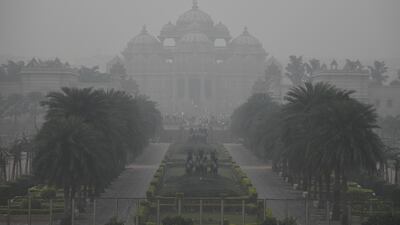
  • The Akshardham temple seen under heavy smog conditions in New Delhi during winter in 2019. The Indian capital was the most polluted city in the world for the second year in a row in 2019. AFP
    The Akshardham temple seen under heavy smog conditions in New Delhi during winter in 2019. The Indian capital was the most polluted city in the world for the second year in a row in 2019. AFP
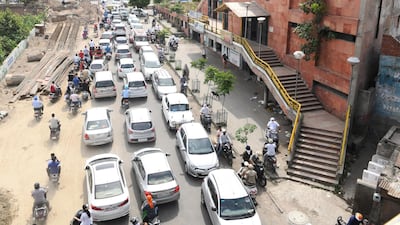
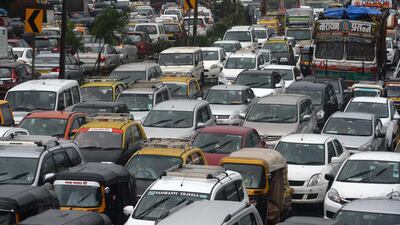
  • Traffic chokes a busy road in Amritsar in the country's Punjab state. Four Indian cities are among the top ten congested globally, according to TomTom Traffic Index 2019 .AFP
    Traffic chokes a busy road in Amritsar in the country's Punjab state. Four Indian cities are among the top ten congested globally, according to TomTom Traffic Index 2019 .AFP
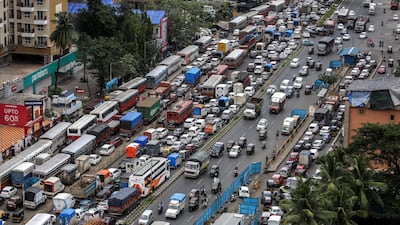
  • A general view of huge traffic jam on the Western Express Highway near Mumbai in June. The Indian commercial capital is the second most congested city in the country. EPA
    A general view of huge traffic jam on the Western Express Highway near Mumbai in June. The Indian commercial capital is the second most congested city in the country. EPA
  • Heavy traffic is seen on a highway during heavy monsoon showers in Mumbai. India's most populous city surprisingly scores low on pollution rankings in the country, finishing 37th in a poll in 2018. AFP
    Heavy traffic is seen on a highway during heavy monsoon showers in Mumbai. India's most populous city surprisingly scores low on pollution rankings in the country, finishing 37th in a poll in 2018. AFP
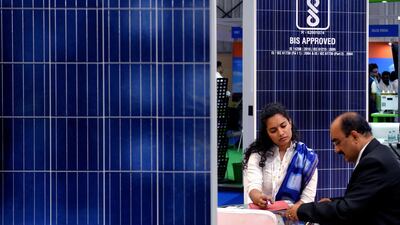
  • A visitor interacts with a representative next to a display of solar panels at a stall during "Inter Solar 2018", an international exhibition on solar technology and energy held in Bangalore. AFP
    A visitor interacts with a representative next to a display of solar panels at a stall during "Inter Solar 2018", an international exhibition on solar technology and energy held in Bangalore. AFP
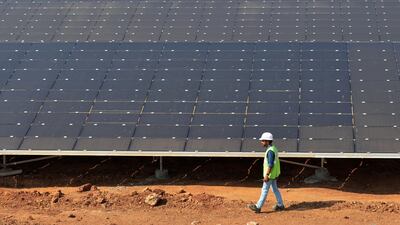
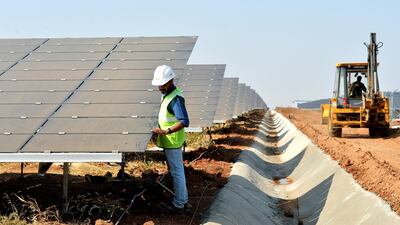
  • A worker conducts routine checks of solar panels at Shakti Sthala, the 2000MW solar power park in Pavagada Taluk, situated about 150 kms from the South Indian city of Bangalore. AFP
    A worker conducts routine checks of solar panels at Shakti Sthala, the 2000MW solar power park in Pavagada Taluk, situated about 150 kms from the South Indian city of Bangalore. AFP
  • India, Asia's third-largest economy plans to add 100GW of solar capacity by 2022. AFP
    India, Asia's third-largest economy plans to add 100GW of solar capacity by 2022. AFP
  • Commuters board the solar-powered DEMU (diesel electrical multiple unit) train at Sarai Rohilla railway station in New Delhi. AFP
    Commuters board the solar-powered DEMU (diesel electrical multiple unit) train at Sarai Rohilla railway station in New Delhi. AFP
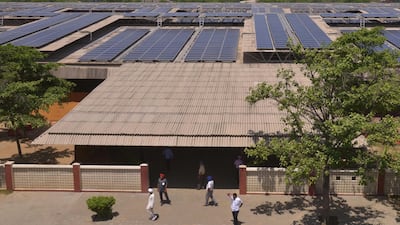
  • Rooftops covered in solar panels are seen at the Indian Solar Photovoltaic Power Plant, some 45kms from Amritsar. India generates just over a fifth of its power from renewables. AFP
    Rooftops covered in solar panels are seen at the Indian Solar Photovoltaic Power Plant, some 45kms from Amritsar. India generates just over a fifth of its power from renewables. AFP
  • Kusumben Parmar works near recently installed solar panels, which help to pump water to irrigate her fields in the village of Dhundi, some 90kms from Ahmedabad in Gujarat state. AFP
    Kusumben Parmar works near recently installed solar panels, which help to pump water to irrigate her fields in the village of Dhundi, some 90kms from Ahmedabad in Gujarat state. AFP
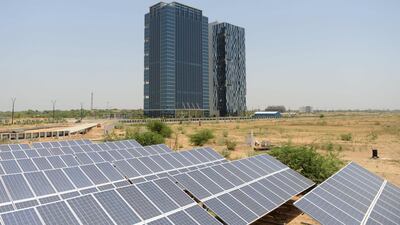
  • Buildings and solar panels, part of the Gujarat International Finance Tec-City are seen on the outskirts of Gandhinagar in Gujarat. India plans to derive 57% of electricity generation from renewables by 2027. AFP
    Buildings and solar panels, part of the Gujarat International Finance Tec-City are seen on the outskirts of Gandhinagar in Gujarat. India plans to derive 57% of electricity generation from renewables by 2027. AFP

With movements in China restricted because of the coronavirus pandemic in the first part of the year, solar panel imports into India remained slow, with the South Asian country still processing backlogs from earlier projects.

China exported around 5.9GW worth of modules to India in 2019, according to Wood Mackenzie.

A possible “full-scale ban” on Chinese solar panels – which has not yet been considered by the Indian government – would impact Chinese manufacturers as India is a key market for them, said Ms Sun.

"However, India represents about 8 per cent of the total Chinese module exports and about 5 per cent of the total shipment of Chinese manufacturers in 2019," she added. "It’s a small scale that manufacturers can manage. The impact on the cost of solar in India should be a bigger concern here.”

The Covid-19 pandemic and policy uncertainty could weigh on the growth of non-hydro renewables capacity, according to Fitch Solutions, the research arm of the credit ratings agency Fitch, which lowered its India forecast for the short-term.

Non-hydro renewables capacity is expected to grow 6.3 per cent this year to reach 88GW, below an earlier projection of 10.1 per cent growth. Only 252MW of wind and 1,184MW of solar capacities were added in the first five months of the year, according to official statistics.

“We highlight risks of a double taxation on solar, which will increase project costs, change solar tariff rates and jeopardise the economic feasibility of several projects in the pipeline,” Fitch Solutions said in its report.

While the agency forecast a pick-up in non-hydro renewables capacity for the second half of the year, the first half of 2020 also had a few bright spots.

In late June, India selected bidders for a mammoth 12GW solar energy project tendered by the Solar Energy Corporation of India (SECI). The $9 billion (Dh33bn) scheme also has a local manufacturing component with an annual capacity of 3GW. The tender is the first of its kind to incorporate manufacturing alongside power generation to the grid. The size of the project is also significant as it eclipses the total value of solar power added in 2019, which was 7.3GW.

In another glimmer of hope for India’s solar sector, the SECI attracted a record low tariff of 2.36 rupees (Dh0.11/$0.03) per kilowatt hour from a Spanish developer for a 300MW segment of a 2GW auction in June.

“The support to renewable energy actually is one that is quite deep and clear,” CEEW’s Ms Chawla said, citing India’s renewable growth story as one of intersectionality with several development priorities.

Whether India is able to achieve its solar ambitions of 175GW in 2022 is of secondary importance, she said.

"It's less important whether we reach there in 2022 or 2020 to 2024," Ms Chawla. "But more than that, the 175GW is really the floor and not the ceiling. So we will actually continue to grow beyond that as well, if you take a 2030 outlook."

What can victims do?

Always use only regulated platforms

Stop all transactions and communication on suspicion

Save all evidence (screenshots, chat logs, transaction IDs)

Report to local authorities

Warn others to prevent further harm

Courtesy: Crystal Intelligence

HER%20FIRST%20PALESTINIAN
%3Cp%3EAuthor%3A%20Saeed%20Teebi%3C%2Fp%3E%0A%3Cp%3EPages%3A%20256%3C%2Fp%3E%0A%3Cp%3EPublisher%3A%C2%A0House%20of%20Anansi%20Press%3C%2Fp%3E%0A
Racecard
%3Cp%3E%0D5pm%3A%20Al%20Maha%20Stables%20%E2%80%93%20Maiden%20(PA)%20Dh80%2C000%20(Turf)%201%2C400m%0D%3Cbr%3E5.30pm%3A%20Al%20Anoud%20Stables%20%E2%80%93%20Handicap%20(PA)%20Dh80%2C000%20(T)%201%2C200m%0D%3Cbr%3E6pm%3A%20Wathba%20Stallions%20Cup%20%E2%80%93%20Handicap%20(PA)%20Dh70%2C000%20(T)%201%2C400m%0D%3Cbr%3E6.30pm%3A%20Arabian%20Triple%20Crown%20Round%202%20%E2%80%93%20Group%203%20(PA)%20Dh%20300%2C000%20(T)%202%2C200m%0D%3Cbr%3E7pm%3A%20Liwa%20Oasis%20%E2%80%93%20Group%202%20(PA)%20Dh300%2C000%20(T)%201%2C400m%0D%3Cbr%3E7.30pm%3A%20Dames%20Stables%20%E2%80%93%20Handicap%20(TB)%20Dh80%2C000%20(T)%201%2C400m%3C%2Fp%3E%0A
The%20specs%3A%20Taycan%20Turbo%20GT
%3Cp%3E%3Cstrong%3EEngine%3A%20%3C%2Fstrong%3EDual%20synchronous%20electric%20motors%0D%3Cbr%3E%3Cstrong%3EPower%3A%20%3C%2Fstrong%3E1%2C108hp%0D%3Cbr%3E%3Cstrong%3ETorque%3A%20%3C%2Fstrong%3E1%2C340Nm%0D%3Cbr%3E%3Cstrong%3ETransmission%3A%20%3C%2Fstrong%3ESingle-speed%20automatic%20(front%20axle)%3B%20two-speed%20transmission%20(rear%20axle)%0D%3Cbr%3E%3Cstrong%3ETouring%20range%3A%20%3C%2Fstrong%3E488-560km%0D%3Cbr%3E%3Cstrong%3EPrice%3A%20%3C%2Fstrong%3EFrom%20Dh928%2C400%0D%3Cbr%3E%3Cstrong%3EOn%20sale%3A%20%3C%2Fstrong%3EOrders%20open%3C%2Fp%3E%0A
SERIES INFO

Afghanistan v Zimbabwe, Abu Dhabi Sunshine Series

All matches at the Zayed Cricket Stadium, Abu Dhabi

Test series

1st Test: Zimbabwe beat Afghanistan by 10 wickets
2nd Test: Wednesday, 10 March – Sunday, 14 March

Play starts at 9.30am

T20 series

1st T20I: Wednesday, 17 March
2nd T20I: Friday, 19 March
3rd T20I: Saturday, 20 March

TV
Supporters in the UAE can watch the matches on the Rabbithole channel on YouTube

Mercer, the investment consulting arm of US services company Marsh & McLennan, expects its wealth division to at least double its assets under management (AUM) in the Middle East as wealth in the region continues to grow despite economic headwinds, a company official said.

Mercer Wealth, which globally has $160 billion in AUM, plans to boost its AUM in the region to $2-$3bn in the next 2-3 years from the present $1bn, said Yasir AbuShaban, a Dubai-based principal with Mercer Wealth.

Within the next two to three years, we are looking at reaching $2 to $3 billion as a conservative estimate and we do see an opportunity to do so,” said Mr AbuShaban.

Mercer does not directly make investments, but allocates clients’ money they have discretion to, to professional asset managers. They also provide advice to clients.

“We have buying power. We can negotiate on their (client’s) behalf with asset managers to provide them lower fees than they otherwise would have to get on their own,” he added.

Mercer Wealth’s clients include sovereign wealth funds, family offices, and insurance companies among others.

From its office in Dubai, Mercer also looks after Africa, India and Turkey, where they also see opportunity for growth.

Wealth creation in Middle East and Africa (MEA) grew 8.5 per cent to $8.1 trillion last year from $7.5tn in 2015, higher than last year’s global average of 6 per cent and the second-highest growth in a region after Asia-Pacific which grew 9.9 per cent, according to consultancy Boston Consulting Group (BCG). In the region, where wealth grew just 1.9 per cent in 2015 compared with 2014, a pickup in oil prices has helped in wealth generation.

BCG is forecasting MEA wealth will rise to $12tn by 2021, growing at an annual average of 8 per cent.

Drivers of wealth generation in the region will be split evenly between new wealth creation and growth of performance of existing assets, according to BCG.

Another general trend in the region is clients’ looking for a comprehensive approach to investing, according to Mr AbuShaban.

“Institutional investors or some of the families are seeing a slowdown in the available capital they have to invest and in that sense they are looking at optimizing the way they manage their portfolios and making sure they are not investing haphazardly and different parts of their investment are working together,” said Mr AbuShaban.

Some clients also have a higher appetite for risk, given the low interest-rate environment that does not provide enough yield for some institutional investors. These clients are keen to invest in illiquid assets, such as private equity and infrastructure.

“What we have seen is a desire for higher returns in what has been a low-return environment specifically in various fixed income or bonds,” he said.

“In this environment, we have seen a de facto increase in the risk that clients are taking in things like illiquid investments, private equity investments, infrastructure and private debt, those kind of investments were higher illiquidity results in incrementally higher returns.”

The Abu Dhabi Investment Authority, one of the largest sovereign wealth funds, said in its 2016 report that has gradually increased its exposure in direct private equity and private credit transactions, mainly in Asian markets and especially in China and India. The authority’s private equity department focused on structured equities owing to “their defensive characteristics.”

Our legal columnist

Name: Yousef Al Bahar

Advocate at Al Bahar & Associate Advocates and Legal Consultants, established in 1994

Education: Mr Al Bahar was born in 1979 and graduated in 2008 from the Judicial Institute. He took after his father, who was one of the first Emirati lawyers

Our legal columnist

Name: Yousef Al Bahar

Advocate at Al Bahar & Associate Advocates and Legal Consultants, established in 1994

Education: Mr Al Bahar was born in 1979 and graduated in 2008 from the Judicial Institute. He took after his father, who was one of the first Emirati lawyers

Sunday's Super Four matches

Dubai, 3.30pm
India v Pakistan

Abu Dhabi, 3.30pm
Bangladesh v Afghanistan

SPEC%20SHEET%3A%20SAMSUNG%20GALAXY%20S24%20ULTRA
%3Cp%3E%3Cstrong%3EDisplay%3A%3C%2Fstrong%3E%206.8%22%20quad-HD%2B%20dynamic%20Amoled%202X%2C%203120%20x%201440%2C%20505ppi%2C%20HDR10%2B%2C%20120Hz%3C%2Fp%3E%0A%3Cp%3E%3Cstrong%3EProcessor%3A%3C%2Fstrong%3E%204nm%20Qualcomm%20Snapdragon%208%20Gen%203%2C%2064-bit%20octa-core%3C%2Fp%3E%0A%3Cp%3E%3Cstrong%3EMemory%3A%3C%2Fstrong%3E%2012GB%20RAM%3C%2Fp%3E%0A%3Cp%3E%3Cstrong%3EStorage%3A%3C%2Fstrong%3E%20256%2F512GB%20%2F%201TB%3C%2Fp%3E%0A%3Cp%3E%3Cstrong%3EPlatform%3A%3C%2Fstrong%3E%20Android%2014%2C%20One%20UI%206.1%3C%2Fp%3E%0A%3Cp%3E%3Cstrong%3EMain%20camera%3A%3C%2Fstrong%3E%20quad%20200MP%20wide%20f%2F1.7%20%2B%2050MP%20periscope%20telephoto%20f%2F3.4%20with%205x%20optical%2F10x%20optical%20quality%20zoom%20%2B%2010MP%20telephoto%202.4%20with%203x%20optical%20zoom%20%2B%2012MP%20ultra-wide%20f%2F2.2%3B%20100x%20Space%20Zoom%3B%20auto%20HDR%2C%20expert%20RAW%3C%2Fp%3E%0A%3Cp%3E%3Cstrong%3EVideo%3A%3C%2Fstrong%3E%208K%4024%2F30fps%2C%204K%4030%2F60%2F120fps%2C%20full-HD%4030%2F60%2F240fps%2C%20full-HD%20super%20slo-mo%40960fps%3C%2Fp%3E%0A%3Cp%3E%3Cstrong%3EFront%20camera%3A%3C%2Fstrong%3E%2012MP%20f%2F2.2%3C%2Fp%3E%0A%3Cp%3E%3Cstrong%3EBattery%3A%3C%2Fstrong%3E%205000mAh%2C%20fast%20wireless%20charging%202.0%2C%20Wireless%20PowerShare%3C%2Fp%3E%0A%3Cp%3E%3Cstrong%3EConnectivity%3A%3C%2Fstrong%3E%205G%2C%20Wi-Fi%2C%20Bluetooth%205.3%2C%20NFC%3C%2Fp%3E%0A%3Cp%3E%3Cstrong%3EI%2FO%3A%3C%2Fstrong%3E%20USB-C%3B%20built-in%20Galaxy%20S%20Pen%3C%2Fp%3E%0A%3Cp%3E%3Cstrong%3EDurability%3A%3C%2Fstrong%3E%20IP68%2C%20up%20to%201.5m%20of%20freshwater%20up%20to%2030%20minutes%3B%20dust-resistant%26nbsp%3B%3C%2Fp%3E%0A%3Cp%3E%3Cstrong%3ESIM%3A%3C%2Fstrong%3E%20Nano%20%2B%20nano%20%2F%20nano%20%2B%20eSIM%20%2F%20dual%20eSIM%20(varies%20in%20different%20markets)%3C%2Fp%3E%0A%3Cp%3E%3Cstrong%3EColours%3A%3C%2Fstrong%3E%20Titanium%20black%2C%20titanium%20grey%2C%20titanium%20violet%2C%20titanium%20yellow%3C%2Fp%3E%0A%3Cp%3E%3Cstrong%3EIn%20the%20box%3A%20%3C%2Fstrong%3EGalaxy%20S24%20Ultra%2C%20USB-C-to-C%20cable%26nbsp%3B%3C%2Fp%3E%0A%3Cp%3E%3Cstrong%3EPrice%3A%3C%2Fstrong%3E%20Dh5%2C099%20for%20256GB%2C%20Dh5%2C599%20for%20512GB%2C%20Dh6%2C599%20for%201TB%3C%2Fp%3E%0A
Pakistan T20 series squad

Sarfraz Ahmed (captain), Fakhar Zaman, Ahmed Shahzad, Babar Azam, Shoaib Malik, Mohammed Hafeez, Imad Wasim, Shadab Khan, Mohammed Nawaz, Faheem Ashraf, Hasan Ali, Amir Yamin, Mohammed Amir (subject to fitness clearance), Rumman Raees, Usman Shinwari, Umar Amin

UAE currency: the story behind the money in your pockets
The specs
Engine: 3.6 V6

Transmission: 8-speed auto

Power: 295bhp

Torque: 353Nm

Price: Dh155,000

On sale: now 

Kamindu Mendis bio

Full name: Pasqual Handi Kamindu Dilanka Mendis

Born: September 30, 1998

Age: 20 years and 26 days

Nationality: Sri Lankan

Major teams Sri Lanka's Under 19 team

Batting style: Left-hander

Bowling style: Right-arm off-spin and slow left-arm orthodox (that's right!)

the pledge

I pledge to uphold the duty of tolerance

I pledge to take a first stand against hate and injustice

I pledge to respect and accept people whose abilities, beliefs and culture are different from my own

I pledge to wish for others what I wish for myself

I pledge to live in harmony with my community

I pledge to always be open to dialogue and forgiveness

I pledge to do my part to create peace for all

I pledge to exercise benevolence and choose kindness in all my dealings with my community

I pledge to always stand up for these values: Zayed's values for tolerance and human fraternity

Squad

Ali Kasheif, Salim Rashid, Khalifa Al Hammadi, Khalfan Mubarak, Ali Mabkhout, Omar Abdulrahman, Mohammed Al Attas, Abdullah Ramadan, Zayed Al Ameri (Al Jazira), Mohammed Al Shamsi, Hamdan Al Kamali, Mohammed Barghash, Khalil Al Hammadi (Al Wahda), Khalid Essa, Mohammed Shaker, Ahmed Barman, Bandar Al Ahbabi (Al Ain), Al Hassan Saleh, Majid Suroor (Sharjah) Walid Abbas, Ahmed Khalil (Shabab Al Ahli), Tariq Ahmed, Jasim Yaqoub (Al Nasr), Ali Saleh, Ali Salmeen (Al Wasl), Hassan Al Muharami (Baniyas) 

BRIEF SCORES

England 353 and 313-8 dec
(B Stokes 112, A Cook 88; M Morkel 3-70, K Rabada 3-85)  
(J Bairstow 63, T Westley 59, J Root 50; K Maharaj 3-50)
South Africa 175 and 252
(T Bavuma 52; T Roland-Jones 5-57, J Anderson 3-25)
(D Elgar 136; M Ali 4-45, T Roland-Jones 3-72)

Result: England won by 239 runs
England lead four-match series 2-1

The biog

Name: Salvador Toriano Jr

Age: 59

From: Laguna, The Philippines

Favourite dish: Seabass or Fish and Chips

Hobbies: When he’s not in the restaurant, he still likes to cook, along with walking and meeting up with friends.

ANDROID%20VERSION%20NAMES%2C%20IN%20ORDER
%3Cp%3EAndroid%20Alpha%3C%2Fp%3E%0A%3Cp%3EAndroid%20Beta%3C%2Fp%3E%0A%3Cp%3EAndroid%20Cupcake%3C%2Fp%3E%0A%3Cp%3EAndroid%20Donut%3C%2Fp%3E%0A%3Cp%3EAndroid%20Eclair%3C%2Fp%3E%0A%3Cp%3EAndroid%20Froyo%3C%2Fp%3E%0A%3Cp%3EAndroid%20Gingerbread%3C%2Fp%3E%0A%3Cp%3EAndroid%20Honeycomb%3C%2Fp%3E%0A%3Cp%3EAndroid%20Ice%20Cream%20Sandwich%3C%2Fp%3E%0A%3Cp%3EAndroid%20Jelly%20Bean%3C%2Fp%3E%0A%3Cp%3EAndroid%20KitKat%3C%2Fp%3E%0A%3Cp%3EAndroid%20Lollipop%3C%2Fp%3E%0A%3Cp%3EAndroid%20Marshmallow%3C%2Fp%3E%0A%3Cp%3EAndroid%20Nougat%3C%2Fp%3E%0A%3Cp%3EAndroid%20Oreo%3C%2Fp%3E%0A%3Cp%3EAndroid%20Pie%3C%2Fp%3E%0A%3Cp%3EAndroid%2010%20(Quince%20Tart*)%3C%2Fp%3E%0A%3Cp%3EAndroid%2011%20(Red%20Velvet%20Cake*)%3C%2Fp%3E%0A%3Cp%3EAndroid%2012%20(Snow%20Cone*)%3C%2Fp%3E%0A%3Cp%3EAndroid%2013%20(Tiramisu*)%3C%2Fp%3E%0A%3Cp%3EAndroid%2014%20(Upside%20Down%20Cake*)%3C%2Fp%3E%0A%3Cp%3EAndroid%2015%20(Vanilla%20Ice%20Cream*)%3C%2Fp%3E%0A%3Cp%3E%3Cem%3E*%20internal%20codenames%3C%2Fem%3E%3C%2Fp%3E%0A