
Opec has reached an agreement in principle to boost oil production, achieving a last-minute compromise that overcame Iran’s threats to veto any supply hike.
The preliminary accord allows for an additional 600,000 barrels a day of oil to flow onto the market, about 0.5 per cent of global supply, said a delegate. That reflects a one million barrel-a-day adjustment on paper to the production cuts implemented by the Organisation of Petroleum Exporting Countries and its allies, the delegate said, asking not to be named because the information is private.
The actual increase will be smaller because several members are unable to raise output.
The new deal would effectively roll back the deeper-than-intended cuts from nations such as Venezuela, returning the curbs back to the level originally agreed in 2016, the delegate said.
The final wording of the deal is still under discussion.
_____________
Read more on Opec
Opec nears compromise on supply boost after Saudi-Iran talks
Opec's Vienna meet could prove bullish for oil markets, say analysts
Opec's new game as rivalries surface over oil production
Business Extra podcast: Russia, Saudi Arabia and the state of oil markets
-
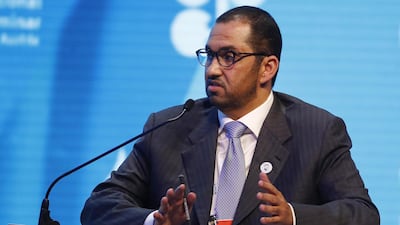
Sultan Al Jaber, chief executive officer of ADNOC, gestures as he speaks during the opening day of the 7th OPEC international seminar in Vienna, Austria. Stefan Wermuth / Bloomberg -

Mohammed Barkindo, Opec secretary general. Stefan Wermuth / Bloomberg -

Opec inched closer to an agreement that would allow an oil-supply increase after positive talks between Saudi Arabia and Iran. Stefan Wermuth / Bloomberg -

Khalid Al Falih, Saudi Arabia's energy minister. Stefan Wermuth / Bloomberg -

Mustapha Guitouni, Algeria's energy minister. Stefan Wermuth / Bloomberg -

Parviz Shahbazov, Azerbaijan's energy minister. Stefan Wermuth / Bloomberg -

Aldo Flores Quiroga, Mexico's deputy energy minister. Stefan Wermuth / Bloomberg -

Ministers have gathered in the Austrian capital to discuss a supply increase that would be equivalent to about 600,000 barrels a day, or 0.5 per cent of global supply. Stefan Wermuth / Bloomberg -
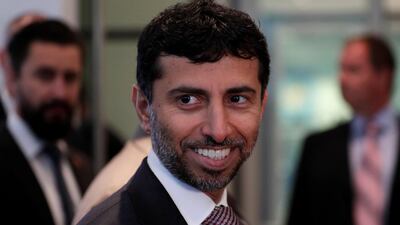
UAE's Energy Minister Suhail Mohamed Al Mazrouei arrives for the Opec meeting in Vienna. Heinz-Peter Bader / Reuters


_____________
The accord is a much-needed show of unity after Iranian oil minister Bijan Namdar Zanganeh walked out of a meeting on Thursday evening, predicting that Opec wouldn’t be able to convince him to back an increase.
Mr Zanganeh met with Khalid al-Falih, his Saudi counterpart, for private talks on Friday morning before the full Opec meeting.
Tehran had bridled at complaints on Twitter by US president Donald Trump that the cartel was artificially inflating oil prices, which touched $80 a barrel last month.
Mr Zanganeh has said the president is to blame for high prices because of his unilateral withdrawal from the international nuclear agreement and the imposition of fresh sanctions that could significantly curb Iran’s crude exports.

