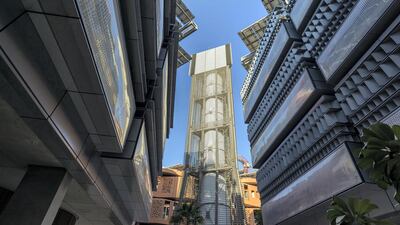
Abu Dhabi's renewable energy company, Masdar, is advancing the development of a hydrogen demonstrator project as part of an alliance of state-backed entities. The project's design will be complete by the end of the year, the company's new director of clean energy, Fawaz Al Muharrami, said.
The company has already begun an assessment of its green hydrogen demonstrator project, which will find uses for fuel cells in buses at the carbon-neutral Masdar City as well as in aviation fuel to be used by Etihad and Lufthansa.
Masdar's parent company Mubadala, alongside Abu Dhabi National Oil Company and holding company ADQ, agreed earlier this year to form a hydrogen alliance to produce green and blue variants of the fuel.
Green hydrogen refers to the gas produced from renewable sources of energy such as wind and solar, which powers electrolysers that split water molecules. Blue hydrogen, which is being produced by Adnoc, is manufactured through steam methane reforming.
"For this year, we have already initiated the assessment, the design aspect of the project," Mr Al Muharrami told The National in an interview.
"Hopefully, by the end of this year we'll be able to complete that work so that we can begin the next phase of that project," he added.
This will involve construction of the demonstrator project and is likely to take two years, he said.
A second phase of the project will look into extending the use of the fuel in the maritime and shipping sectors.
Hydrogen has become an increasingly popular alternative fuel that is being prioritised for development by Gulf oil-exporting countries such as the UAE and Saudi Arabia.
Masdar's project has backers including Germany's Siemens Energy, Japan's Marubeni, Etihad Airways, the Lufthansa Group, the UAE's Khalifa University of Science and Technology and the Abu Dhabi Department of Energy.
The main infrastructure for the green hydrogen project is being developed by Siemens Energy and Marubeni. The German company is also developing one of the first solar-powered electrolyser projects to produce hydrogen for fuel cells at Dubai's Expo 2020, which was delayed until this year due to the Covid-19 pandemic.
Masdar will trial the manufacture of hydrogen using solar photovoltaic power and will look at opportunities in the future to export such fuel to meet growing demand globally, particularly in Europe.
"The UAE, in particular, has that advantage, being the cheapest source of renewable [energy and] through PV [we] could actually be able to generate this easily," said Mr Al Muharrami.
Solar power capacity of around 10 to 25 megawatts could power the initial electrolyser needed to generate green hydrogen, he added.
"We are able to easily adapt to hydrogen and transport that hydrogen to the world – including Europe – and we can actually play that role in the future," Mr Al Muharrami said.
Falling costs for solar will allow green hydrogen to cost less than natural gas by 2050, according to BloombergNEF.
The UAE's Gulf neighbour Saudi Arabia is also looking to become an exporter of green hydrogen.
The kingdom, the world's largest exporter of crude, plans to sell green hydrogen produced locally to Europe through a pipeline "if the economics allow for it", energy minister Prince Abdulaziz bin Salman said in February.
The UAE is in the process of updating its 2050 energy strategy with a greater potential role for hydrogen.
The country also plans to tap nuclear energy as a baseload to power hydrogen production in the future.
In March, the UAE Cabinet approved a nationwide system for hydrogen vehicles.

Who is Mohammed Al Halbousi?
The new speaker of Iraq’s parliament Mohammed Al Halbousi is the youngest person ever to serve in the role.
The 37-year-old was born in Al Garmah in Anbar and studied civil engineering in Baghdad before going into business. His development company Al Hadeed undertook reconstruction contracts rebuilding parts of Fallujah’s infrastructure.
He entered parliament in 2014 and served as a member of the human rights and finance committees until 2017. In August last year he was appointed governor of Anbar, a role in which he has struggled to secure funding to provide services in the war-damaged province and to secure the withdrawal of Shia militias. He relinquished the post when he was sworn in as a member of parliament on September 3.
He is a member of the Al Hal Sunni-based political party and the Sunni-led Coalition of Iraqi Forces, which is Iraq’s largest Sunni alliance with 37 seats from the May 12 election.
He maintains good relations with former Prime Minister Nouri Al Maliki’s State of Law Coaliton, Hadi Al Amiri’s Badr Organisation and Iranian officials.
Mercer, the investment consulting arm of US services company Marsh & McLennan, expects its wealth division to at least double its assets under management (AUM) in the Middle East as wealth in the region continues to grow despite economic headwinds, a company official said.
Mercer Wealth, which globally has $160 billion in AUM, plans to boost its AUM in the region to $2-$3bn in the next 2-3 years from the present $1bn, said Yasir AbuShaban, a Dubai-based principal with Mercer Wealth.
“Within the next two to three years, we are looking at reaching $2 to $3 billion as a conservative estimate and we do see an opportunity to do so,” said Mr AbuShaban.
Mercer does not directly make investments, but allocates clients’ money they have discretion to, to professional asset managers. They also provide advice to clients.
“We have buying power. We can negotiate on their (client’s) behalf with asset managers to provide them lower fees than they otherwise would have to get on their own,” he added.
Mercer Wealth’s clients include sovereign wealth funds, family offices, and insurance companies among others.
From its office in Dubai, Mercer also looks after Africa, India and Turkey, where they also see opportunity for growth.
Wealth creation in Middle East and Africa (MEA) grew 8.5 per cent to $8.1 trillion last year from $7.5tn in 2015, higher than last year’s global average of 6 per cent and the second-highest growth in a region after Asia-Pacific which grew 9.9 per cent, according to consultancy Boston Consulting Group (BCG). In the region, where wealth grew just 1.9 per cent in 2015 compared with 2014, a pickup in oil prices has helped in wealth generation.
BCG is forecasting MEA wealth will rise to $12tn by 2021, growing at an annual average of 8 per cent.
Drivers of wealth generation in the region will be split evenly between new wealth creation and growth of performance of existing assets, according to BCG.
Another general trend in the region is clients’ looking for a comprehensive approach to investing, according to Mr AbuShaban.
“Institutional investors or some of the families are seeing a slowdown in the available capital they have to invest and in that sense they are looking at optimizing the way they manage their portfolios and making sure they are not investing haphazardly and different parts of their investment are working together,” said Mr AbuShaban.
Some clients also have a higher appetite for risk, given the low interest-rate environment that does not provide enough yield for some institutional investors. These clients are keen to invest in illiquid assets, such as private equity and infrastructure.
“What we have seen is a desire for higher returns in what has been a low-return environment specifically in various fixed income or bonds,” he said.
“In this environment, we have seen a de facto increase in the risk that clients are taking in things like illiquid investments, private equity investments, infrastructure and private debt, those kind of investments were higher illiquidity results in incrementally higher returns.”
The Abu Dhabi Investment Authority, one of the largest sovereign wealth funds, said in its 2016 report that has gradually increased its exposure in direct private equity and private credit transactions, mainly in Asian markets and especially in China and India. The authority’s private equity department focused on structured equities owing to “their defensive characteristics.”
MATCH INFO
Real Madrid 3 (Kroos 4', Ramos 30', Marcelo 37')
Eibar 1 (Bigas 60')
Turning%20waste%20into%20fuel
%3Cp%3EAverage%20amount%20of%20biofuel%20produced%20at%20DIC%20factory%20every%20month%3A%20%3Cstrong%3EApproximately%20106%2C000%20litres%3C%2Fstrong%3E%3C%2Fp%3E%0A%3Cp%3EAmount%20of%20biofuel%20produced%20from%201%20litre%20of%20used%20cooking%20oil%3A%20%3Cstrong%3E920ml%20(92%25)%3C%2Fstrong%3E%3C%2Fp%3E%0A%3Cp%3ETime%20required%20for%20one%20full%20cycle%20of%20production%20from%20used%20cooking%20oil%20to%20biofuel%3A%20%3Cstrong%3EOne%20day%3C%2Fstrong%3E%3C%2Fp%3E%0A%3Cp%3EEnergy%20requirements%20for%20one%20cycle%20of%20production%20from%201%2C000%20litres%20of%20used%20cooking%20oil%3A%3Cbr%3E%3Cstrong%3E%E2%96%AA%20Electricity%20-%201.1904%20units%3Cbr%3E%E2%96%AA%20Water-%2031%20litres%3Cbr%3E%E2%96%AA%20Diesel%20%E2%80%93%2026.275%20litres%3C%2Fstrong%3E%3C%2Fp%3E%0A
Benefits of first-time home buyers' scheme
- Priority access to new homes from participating developers
- Discounts on sales price of off-plan units
- Flexible payment plans from developers
- Mortgages with better interest rates, faster approval times and reduced fees
- DLD registration fee can be paid through banks or credit cards at zero interest rates
Our legal columnist
Name: Yousef Al Bahar
Advocate at Al Bahar & Associate Advocates and Legal Consultants, established in 1994
Education: Mr Al Bahar was born in 1979 and graduated in 2008 from the Judicial Institute. He took after his father, who was one of the first Emirati lawyers
COMPANY%20PROFILE
%3Cp%3E%3Cstrong%3EName%3A%20%3C%2Fstrong%3ETelr%3Cbr%3E%3Cstrong%3EBased%3A%20%3C%2Fstrong%3EDubai%2C%20UAE%3Cbr%3E%3Cstrong%3ELaunch%20year%3A%3C%2Fstrong%3E%202014%3Cbr%3E%3Cstrong%3ENumber%20of%20employees%3A%20%3C%2Fstrong%3E65%3Cbr%3E%3Cstrong%3ESector%3A%20%3C%2Fstrong%3EFinTech%20and%20payments%3Cbr%3E%3Cstrong%3EFunding%3A%20%3C%2Fstrong%3Enearly%20%2430%20million%20so%20far%3C%2Fp%3E%0A
ESSENTIALS
The flights
Emirates flies from Dubai to Phnom Penh via Yangon from Dh2,700 return including taxes. Cambodia Bayon Airlines and Cambodia Angkor Air offer return flights from Phnom Penh to Siem Reap from Dh250 return including taxes. The flight takes about 45 minutes.
The hotels
Rooms at the Raffles Le Royal in Phnom Penh cost from $225 (Dh826) per night including taxes. Rooms at the Grand Hotel d'Angkor cost from $261 (Dh960) per night including taxes.
The tours
A cyclo architecture tour of Phnom Penh costs from $20 (Dh75) per person for about three hours, with Khmer Architecture Tours. Tailor-made tours of all of Cambodia, or sites like Angkor alone, can be arranged by About Asia Travel. Emirates Holidays also offers packages.
