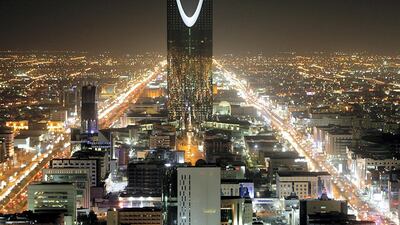
The Kingdom Tower stands in the night above the Saudi capital Riyadh November 16, 2007. REUTERS/Ali Jarekji (SAUDI ARABIA) - GM1DWPNRBQAA

Acciona awarded $384m contract to build desalination plant in Saudi Arabia


Fareed Rahman
  • English
  • Arabic

Spanish company Acciona and its local partner Al Rashid Trading & Contracting Company, or RTCC, secured a $384 million contract to build a desalination plant on Saudi Arabia's Red Sea coast as the kingdom looks to increase the capacity of its water supply.

The contract was awarded by state-owned Saline Water Conversion Corporation and will have a production capacity of 400,000 cubic metres per day, Acciona said on Tuesday.

The Shuqaiq 1 plant “will help to improve the supply of drinking water and offset water shortages in south-west Saudi Arabia by providing a new source of potable water”, it said.

The desalination plant is Acciona’s fifth in the country and the third awarded to the company by SWCC.

It is expected to be completed in 2023.

Last year, Acciona won a $530m contract for the design, construction, operation and maintenance of the Shuqaiq 3 desalination plant with a capacity of 450,000 cubic metres per day.

The plant is currently under construction and is expected to be completed in 2021.

The company is also developing the Al Khobar reverse osmosis plant in Khobar on the east coast with a capacity of 630,000 cubic metres per day.

Acciona has also designed and built Al Jubail reverse osmosis seawater desalination plant with a capacity of 100,000 cubic metres per day.

The plant serves both the city of Jubail and its industrial complex in the Eastern Province.

Saudi Arabia, the Arab world’s largest economy, is planning to use public-private partnerships with local and foreign companies to fund infrastructure projects and diversify its economy away from oil.

Last month, SWCC's governor Abdullah Al-Abdul Kareem said the amount of desalinated water produced by SWCC and private sector partners had increased to 7.9 million cubic metres per day, up from 5.3 million cubic metres per day in 2016.

He said that plans were in place to increase capacity by 4 million cubic metres, according to SWCC's website. Capacity will top 10.4 million cubic metres per day within two years.

The kingdom's National Water Company is also inviting private sector participation to build and run a series of new wastewater treatment plants across the country.

NWC is issuing tenders inviting private companies to participate in developing 114 sewage treatment plants with a total capacity of 5.1 million cubic metres per day, as part of its 2030 National Water Strategy, it said in July.


Ten tax points to be aware of in 2026

1. Domestic VAT refund amendments: request your refund within five years

If a business does not apply for the refund on time, they lose their credit.

2. E-invoicing in the UAE

Businesses should continue preparing for the implementation of e-invoicing in the UAE, with 2026 a preparation and transition period ahead of phased mandatory adoption. 

3. More tax audits

Tax authorities are increasingly using data already available across multiple filings to identify audit risks. 

4. More beneficial VAT and excise tax penalty regime

Tax disputes are expected to become more frequent and more structured, with clearer administrative objection and appeal processes. The UAE has adopted a new penalty regime for VAT and excise disputes, which now mirrors the penalty regime for corporate tax.

5. Greater emphasis on statutory audit

There is a greater need for the accuracy of financial statements. The International Financial Reporting Standards standards need to be strictly adhered to and, as a result, the quality of the audits will need to increase.

6. Further transfer pricing enforcement

Transfer pricing enforcement, which refers to the practice of establishing prices for internal transactions between related entities, is expected to broaden in scope. The UAE will shortly open the possibility to negotiate advance pricing agreements, or essentially rulings for transfer pricing purposes. 

7. Limited time periods for audits

Recent amendments also introduce a default five-year limitation period for tax audits and assessments, subject to specific statutory exceptions. While the standard audit and assessment period is five years, this may be extended to up to 15 years in cases involving fraud or tax evasion. 

8. Pillar 2 implementation 

Many multinational groups will begin to feel the practical effect of the Domestic Minimum Top-Up Tax (DMTT), the UAE's implementation of the OECD’s global minimum tax under Pillar 2. While the rules apply for financial years starting on or after January 1, 2025, it is 2026 that marks the transition to an operational phase.

9. Reduced compliance obligations for imported goods and services

Businesses that apply the reverse-charge mechanism for VAT purposes in the UAE may benefit from reduced compliance obligations. 

10. Substance and CbC reporting focus

Tax authorities are expected to continue strengthening the enforcement of economic substance and Country-by-Country (CbC) reporting frameworks. In the UAE, these regimes are increasingly being used as risk-assessment tools, providing tax authorities with a comprehensive view of multinational groups’ global footprints and enabling them to assess whether profits are aligned with real economic activity. 

Contributed by Thomas Vanhee and Hend Rashwan, Aurifer

MATCH INFO

Uefa Champions League semi-final, first leg
Bayern Munich v Real Madrid

When: April 25, 10.45pm kick-off (UAE)
Where: Allianz Arena, Munich
Live: BeIN Sports HD
Second leg: May 1, Santiago Bernabeu, Madrid

The Perfect Couple

Starring: Nicole Kidman, Liev Schreiber, Jack Reynor

Creator: Jenna Lamia

Rating: 3/5

Jetour T1 specs

Engine: 2-litre turbocharged

Power: 254hp

Torque: 390Nm

Price: From Dh126,000

Available: Now

The five pillars of Islam

1. Fasting

2. Prayer

3. Hajj

4. Shahada

5. Zakat 

COMPANY PROFILE
Name: HyperSpace
 
Started: 2020
 
Founders: Alexander Heller, Rama Allen and Desi Gonzalez
 
Based: Dubai, UAE
 
Sector: Entertainment 
 
Number of staff: 210 
 
Investment raised: $75 million from investors including Galaxy Interactive, Riyadh Season, Sega Ventures and Apis Venture Partners
Who's who in Yemen conflict

Houthis: Iran-backed rebels who occupy Sanaa and run unrecognised government

Yemeni government: Exiled government in Aden led by eight-member Presidential Leadership Council

Southern Transitional Council: Faction in Yemeni government that seeks autonomy for the south

Habrish 'rebels': Tribal-backed forces feuding with STC over control of oil in government territory

ARGYLLE
%3Cp%3EDirector%3A%20Matthew%20Vaughn%3C%2Fp%3E%0A%3Cp%3EStarring%3A%20Bryce%20Dallas%20Howard%2C%20Sam%20Rockwell%2C%20John%20Cena%3C%2Fp%3E%0A%3Cp%3ERating%3A%203%2F5%3C%2Fp%3E%0A
The years Ramadan fell in May

1987

1954

1921

1888