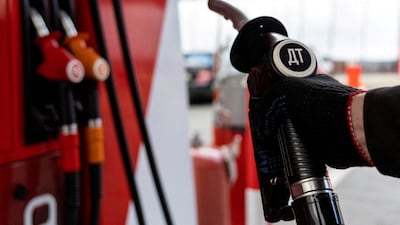

US President Donald Trump's announcement that Russia will be supplying diesel to global markets has opened up a can of worms, says analysts.
Washington agreed to lift sanctions on the Kremlin in a bid to bring down energy prices, especially for diesel, which is vital to many economic sectors.
Analysts, however, have raised alarm bells, saying the numbers Mr Trump has touted will not add up, and highlighting double standards over Russia's conflict with Ukraine and the International Criminal Court.
'Happy birthday Putin'
The first fallout came from Ukraine's President Volodymyr Zelenskyy immediately after Mr Trump announced the deal.
Mr Zelenskyy said allowing Russia to sell its petroleum products “is an investment in war that needs to end, not continue”, and that the Kremlin “will ‘repay’ the diesel with further terror and perfidy”.
In a subsequent interview with Axios, Mr Zelenskyy likened the deal to a “birthday present” to Russian President Vladimir Putin, who turned 74 on October 7.
Mr Zelenskyy apparently also felt betrayed. Last week, the Ukrainian President met Steve Witkoff, the US special envoy to the Middle East, and Jared Kushner, the US envoy for peace (and Mr Trump's son-in-law), to discuss a potential peace breakthrough before the US midterm elections. But nothing was discussed about a potential diesel deal with the Russians.
“It looks like that they used this opportunity to meet us from one side, and from the other side called Putin and negotiate this,” Mr Zelenskyy said in the Axios interview.
“If the price is energy ceasefire, this negotiation is good … what did [Trump] get? That he will have more diesel? For whom? More Russian diesel for Americans? It shows weakness of the world.”
'Fantasy arithmetic'
Mr Trump, in a social media post, said that under the deal, Russia would immediately supply more than 300,000 tonnes of diesel fuel to the US and global market, in addition to 500,000 tonnes in November, followed by one million more tonnes “immediately thereafter”.
In total, and “based on the condition of their diesel refineries”, Russia will deliver three million tonnes of diesel fuel “within a short period of time”, he added.
Those numbers “will not work”, according to analysts at Quantum Strategy and Geonomics, which said the figures above are, respectively, 60 per cent, 100 per cent and 200 per cent of Russia's diesel exports.
Furthermore, Russia needs to import 80,000 and 140,000 barrels per day of diesel, petrol and other refined products just to run its domestic refineries and make up for the shortages of refined products, Singapore-based Quantum said.
Its analysts also pointed out that Ukrainian strikes have taken out more than half of Russia's refining capacity, according to Kyiv's defence ministry. The International Energy Agency estimates that Russia's diesel production capacity has been cut by nearly a third as a result of the attacks.
In addition, Russia's exports of diesel and gasoil fell to a decade low of about 144,000 barrels per day in September, down from as high as 270,000 bpd in August and a peak of 820,000 in April, according to Quantum data.
“Russia cannot supply the diesel Trump claims it will … technically, the balance [between diesel and other refined product exports and imports] needed to run domestic refineries cannot be switched into supplying Trump without endangering Russian domestic refinery supply in other areas,” the Quantum analysts said.
“So Trump's simple fantasy arithmetic is nothing but that … we expect this deal to fail economically.”
Double standard
The US-Russia diesel deal also poses as a double standard. On Friday, Washington imposed more sanctions on the International Criminal Court, on the same day that former ICC judge Navanethem “Navi” Pillay was awarded the Nobel Peace Prize. The move was seen as retaliation for Mr Trump not being awarded the honour, which he claimed he deserved.
“The contrast is striking. Sanctions against an institution pursuing accountability for war crimes; sanctions relaxed on energy exports from a country waging a war of aggression against Ukraine,” said Nicolai Kiskalt, a Germany-based partner at global consultancy KPMG.
“The US administration has its own arguments: protecting American sovereignty from the ICC’s jurisdiction and bringing down energy prices for American consumers. But from a European perspective, these decisions raise fundamental questions that go far beyond trade, energy or diplomacy.”
Riku Huttunen, director general of the energy department at Finland's Economy and Employment Ministry, also called this a “stark contrast” to the US sanctions law aimed at clamping down on the oil and gas revenue that fuels Russia’s war against Ukraine.
“At the same time, there are doubts concerning Russian supplies. Russian oil refining capacities have been destroyed by Ukrainian drone attacks, causing fuel shortages,” he said.
“The deal's effects on diesel markets might remain small. The agreed amounts are relatively modest and it is still unclear how the deliveries would be made in practice.”
The timing of the US-Russia deal may also be bad, especially for Ukrainians, as winter approaches. Any further attacks on energy infrastructure would prove to be a serious challenge for both the economy and society.
“An energy ceasefire was one of the few practical ideas that could have directly protected Ukrainian civilians this winter,” said Robert Potter, founding partner of Washington-based Cyber Activities Group, who is also an expert in geopolitics and security.
“The negotiating logic was straightforward: if Moscow wanted sanctions relief or economic concessions, those could potentially be exchanged for something tangible, stopping attacks on Ukrainian energy infrastructure. Instead, Trump has handed Putin the economic benefit first,” he said.
“That pulls the rug from under one of the few areas where western leverage could have been converted into immediate civilian protection. Worse, the signal to Moscow is really dangerous. Putin can escalate attacks on Ukrainian energy infrastructure, refuse to commit to renewed peace talks, and still receive access to western-linked energy markets because US diesel prices are politically painful ahead of the midterms.”