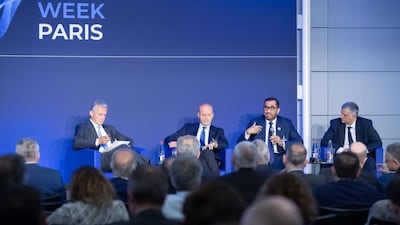
XRG, the international energy investment unit of Adnoc, has committed to investing in Argentina's liquefied natural gas to help the country achieve a goal of becoming a top player in the industry.
XRG’s participation in the South American nation's LNG network reflects confidence in the scale and quality of Vaca Muerta, the 30,000 square kilometre unconventional shale oil and gas deposit in the Neuquen Basin, Dr Sultan Al Jaber, Minister of Industry and Advanced Technology, executive chairman of XRG, and managing director and group chief executive of Adnoc said at the Argentina Week summit in Paris on Thursday.
Vaca Muerta is the world’s second-biggest shale gas resource and the fourth-largest for shale oil. XRG did not disclose the value of its investment.
XRG and Italy's Eni in June signed agreements with Argentina’s YPF to acquire stakes in three upstream blocks to supply a new LNG project in the South American nation.
The first phase of Argentina LNG is designed to produce 12 million tonnes a year, which in turn will support XRG’s ambition to become a top-five global gas player, as well as establish Latin America as an important new growth region within its portfolio, XRG said on Thursday.
Dr Al Jaber also expressed confidence in the nation's improving investment environment and the combined ability of XRG, YPF and Eni to "deliver a globally competitive LNG project".
“Argentina has the ingredients to build a world-class LNG business," he said. "Oil production is at record levels and last year Argentina posted its largest energy trade surplus in more than three decades.
"That is not a forecast, it is a track record. It gives XRG confidence that the resource is real, the capability is proven and Argentina can deliver at scale.”
At Argentina Week, Dr Al Jaber met Argentine President Javier Milei and joined a panel featuring Horacio Marin, chairman and chief executive of YPF, and Eni chief executive Claudio Descalzi. Dr Al Jaber noted investments of this scale tend to span decades and require "confidence, predictability and a shared commitment to delivery".
"The reforms led by President Milei, including the new Rigi investment framework, are creating the long-term stability that capital-intensive energy projects need and strengthening Argentina's appeal to international investors," Dr Al Jaber said.
Rigi, or the Incentive Regime for Large Investments initiative, is a strategic programme designed to attract and encourage large-scale investments in Argentina. It offers significant tax, customs and exchange benefits, while establishing a solid legal framework to facilitate the realisation of long-term investment projects, according to the government.
The success of Argentina's LNG is also "measured in the value that stays there", Dr Al Jaber said.
"It means export earnings. It means business for local suppliers. It means skilled jobs for Argentine people. We are talking more than 40,000 jobs and billions flowing back into the Argentine economy.
"No country or company secures its energy future alone," he added. "You need different sources of supply, reliable routes to market and partners you can count on.”
XRG has been actively increasing its portfolio of investments globally and plans to double its asset value over the next decade.
Launched in 2024 as an international lower-carbon energy and chemicals investment company, with an enterprise value exceeding $80 billion, it has acquired stakes in several global gas projects.
Last week, XRG said it would be boosting its gas portfolio with plans for the next phase of its strategic field development in Azerbaijan. In September, XRG, along with Adnoc and Masdar, announced agreements with German companies to boost expertise, and in August, XRG entered Venezuela's energy sector through an offshore natural gas project.
Dr Al Jaber also highlighted the deepening relationship between the UAE and Argentina, which last week launched negotiations on a Comprehensive Economic Partnership Agreement, and identified the YPF-XRG partnership as "an example of the high-impact, long-term investment both countries want to advance".

