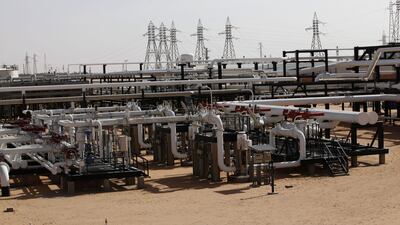

Libya's National Oil Company has said one of the refineries at its key Zawiya site has been shut down, bringing its financial losses to about $95 million through the week amid fears of wider economic harm.
The decision came amid the continued forced closure of Zawiya's valve for its Sharara crude transmission line, spurred by armed groups belonging to the Western South Oil Facilities Guard Agency and Western Military Zone, the state oil company said in a statement on Saturday.
That has brought Tripoli-based NOC's lost crude production to more than 942,000 barrels of oil for the week, it said. The losses peaked at nearly 260,000 barrels on Tuesday.
NOC "forcibly shut down one of the refining units at the Zawiya refinery to ensure the continued operation of the other unit for as long as possible", it said.
Zawiya is Libya’s largest operating refinery, with a refining capacity of 120,000 barrels per day. It produces petrol, diesel, jet fuel, liquefied petroleum gas, fuel oil and naphtha for domestic consumption. The wider site also includes a centre for the production of asphalt and lubricants.
The complex is important for the country’s upstream operations because it is connected to Sharara, one of Libya’s largest fields, through a pipeline that transports crude for domestic supply and for export in global markets.
The company repeated warnings that the disruption will hit government finances and the overall economy.
"The continued disruption of crude oil flow through the main line ... will have a negative impact directly on the country's oil revenues, as well as double the import bill for petroleum products," it said. "Specialised teams ... have programmed a shipment of crude oil through one of the ports to feed the refinery and ensure its continuity of operation, as a precautionary measure to avoid any repercussions that may affect the supplies to electricity generation stations."
Libya has been beset with problems, including political instability and violence, after former leader Muammar Qaddafi was overthrown in 2011. Much of its oil production has since remained offline amid unrest.
The country is run by two governments, in Tripoli and Benghazi, with the presence of numerous armed groups wielding influence and discouraging investors to pump finances into the country.
Libya has the world's 10th-largest proven oil reserves at nearly 48.4 million barrels, which is also the largest in Africa, data from Worldometer shows.
Libya needs investment of up to $40 billion to develop its oil and gas sector as it aims to boost production and become a reliable global supplier, NOC chairman Masoud Suleman said last month, while noting "untapped resources".
Most of Libya's largest oilfields and export terminals lie in eastern areas controlled by forces commanded by Field Marshal Khalifa Haftar, the Financial Times reported in August. In the west, the UN-recognised Government of National Unity is backed by a patchwork of armed groups.

