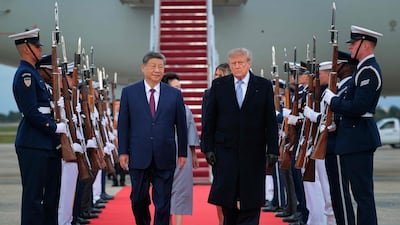
When Chinese President Xi Jinping sits down with his US counterpart Donald Trump at the White House today, the cameras will focus on the usual subjects: tariffs, Taiwan, artificial intelligence, rare earths.
The commentary in Washington and Beijing already reads the meeting as a contest between the world's two largest economies, each holding a chokepoint over the other. America controls the most advanced chips; China controls the refining of the minerals those chips – and everything else – depend on.
That reading is correct, but incomplete. There is a third chokepoint in this story, and it is not in Washington or Beijing. It is in the Gulf. And for the first time in a generation, the country holding the key to it is the UAE.
Consider the map as it stands right now. The Strait of Hormuz has been largely closed since late February. Iran's exports from the Gulf have been halted by the American blockade. On September 11, attacks by an Iran-backed group in Iraq forced Saudi Arabia to shut the East-West pipeline that carries crude across the kingdom to the Red Sea, the route that had become Riyadh's lifeline to Asian buyers. Shanghai crude futures have hit record highs.
Before this war, the International Energy Agency noted that only two Gulf producers had operational pipelines capable of bypassing Hormuz, Saudi Arabia and the UAE. Today, one of those two routes is down. What remains is the line from Habshan to Fujairah on the Gulf of Oman, outside the strait.
In May, Abu Dhabi announced it would fast-track a second pipeline to double export capacity through Fujairah, with completion targeted for 2027. At the time, it felt like prudent planning. Today, it spells a long-term winning strategy.
China’s energy dilemma
This matters to the summit because of what China actually wants on energy. In May, according to the White House, Mr Xi expressed interest in buying more American oil to reduce China's dependence on the strait. That phrase is the key.
Beijing is not looking to punish Iran, which supplies only about 13 per cent of its crude imports. It is looking to stop being hostage to a single stretch of water. American barrels from Texas and Alaska are one answer. Barrels loaded outside Hormuz are the other.
The UAE is uniquely placed to supply the second answer. It left Opec in May, which means it can sell volume on its own terms rather than within a quota often chosen by Riyadh. It has a working bypass route when that of its neighbour is shut. And it has spent a decade building relationships in Beijing and Washington at the same time, supplying Chinese energy demand while becoming one of America's closest partners on AI and data centres.
I spent years as a senior specialist in risk management at the World Bank, and one lesson from that seat never changes. In a crisis, the most valuable asset is not the biggest one; it is the one that still works.
Fujairah is the asset that still works.
That creates an opportunity and, also, a test. The opportunity is obvious. Every barrel that reaches Asia without crossing Hormuz carries a premium this year, in price, in reliability and in political goodwill.
A China that wants to diversify away from the strait needs suppliers who can deliver around it. A US that wants China less dependent on Iranian oil should welcome any supplier that makes that shift easier. For once, the interests of Washington and Beijing point towards the same port.
A balancing act

The test is subtler. When a country becomes indispensable to two rivals, each will eventually ask it to demonstrate its loyalty. The question will not come on energy first. It will come on technology.
Washington's export controls on advanced chips are among the main issues on the table at this summit, and Beijing is openly asking for them to be relaxed. The Gulf's ambitions in artificial intelligence rest on access to exactly those American chips.
If the two superpowers agree on a channel for managing AI risks and a gradual easing of controls, the Gulf's compute strategy becomes stronger. If controls tighten, Abu Dhabi will face harder questions about who sits in its data centres and whose models run on them.
There is a temptation in the Gulf to hope that China will resolve the Iran crisis on the region's behalf. Beijing is Iran's largest trading partner and buys more than 80 per cent of its seaborne oil.
On paper, no capital has more leverage in Tehran. In practice, China has chosen not to spend it. When Chinese Foreign Minister Wang Yi met Iranian Foreign Minister Abbas Araghchi on September 16, he stopped well short of pressing Tehran to reopen the strait. Beijing's influence is real, but it is reserved for Beijing's priorities. Gulf capitals should welcome Chinese diplomacy yet plan as if it will not arrive.
The UAE, then, can take away at least three things from this summit.
Bypass is now the business: The value of Fujairah is no longer only in the barrels it carries, but also in the certainty it offers. That certainty should be priced into long-term supply agreements with Asian buyers, and the second pipeline should be treated as national infrastructure rather than a commercial project.
Stay useful to both and dependent on neither: The UAE has earned the rare position of being a partner that Washington and Beijing both need. That position survives only as long as it is balanced. Energy towards the East and technology from the West is a workable arrangement, provided it is managed with transparency on the technology side, where American scrutiny will be sharpest.
Watch November 10: That is when the current US-China trade truce and China’s suspension of rare earths export controls both expire. A rollover would keep global trade flowing and support demand for Gulf energy. A breakdown would hit Asian growth and, with it, the region's largest customers. The Gulf has no vote in that decision, but it has everything at stake over it.
The leaders in Washington will tell the story of this summit as a duel between two powers. The more accurate story is a triangle: chips in America, minerals in China and, in between, a narrow strip of coastline on the Gulf of Oman that has quietly become one of the most important pieces of real estate in the world economy.
Andrea Zanon is senior adviser to entrepreneurs and global leaders, with more than 20 years of experience in economic strategy, market access and geopolitical risk

