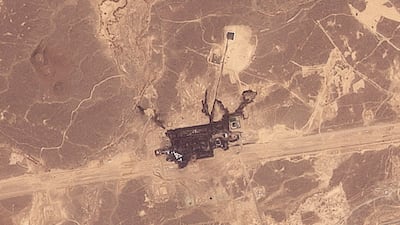

Oil prices surged towards $108 a barrel on Monday after Saudi Arabia shut its East-West oil pipeline after attacks, removing a crucial route for exporting crude without passing through the Strait of Hormuz and intensifying fears of a global supply crunch.
Brent, the benchmark for about two thirds of the world’s oil, rose as much as 3.7 per cent before paring back gains to trade 2 per cent higher at $106.7 a barrel at 10.35am UAE time. West Texas Intermediate gained 2.14 per cent to $102.19.
Saudi Arabia’s Energy Ministry said late on Friday that it had suspended operations on the pipeline as a precaution after “multiple” attacks in the Riyadh and Madinah regions on Thursday, which caused a number of injuries.

It did not give details about any damage the pipeline sustained, or when Saudi Arabia, Opec’s biggest oil producer, plans to resume flow of crude through the pipeline.
The pipeline is critical in linking oil production sites in the Eastern Province with Yanbu on the kingdom's western coast. The full pumping capacity through the East–West pipeline amounts to about seven million barrels per day.
It has allowed Saudi Arabia to continue exporting oil through its Red Sea export hub, bypassing the US-Iran war shipping chaos in the Strait of Hormuz.
The pipeline’s closure removes a significant outlet for Gulf crude at a time when shipping through the strait remains severely disrupted, said Ahmad Assiri, research strategist at Pepperstone.
“The East-West pipeline reportedly supplied the world by six to seven [million barrels per day] pre-closure, though said to be precautionary, representing 30 to 40 per cent of crude supply out of the Gulf,” Mr Assiri said. “Market reaction was clear and pushed oil price [higher]."
Saudi Arabia is likely to run out of oil stocks for export if it does not restart the pipeline within days, leading to a loss of up to 4 per cent of global supply, Reuters reported, quoting traders and buyers of Saudi oil.
If the pipeline remains idle and disruption persists then "markets will be forced to reprice crude much higher", with the possibility of crude prices hitting the levels seen after the regional conflict broke out, Mr Assiri said.
Diplomatic front
Traffic through the Strait of Hormuz has been reduced to a trickle amid recent attacks on oil tankers by the US and Iran. Talks through intermediaries have not yet led to a halt in hostilities and a meeting between Iran and Gulf states in Oman was postponed after “some regional countries” requested a delay, Iranian officials said.
Tehran and Muscat have jointly agreed to reschedule the talks, which had been set to take place in Salalah later on Monday.
Mohammad Ali Bak, Iran’s director general for Gulf affairs, told the state news agency Irna that Tehran would co-ordinate with Oman to schedule a new date for the meeting.
The growing disruption to global energy exports suggests that supplies can no longer be managed through temporary measures, Mr Assiri said. “Recent tensions in the region indicate that the oil supply shortage may have exhausted symptom-based solutions, and now appears to require an actual resolution to Hormuz disruption,” he added.
Houthi dynamic
Global energy markets and traders are also closely monitoring the effect of an advance by the Iran-backed Houthi rebels along Yemen’s Red Sea coast. The Houthis have seized the entire western coast, along with several strategic islands, establishing a chokehold over the Bab Al Mandeb strait.
The group, which previously announced a "maritime blockade" on Saudi Arabia, has struck several oil tankers in the vital waterway. The Houthis have also claimed attacks on the kingdom's energy infrastructure, including the Ras Tanura oil refinery.
"This keeps an unusually large geopolitical premium embedded in crude prices and explains why oil remains above $100, even as tighter monetary policy threatens global demand," said Waleed Said, technical analyst at multi-asset brokerage GivTrade.

Inflationary impact
Brent crude prices have rallied by more than three quarters this year as the regional conflict, now in its seventh month, escalates. The disruption to supplies and a recent increase in demand from China, the world's biggest oil importer, has also pushed prices higher.
The energy crisis has delivered an inflationary shock to the global economy, with prices of natural gas and petroleum products, including diesel, also rallying.
Rising consumer prices have forced central banks around the world to adjust their monetary policy, with the US Federal Reserve widely expected to increase borrowing rates this week. Goldman Sachs and JP Morgan were the latest among the growing list of Wall Street banks that expect the Fed to increase interest rates this week after a string of stronger-than-expected inflation readings.
Most central banks in the Gulf, with the exception of Kuwait, follow the Fed's interest rate moves due to their currencies being pegged to the US dollar.

