
“War is too important to be left to the generals,” said Georges Clemenceau, France’s victorious prime minister in the First World War. Energy executives keenly anticipate Adipec in Abu Dhabi at the start of November. For the energy industry to confront a new era of disorder, it needs leaders from its own ranks, but also from across global society – politics, government, science, media and the military.
The modern energy system grew up in a post-1945 and post-1989 world which, for all its risks and uncertainties, operated within understood structures: the UN, the Bretton Woods financial arrangements, the World Trade Organisation and International Monetary Fund, the Seven Sisters, the major western oil corporations and Opec. The US was a fairly predictable and, to its allies, mostly benign hegemon.
Rigidities and regulation constrained innovation, but were highly profitable to incumbents. From an energy perspective, trade, investment and capital mobility were high and rising, especially after 1989.
This arrangement has been beaten by an accelerating series of hammer blows, as New York marks the 25th anniversary of the 9/11 attacks, then 2003, 2008, 2020, 2022 and now 2026. Free trade is increasingly fragmented and under siege from Brexit, sanctions, tariffs, corruption and policies of strategic autonomy, as in the 1930s.
-
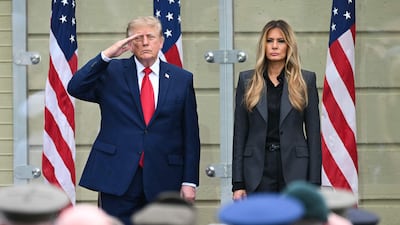
Donald and Melania Trump listen to the national anthem during the commemoration at the Pentagon in Washington DC. AFP -
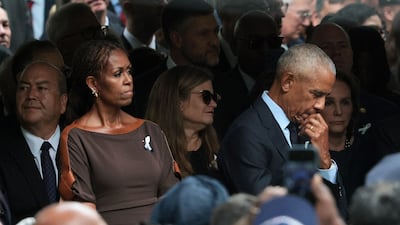
Michelle and Barack Obama during the ceremony at the National 9/11 Memorial & Museum. Getty Images via AFP -
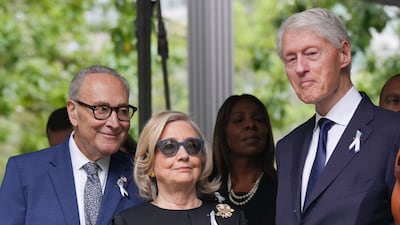
US Senate Minority Leader Chuck Schumer with Hillary and Bill Clinton. AFP -
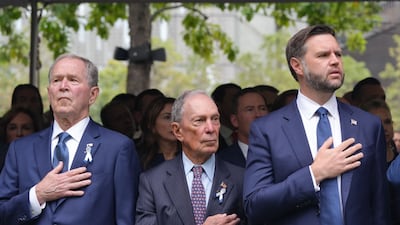
Former president George W Bush, former New York City mayor Michael Bloomberg and Vice President JD Vance. AFP -
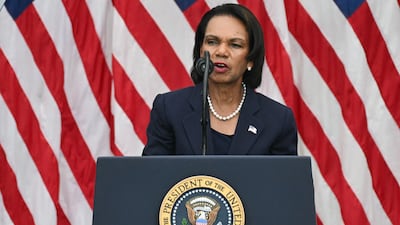
Former US secretary of state Condoleezza Rice speaks during the commemoration at the Pentagon. AFP -
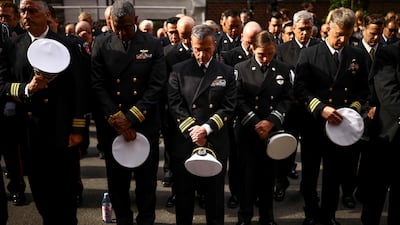
Firefighters pay tribute outside the Engine 54/Ladder 4/Battalion 9 firehouse in New York. AFP -
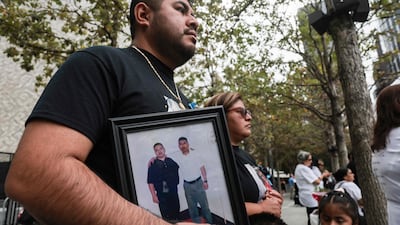
Juan Lopez, who lost his father Leobardo in the attacks. Getty Images via AFP -

Matt Dunleavy holds his daughter Ellie during the ceremony at the 9/11 Memorial. EPA -

People at the commemoration event at the 9/11 Memorial. AFP -

The ceremony at the Pentagon. Getty Images via AFP -
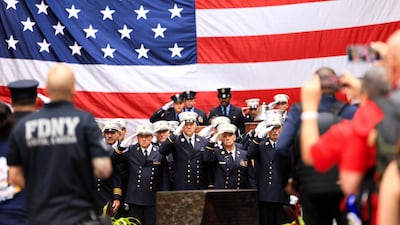
Firefighters outside Engine 54/Ladder 4/Battalion 9 firehouse. AFP


A modern militaristic mercantilism seeks direct control of the world's crucial chokepoints and natural resources. Iran attacks ships in the Gulf and its allies, while the Houthis in Yemen do the same in the Red Sea. The US enforces a counter-blockade against Iran’s oil exports, with no clear objective.
Ukraine and Russia fight over the shipping of oil and grain from the Black Sea. Moscow, Washington, Ottawa and Brussels watch each other warily in the Arctic. Beijing seeks to secure supplies of rare earths, nickel and other critical minerals. The US impedes the provision of advanced computing.
On Friday, Sheikh Khaled bin Mohamed, Crown Prince of Abu Dhabi, highlighted an “increasingly complex global energy landscape”. Chairing a meeting of Adnoc’s executive committee, he directed the national oil and gas giant to reinforce its integration of production, trading and logistics. The ability to deliver, despite bottlenecks, has been a crucial part of the UAE’s resilience and the energy security of its customers.
Conversely, countries seek self-sufficiency because they fear depending on others. But when they achieve leverage – the ability to direct, or at least to impede – physical flows of ships, or the virtual flow of money or information, it is very tempting to use that as a weapon.
These maritime, financial or regulatory tollbooths impede economic growth and co-operation. This can become a vicious cycle. As a country becomes more self-sufficient, the costs of hostility to others decrease. Because no state today can be truly autarkic, there is a temptation to pressure others to hand over their resources. While war threatens hydrocarbon supplies, home-grown renewable energy promises security. But it comes with its own dependencies and vulnerabilities.
Nevertheless, the technological and economic magnetism for greater globalisation is gaining force, even if repelled socially and politically. Viewed technically, the flow of services and information, especially, but also of goods and people, is easier than ever.
Traditional great powers are no longer capable or desirous of leading willing group endeavours. The US has become unpredictable, turning against the very concept of global public goods, more inclined to overturn the structures of which it was the major beneficiary. Its “energy independence” makes it not more secure but more risk-taking.
China has become the world's major provider of new energy technologies and goods, and a key player in oil and gas markets, but is unwilling to take on a global collective role (nor really trusted to do so).
The timidity in Brussels and Berlin, the rise of India, the revanchism of Russia and the increasing assertiveness of middle powers in their regions of influence complicate any policy co-ordination. Global freedom of navigation is under threat in a way not seen since the 1940s. The “warm war” in the Gulf could persist indefinitely and invite more external meddling, as Russia's war in Ukraine has. The diminishment of Opec may unleash more competition for oil producers.
After the promise of the Cop28 conference in Dubai in 2023, serious international collaboration on climate change has essentially evaporated, even as it increasingly causes real-time damage. Europe has just sweated through its hottest recorded summer and glacial floods drowned thousands of people in Nepal. We have clearly failed to limit global warming to below 1.5°C.

Yet the energy industry, with most credit to China’s industrial juggernaut, has achieved remarkable low-carbon solutions. Reaching near-zero emissions in electricity and water production, and in ground transport, is far cheaper and easier than we could have hoped for even a decade ago.
The inability to co-operate on global public goods is seen most clearly in the failure on maritime passages and on climate. But it also looms menacingly in other areas. Only six years after the Covid pandemic, there is little sign we would deal any better with a future contagion.
AI offers transformational technological capabilities but also intensive geoeconomic competition and social and economic disruption. Despite the dangers of unleashing AI in the hands of a rogue company or state, or of a silicon superintelligence itself, the arms race runs without sufficient safeguards. Nor, even in the happy case of a powerful but controllable AI, is there much thought of how to spread the benefits beyond a few billionaires.
Energy executives have at least to formulate strategies to function in this disorder, and to continue to deliver essential functions. Individual companies and even countries may well profit by exploiting new opportunities and gaps. At least they fill some of the void in mutually respectful and beneficial exchange.
The UAE’s Masdar agreed last week to work with Germany on offshore wind power and batteries. As refining margins soar and customers worry about fuel supplies, Adnoc is looking into partnerships with emerging markets, including Nigeria’s colossal new Dangote refinery and Thailand’s state-owned refiner PTT.
The industry should build on this to think more holistically: without collusion, which alignments are vital, and how can they be agreed? What structures and norms are needed? Where should the industry's voice be heard, on energy security, on trade, on climate, on technology? Who speaks for the energy business, or businesses?
Energy is too important to be left in the hands of any one set of representatives. A multifarious dialogue and debate in the UAE capital might begin to define the leadership that is in deficit elsewhere.

