
The world is facing a shortage of refining capacity that could keep petrol, diesel and jet fuel prices elevated well into 2027, even if the Strait of Hormuz reopens and millions of barrels of crude stranded by the war return to the market.
Damage to refineries in the Gulf and Russia, coupled with limited spare capacity elsewhere, has left too little infrastructure to turn crude into the fuels the world needs, creating an unusual divergence between prices for crude and refined products.
There will be “a steep, steep fall” in the first quarter of 2027, said Nikhil Agarwal, managing director of Globestar Energy, at Energy Trading Week Middle East in Dubai, on Wednesday. “But refining capacity will not come back so soon. Bapco is gone, the GTL Qatar is gone, Russian refineries are gone. It will take years to build them back and bring them on board.”

If the strait reopens, Mr Agarwal expects crude to sell off sharply while fuel markets remain constrained.
“Crude is surplus globally, but there is no refining capacity available to refine it and bring it to market,” he said. “That's why there is a disparity between crude price and the finished derivatives.”
Mahmoud Nabil, head of trading at Rabdan Petroleum Trading in Abu Dhabi, expects refining margins and the fuel prices behind them to stay elevated.
“I don't see any downs right now,” he said. “Everyone is running to try to be at full capacity, either in the Med [Mediterranean], in Europe or in Asia,” he said.
Bahrain's Bapco Energies declared force majeure after an attack on its 380,000-barrels per day Sitra refinery, while the 140,000-bpd Pearl gas-to-liquids plant, a QatarEnergy joint venture operated by Shell, halted after a strike on Qatar's Ras Laffan Industrial City.
The losses came when spare refining capacity was already limited. Global refinery runs are about 7.5 million bpd below July 2025 levels, while product exports from key suppliers have fallen 30 per cent, or about 4 million bpd, since the Iran conflict began, according to S&P Global Energy.
S&P Global cut its second-half forecast for global refinery runs to 80.1 million bpd, with much of the capacity outside Russia, the Middle East and China already operating at near multidecade highs.
Middle East refinery runs are expected to average about 8 million bpd this year, 1.6 million bpd below 2025, S&P Global said.
The strain is particularly visible in Gulf fuel exports. Gulf states supplied up to 32 per cent of the world's jet fuel before the war, but that share fell to 8.2 per cent in March and 3.7 per cent in April, according to Kpler.
Jet fuel exports through the Strait of Hormuz and Bab Al Mandeb strait fell more than 90 per cent by April, briefly recovering to about half of prewar volumes in June. They fell again to 68,000 bpd in August, 88 per cent below February's 574,000 bpd, according to Kpler.
Liquefied petroleum gas, widely used for cooking and transport in Asia, has suffered a similar shock. Exports through Hormuz fell about 80 per cent in March to roughly 300,000 bpd, from an average of 1.5 million bpd in 2025, according to the International Energy Agency, forcing Asian buyers to turn increasingly to US cargoes.
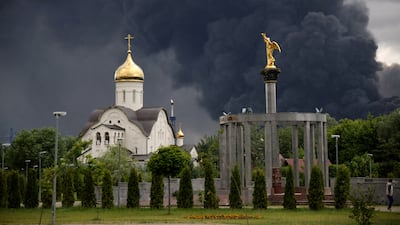
Russian refineries have also been damaged by a rise in Ukrainian drone strikes in recent months. Mr Agarwal estimated product runs had fallen to about 3.5 million bpd from 5.5 million bpd, affecting roughly 35 per cent of the system.
Moscow banned diesel exports on July 8, removing about a tenth of waterborne supply. However, S&P Global said exports had already fallen about 500,000 bpd before the ban took effect, pointing to refinery damage rather than policy as the bigger driver.
The shifting supply picture is redrawing trade routes. US fuel is being pulled towards West and East Africa, while higher prices in the Mediterranean draw cargoes away from Asia, Mr Nabil said.
The loss of capacity is showing up in fuel prices. Gasoline, diesel and jet fuel are trading at about $130-$170 a barrel, while the US Gulf Coast diesel crack rose above $100 a barrel in August.
“Refineries across the globe are making a lot of money, and the cracks are widening,” Mr Agarwal said. “The maximum margin they are making is on gasoline, because of a huge shortage from China and from the Russia side.”
For traders, the disruption is also changing how fuel is priced and moved as conventional routes become less reliable.
“You have to innovate how you're going to move,” Mr Nabil said. “Even your pricing methodologies have changed. You have to put optionality in.”